

On this page
If you have ever counted the rings on a tree stump, you have seen secondary growth: the way a dicot stem gets thicker year after year, driven by two thin layers of dividing cells.
The current NCERT Class 11 chapter, Anatomy of Flowering Plants (2026-27 reprint), no longer has a full section on secondary growth. Its summary only says that secondary growth occurs in most dicotyledonous roots and stems. Some state board books and college botany courses still teach it in detail, so check your current syllabus before deciding how deep to go.
What are the steps of secondary growth in a dicot stem?
Secondary growth comes from two lateral meristems: the vascular cambium and the cork cambium. The open textbook Botany by Ha, Morrow and Algiers/03%3A_Plant_Structure/3.03%3A_Stems/3.3.03%3A_Secondary_Stem) and a UC Davis plant anatomy page by Thomas Rost describe the same sequence.
Fascicular cambium is already there. Each vascular bundle in a young dicot stem has a strip of cambium between primary xylem and primary phloem. That is why these bundles are called open; our explainer on open versus closed vascular bundles covers the difference.
Interfascicular cambium forms. Parenchyma cells between the bundles, in the medullary rays, dedifferentiate and start dividing again.
A complete ring forms. The two kinds of strip join into one continuous cylinder, the vascular cambium.
The ring divides both ways. Its fusiform initials make secondary xylem on the inside and secondary phloem on the outside. Its ray initials make vascular rays.
Xylem wins. Rost notes that secondary xylem is usually produced in much greater amounts than secondary phloem.
Old phloem is crushed. Older secondary phloem is pushed outward and crushed, apart from its fibres, while old secondary xylem is kept.
Cork cambium replaces the epidermis. The widening stem outgrows its epidermis. The first cork cambium (phellogen) arises in the cortex. It makes heavily suberised cork (phellem) outward and parenchyma-like phelloderm inward. Phellem, phellogen and phelloderm together form the periderm.
Lenticels open. Gas exchange continues through lenticels, raised parts of the periderm with many air spaces.
Bark consists of all the tissue layers outside the vascular cambium, according to the Ha, Morrow and Algiers textbook. So secondary phloem counts as bark, a common one-mark trap.
Why do annual rings form?
The cambium does not make the same wood all year. OpenStax Biology 2e explains that in spring, secondary xylem cells have a large internal diameter and thin walls (early wood, or spring wood). In autumn they develop thickened walls (late wood, or autumn wood), which is denser. The sharp line where one year's dense late wood meets the next year's light early wood is what you see as a ring.
Counting rings tells you a tree's age only where seasons are distinct. In a US Forest Products Laboratory chapter on wood structure, botanist Alex Wiedenhoeft notes that in many tropical woods growth rings are not evident, and that growth ring is the preferred term over annual ring.
What is the difference between heartwood and sapwood?
The same Forest Products Laboratory chapter gives clear definitions.
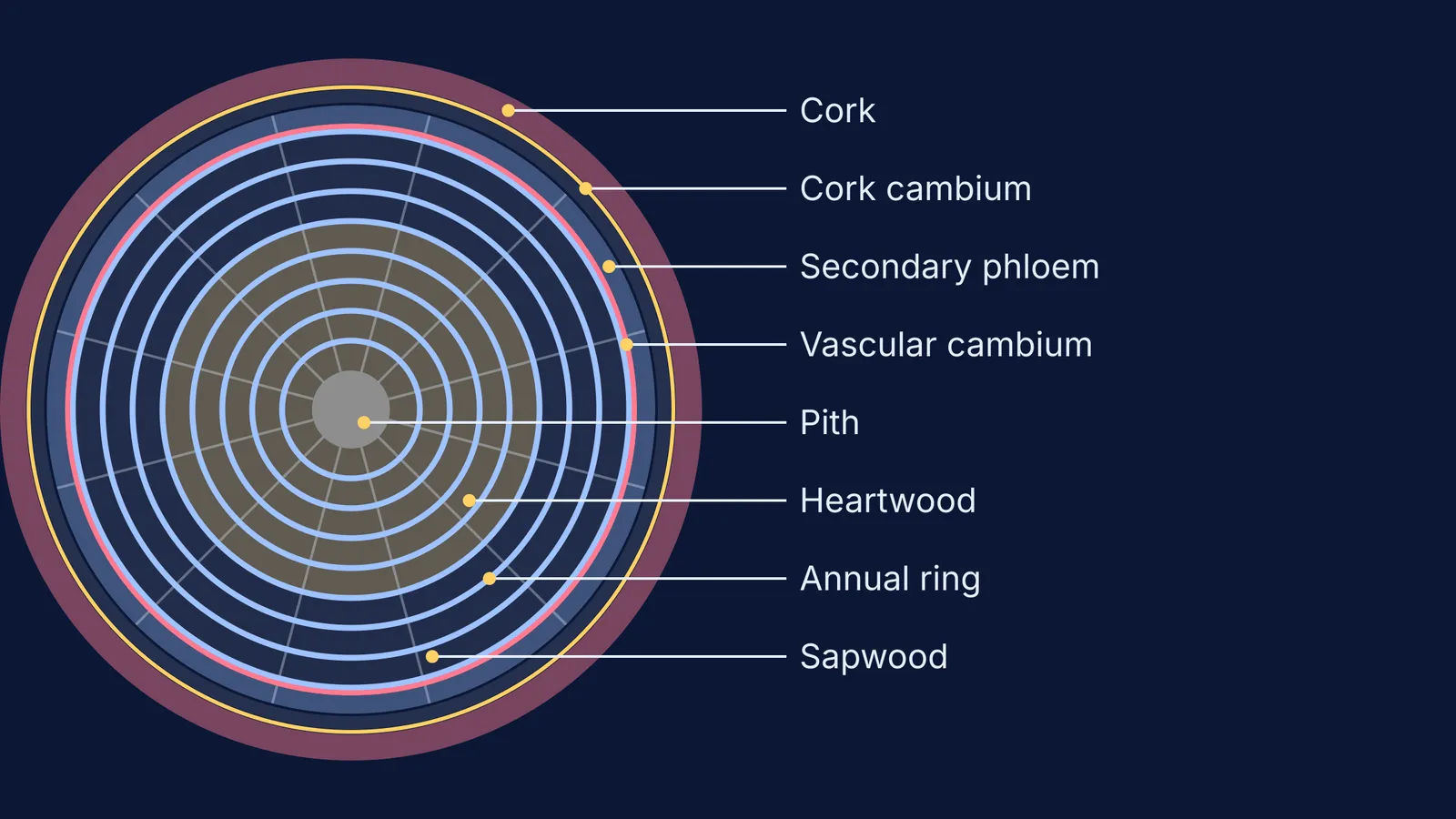
Sapwood is the lighter outer wood next to the bark. Its parenchyma cells are still alive, it conducts water from roots to leaves, and it stores starch.
Heartwood is the darker core. It no longer conducts water. Living cells at the heartwood-sapwood boundary make chemicals called extractives and pass them into neighbouring cells.
Why it matters: extractives give many woods their colour and their resistance to decay. Wiedenhoeft credits teak's stability and water resistance largely to waxes and oils in its heartwood, and notes that sandalwood is valuable only if its heartwood is rich in scented extractives.
In some trees, vessels in heartwood are also blocked by outgrowths of neighbouring cells; our post on tyloses in heartwood explains how.
How do you draw the labelled diagram examiners expect?
Draw a transverse section of a stem a few years old, usually as a quarter or half circle so the labels fit. Label from the outside in:
Cork (phellem), with one lenticel
Cork cambium (phellogen)
Phelloderm (secondary cortex)
Secondary phloem, with crushed primary phloem outside it
Vascular cambium, as a thin continuous ring
Secondary xylem, with two or three annual rings, each showing wide spring wood and narrow autumn wood
Primary xylem, next to the pith
Pith
Add medullary rays running outward, bracket the inner rings as heartwood and the outer rings as sapwood, and keep label lines straight and uncrossed. Dicot stem xylem is endarch, with protoxylem towards the pith; see exarch versus endarch xylem.
If you can list the steps but cannot picture where the rings come from, Fermi's AI tutor draws the figure and checks your understanding as it goes. To see how secondary growth links to meristems and vascular bundles, look it up in the Fermi Concept Library, where each concept has its own lesson and its place in the map.


