

On this page
When botanists examine an unknown plant transverse section under a microscope, they look first at the vascular cylinder. Tracing whether protoxylem sits near the periphery or near the centre identifies whether a specimen is a root or a stem before observing any external tissue.
How do protoxylem and metaxylem differ in structure and timing?
Primary xylem differentiates from procambium in two developmental phases:
Protoxylem: First-formed primary xylem. Because it matures during organ elongation, protoxylem has narrow lumens and extensible annular or spiral wall thickenings.
Metaxylem: Later-formed primary xylem. Maturing after elongation ceases, metaxylem features wider lumens and heavily lignified pitted or scalariform walls.
This sequence reflects fluid physics. As Melvin T. Tyree and Martin H. Zimmermann documented in *Xylem Structure and the Ascent of Sap*, hydraulic conductance through a capillary tube scales with the fourth power of the lumen radius (r⁴) under the Hagen-Poiseuille relationship. A metaxylem vessel with three times the radius carries eighty-one times as much sap per unit pressure gradient. Stretchable protoxylem maintains water flow during growth, while wide metaxylem handles bulk transpiration pull.
Minoru Kubo and colleagues showed in *Genes & Development* that transcription factor VND7 triggers protoxylem differentiation, whereas VND6 switches on metaxylem differentiation.
What is the difference between exarch and endarch xylem?
Exarch and endarch define the spatial direction of primary xylem maturation, as outlined in the NCERT Class 11 Biology curriculum:
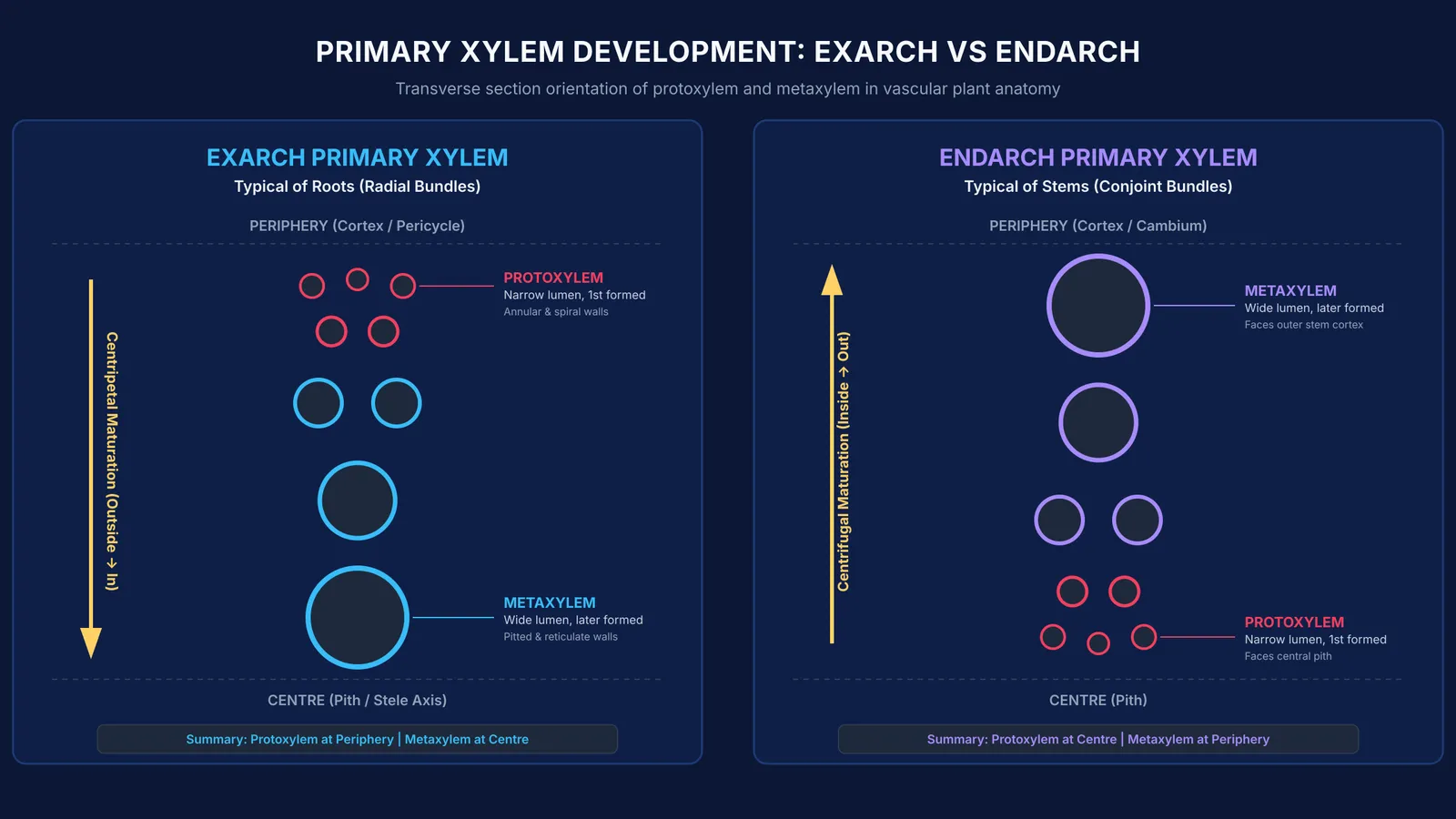
Exarch xylem: Protoxylem lies towards the periphery, while metaxylem lies towards the centre. Differentiation proceeds centripetally (outside inward). Exarch xylem is universal in vascular plant roots.
Endarch xylem: Protoxylem lies towards the centre (pith), while metaxylem lies towards the periphery. Differentiation proceeds centrifugally (inside outward). Endarch xylem is characteristic of seed plant stems.
Comparative plant anatomy also records intermediate states. In mesarch xylem, protoxylem sits surrounded by metaxylem, typical of fern stems, while ancestral centrarch xylem placed protoxylem at the geometric core.
Two mnemonics simplify revision: "SEND" links Stems to ENDarch xylem, while "REX" links Roots to EXarch xylem.
Why do roots develop exarch xylem while stems develop endarch xylem?
The opposing developmental orientations match each organ's transport role.
In roots, water and minerals absorbed by root hairs cross the cortex radially. Locating protoxylem at the outer perimeter of the vascular cylinder allows roots to tap incoming radial flow directly behind the elongation zone. Annelie Carlsbecker and co-authors showed in *Nature* that microRNA-165/166 produced in the root endodermis diffuses inward, repressing HD-ZIP III transcription factors at the periphery to specify protoxylem, while higher internal HD-ZIP III levels specify metaxylem.
In stems, procambial strands follow leaf traces downward from shoot tips. Protoxylem forms first near the central pith. As the stem thickens, metaxylem differentiates centrifugally towards the cortex, placing new vessels alongside the fascicular cambium for subsequent secondary growth. At the seedling hypocotyl, vascular bundles rotate 180 degrees to connect the root's radial exarch strands with the stem's conjoint endarch bundles.
When students struggle to visualise these transitions, Fermi Simulation Lab provides interactive simulations for ideas that are easier to see than to read.
How do you identify root and stem sections in four diagnostic steps?
According to diagnostic criteria in the NCERT Class 11 Biology curriculum, use this four-step diagnostic workflow to identify unknown cross-sections:
Check bundle arrangement: If xylem and phloem alternate on different radii, the bundle is radial, confirming a root. If xylem and phloem share the same radius, the bundle is conjoint, confirming a stem.
Locate protoxylem poles: Find the narrowest vessels. If they face outward toward the pericycle, the specimen is an exarch root. If they face inward toward the pith, it is an endarch stem.
Count root xylem arches: An exarch root with 2 to 4 (diarch to tetrarch) xylem bundles and a small pith is a dicot root. An exarch root with more than six bundles (polyarch) and a prominent pith is a monocot root.
Inspect stem bundle distribution: An endarch stem with open bundles arranged in a ring around a central pith is a dicot stem. Closed bundles scattered through ground tissue indicate a monocot stem.
This diagnostic sequence builds on our guide to meristems and tissue layers and extends our walkthrough of flowering plant anatomy. For broader vascular patterns, see our guide to the plant kingdom for NEET.
Which common exam traps catch students on primary xylem?
Primary xylem questions appear regularly in NEET-UG, conducted by the National Testing Agency. The most common traps exploit terminology:
Primary versus secondary xylem: In NEET-UG 2023, an official question asked whether endarch and exarch describe secondary xylem. These terms apply strictly to primary xylem formed from procambium, never secondary xylem produced by vascular cambium.
Directional terms: Centripetal means developing inward from the periphery (exarch in roots). Centrifugal means developing outward from the centre (endarch in stems).
Protoxylem lacunae: In monocot stems like maize, rapid elongation ruptures the earliest protoxylem, creating a water cavity (lacuna) at the inner edge of each bundle. Because this cavity borders the pith, it confirms endarch xylem.
To consolidate root and stem anatomy across plant groups, the Fermi Concept Library maps every concept in biology, each with its own lesson and its place in the map. For multi-statement assertion-reason practice, the Fermi Problem Library offers worked problems with a step-by-step solver that explains the reasoning rather than printing an answer.


