On this page
Anatomy questions in NEET often describe a section and ask you to name it: "conjoint, closed, scattered bundles with a sclerenchymatous sheath". Students who memorised four separate diagrams struggle, because the question gives features, not a picture. This post turns the chapter into four questions that identify any section, then covers the details that are easy to confuse.
What does the current NCERT chapter cover?
The NEET (UG)-2026 syllabus lists "Tissues; Anatomy and functions of different parts of flowering plants". The current NCERT Class 11 chapter on anatomy (reprint 2026-27) has two sections: the tissue systems, and the anatomy of dicot and monocot roots, stems and leaves. Check the syllabus for your exam year, as NMC can change it.
What are the three tissue systems?
Epidermal tissue system. The epidermis is usually a single layer of parenchyma cells, often covered by a waxy cuticle that cuts water loss. The cuticle is absent in roots. Stomata have two bean-shaped guard cells, or dumb-bell shaped ones in grasses. The inner walls of guard cells, facing the pore, are thick, and the outer walls are thin. Guard cells, the pore and any subsidiary cells together form the stomatal apparatus. Root hairs are unicellular; trichomes on the shoot are usually multicellular.
Ground tissue system. Everything except the epidermis and vascular bundles: parenchyma, collenchyma and sclerenchyma in the cortex, pericycle, pith and medullary rays. In leaves, the ground tissue is the mesophyll.
Vascular tissue system. Xylem and phloem form vascular bundles.
Open bundles have cambium between phloem and xylem (dicot stems). Closed bundles have none (monocots).
Radial bundles have xylem and phloem on different radii (roots). Conjoint bundles have them on the same radius, usually with phloem outside (stems and leaves).
Worked example: naming a section in four questions
Question 1: radial or conjoint? Radial means a root. Conjoint means a stem or leaf.
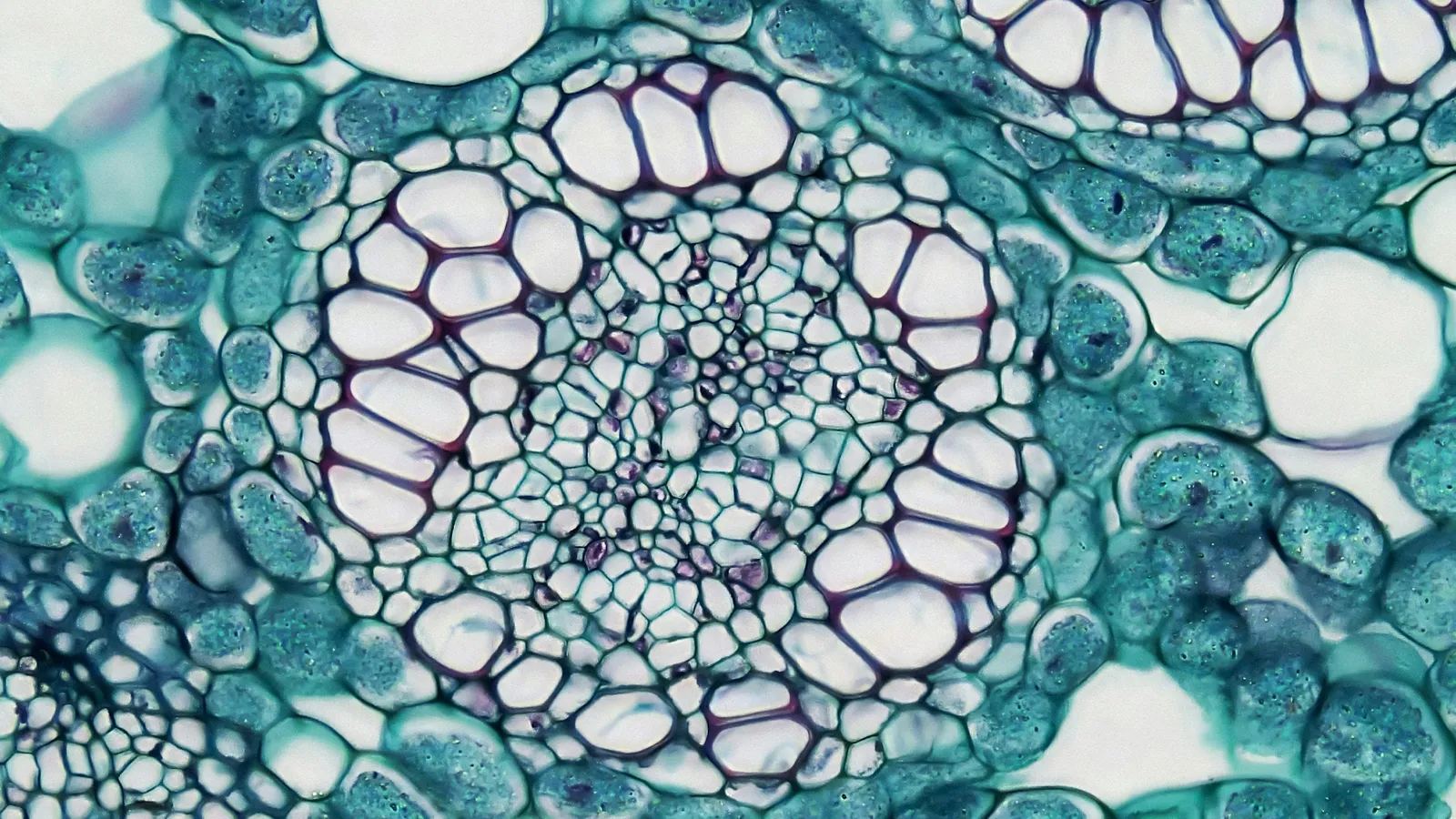
Question 2, for a root: how many xylem patches? Two to four patches with a small pith is a dicot root, such as sunflower. More than six (polyarch) with a large, well-developed pith is a monocot root.
Question 3, for a stem: ring or scattered?
Dicot stem: bundles in a ring, each conjoint, open and with endarch protoxylem. A collenchymatous hypodermis, an endodermis rich in starch (the starch sheath) and a large parenchymatous pith.
Monocot stem: many scattered bundles, each conjoint and closed, with a sclerenchymatous bundle sheath. A sclerenchymatous hypodermis, no phloem parenchyma, and water-containing cavities in the bundles. Peripheral bundles are smaller than central ones.
Question 4, for a leaf: is the mesophyll split?
Dorsiventral (dicot) leaf: palisade cells on the upper side and spongy cells below, with more stomata on the lower surface.
Isobilateral (monocot) leaf: mesophyll not split, stomata on both surfaces, and in grasses, bulliform cells along the veins.
Now apply it to NCERT's own exercise. A section has conjoint, scattered bundles with sclerenchymatous sheaths, and phloem parenchyma is absent. Conjoint means stem or leaf. Scattered bundles with a sheath and no phloem parenchyma answer Question 3: it is a monocot stem.
Which details are commonly confused?
Endodermis: in the root, a single layer of barrel-shaped cells with casparian strips of suberin on the tangential and radial walls. In the dicot stem, it is the starch sheath.
Pericycle: in the root, thick-walled parenchyma where lateral roots and the vascular cambium start. In the dicot stem, semi-lunar patches of sclerenchyma above the phloem.
Conjunctive tissue is the parenchyma between xylem and phloem in roots.
Stele means every tissue inside the endodermis: pericycle, vascular bundles and pith.
Secondary growth: monocot roots do not undergo it.
Bulliform cells: when turgid, the leaf surface is exposed. When flaccid under water stress, the leaf curls inward to reduce water loss.
Why draw the sections from memory?
Drawing is not just for the practical record. In seven experiments, Wammes, Meade and Fernandes found that people recalled words they had drawn better than words they had written out, and the benefit was not explained by deeper processing or visual imagery alone. Those studies used word lists, not botany, so treat this as a reason to try drawing, not a promise. Our post on why you should draw the diagram first shows how to make this a habit.
When you meet a term you cannot define while drawing, such as casparian strip or endarch, look it up in the Fermi Concept Library, which covers every concept in biology with its own lesson.
A practice routine for this chapter
Day 1: Draw the four-question flow on one page.
Day 2: Draw the dicot root and monocot root sections from memory and label every layer. Compare with NCERT Figure 6.3.
Day 3: Same for dicot and monocot stems, then both leaves.
Day 4: Write five feature descriptions like NCERT's exercise, hide the answers, and identify them two days later.
Weekly: One blank drawing of a random section before you start other biology.
The anatomy makes more sense once the external structure is clear, so read our guide to the morphology of flowering plants alongside this one.
Today, draw a monocot stem section from memory and check it against the textbook figure.