

On this page
Every Class 11 student meets the two big groups of flowering plants, monocots and dicots, in the morphology and anatomy chapters. On a walk you sort a plant by its leaves, flowers and roots. In the exam you sort a stem or root section by where its vascular bundles sit. This guide puts the main differences in one place, taken from the NCERT textbook and a Cornell extension sheet.
What is the difference between monocot and dicot plants?
The names come from the seed. According to NCERT Class 11 Biology, Chapter 5 (Morphology of Flowering Plants), the embryo in a seed has one cotyledon, as in wheat and maize, or two cotyledons, as in gram and pea. One cotyledon makes a monocot (monocotyledon); two make a dicot (dicotyledon). The same chapter explains the roots: in monocots the primary root is short-lived and is replaced by many roots from the base of the stem, giving a fibrous root system, as in wheat, while in most dicots it branches into a tap root system, as in mustard.
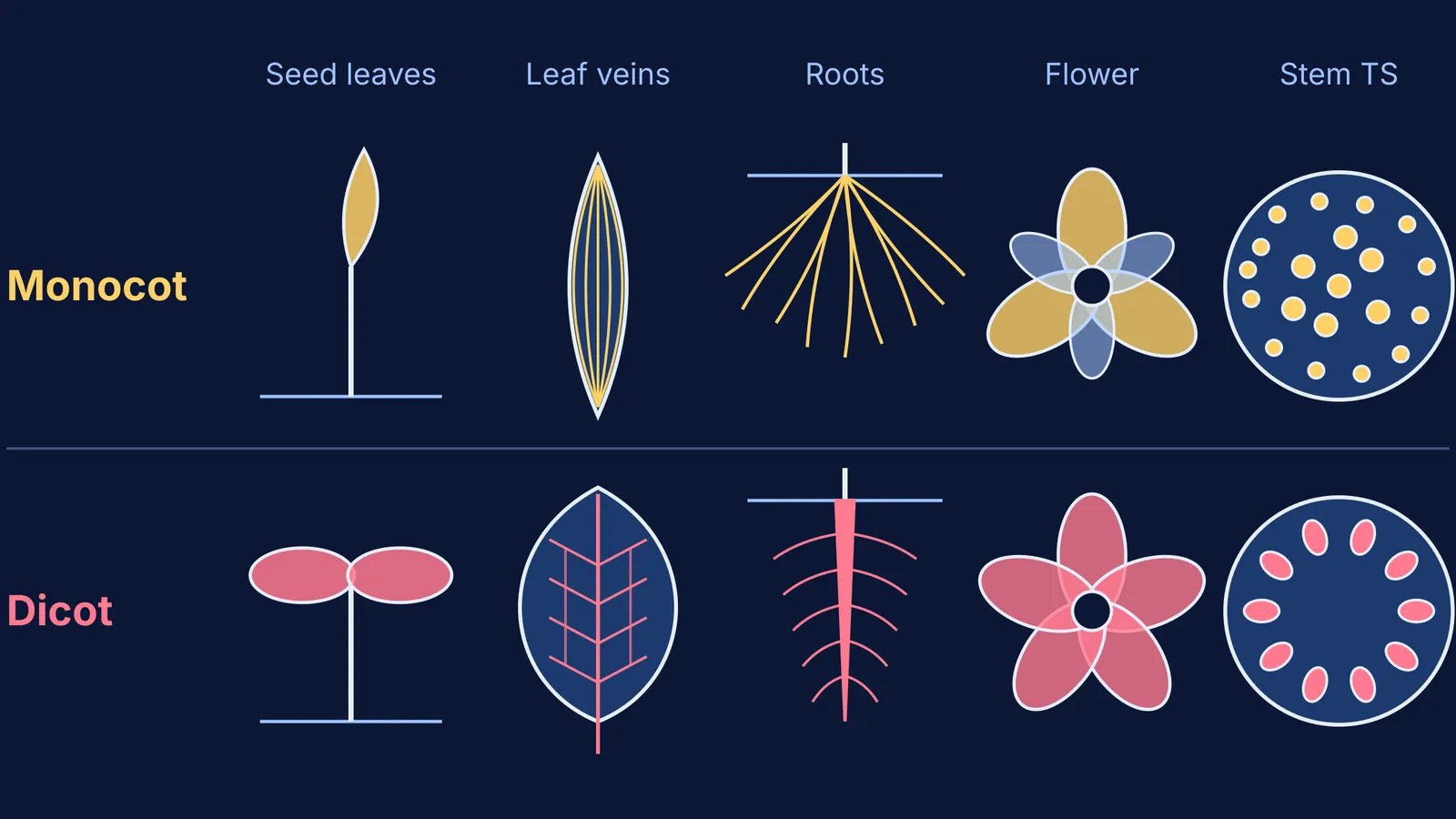
Monocot vs dicot: the key features side by side
Read each line as monocot first, then dicot. The cotyledon, root, leaf and vascular bundle lines come from NCERT Chapter 5 and Chapter 6 (Anatomy of Flowering Plants). The flower and pollen lines come from a Cornell Cooperative Extension comparison sheet.
Cotyledons: one (wheat, maize) versus two (gram, pea).
Leaf venation: parallel versus reticulate (net-like).
Root system: fibrous versus tap root.
Floral parts: in threes or multiples of three versus fours or fives or their multiples.
Vascular bundles in the stem: many, scattered and closed versus arranged in a ring and open.
Xylem bundles in the root: usually more than six (polyarch) versus usually two to four.
Leaf type: isobilateral, with stomata on both surfaces, versus dorsiventral, with palisade and spongy mesophyll.
Pollen: one pore or furrow versus three.
For the roots and the seed in more detail, see our guides to reading a dicot and monocot root transverse section and to monocot and dicot seed structure, from scutellum to aleurone.
Why are monocot vascular bundles called closed?
NCERT Chapter 6 explains that dicot stem bundles have cambium between phloem and xylem. Cambium can make secondary xylem and phloem, so these bundles are called open. Monocot bundles have no cambium, cannot form secondary tissue and are called closed.
In the dicot stem, each bundle in the ring is conjoint and open, with endarch protoxylem. The monocot stem's scattered bundles each sit inside a sclerenchymatous bundle sheath, have no phloem parenchyma, and are generally smaller near the edge. The chapter's summary says secondary growth occurs in most dicot roots and stems, and its section on the monocot root says monocot roots do not undergo any secondary growth.
How do you tell a monocot from a dicot in an exam question?
Work from what the question gives you. Here is a worked example built on a question at the end of NCERT Chapter 6: a transverse section shows conjoint, scattered vascular bundles, each surrounded by a sclerenchymatous bundle sheath, and phloem parenchyma is absent. What is it?
Decide the organ. Conjoint bundles, with xylem and phloem on the same radius, are common in stems and leaves. Roots have radial bundles, so this is not a root.
Read the layout. Scattered bundles rule out a dicot stem, which has a ring.
Confirm with a second clue. The bundle sheath and the absence of phloem parenchyma both match the textbook's monocot stem.
Answer: a monocot stem, giving one clue as the reason.
On a live plant, go from the easiest clue to the hardest: leaf veins, then petals, then roots. For drawing the sections, our guide to identifying dicot and monocot stem sections in the practical walks through the labels.
If one step in that chain is fuzzy, such as what conjoint means or where endarch protoxylem sits, look it up in the Fermi Concept Library, where each biology concept has its own lesson. To practise the reasoning on more sections, the Fermi Problem Library has worked problems with a step-by-step solver that explains the reasoning rather than printing an answer.
Do all monocots and dicots follow these rules?
Not always, and the NCERT text tells you so in its own wording. Its sentences say that the tap root occurs in the majority of dicots, that dicot leaves generally have reticulate venation, and that parallel venation is a feature of most monocots (Chapter 5). The seed is a good example. Monocot seeds are generally endospermic, but orchid seeds are not. Among dicots, castor keeps its endosperm, while bean, gram and pea seeds have none when mature.
Tonight, close this page and write the list from memory, monocot first. Then check each one against the list above.


