

On this page
Have you ever noticed that a peanut easily splits into two perfect halves, while a grain of corn does not? That single physical split is the defining boundary for all flowering plants, dividing them into dicotyledons (dicots) and monocotyledons (monocots).
For biology students and medical aspirants, understanding the exact anatomy of these seeds, alongside topics like placentation types in flowers, is a fundamental part of plant morphology. While both seed types contain an embryo waiting to grow into a new plant, the way they store food and protect their delicate growing tips is entirely different.
What is the structure of a monocot seed?
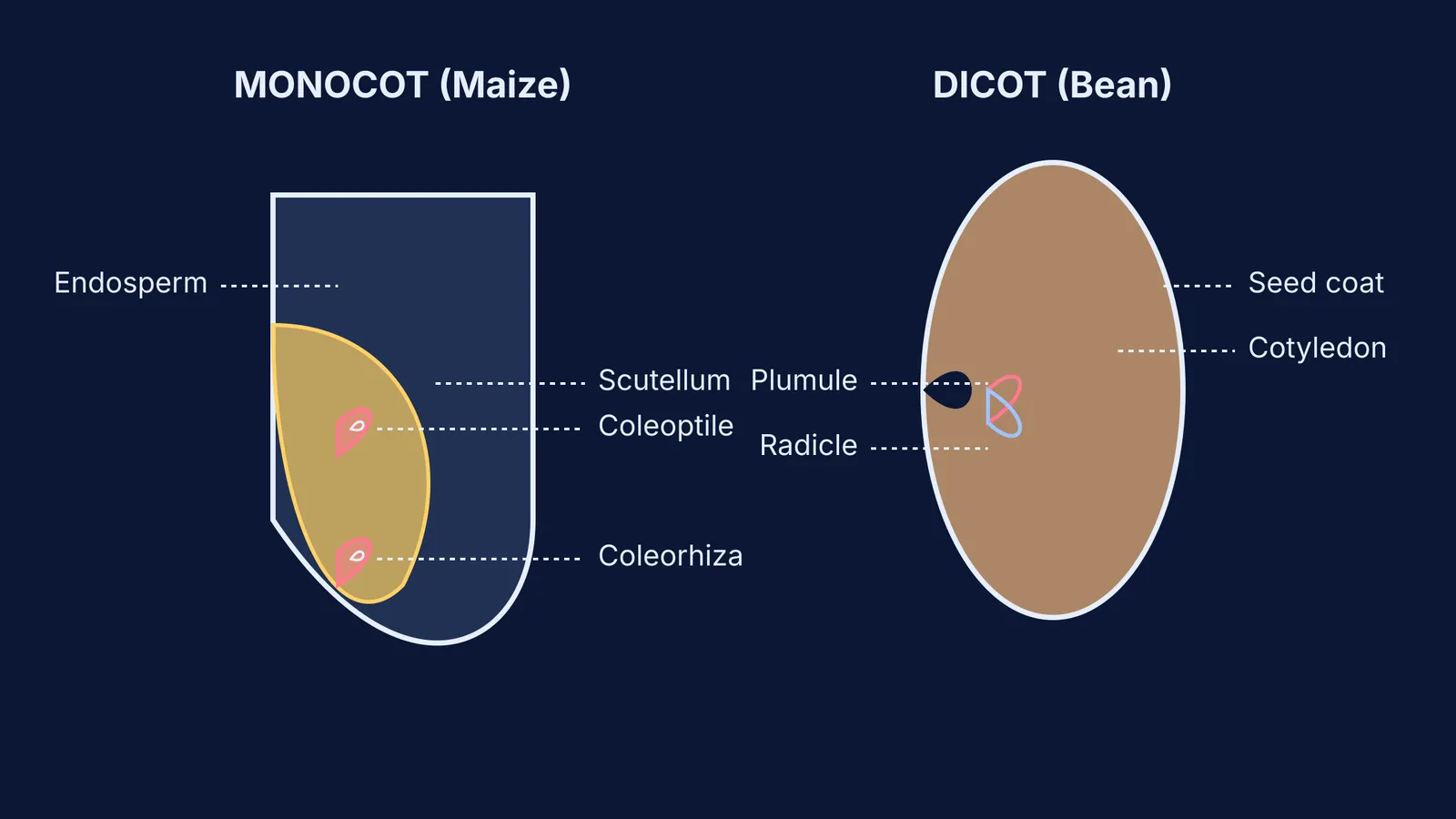
A classic example of a monocot seed is the maize (corn) grain. In maize, the outer hull is technically the fruit wall (the pericarp), and its seed coat's layers are fused, which is why we call a corn kernel a fruit rather than just a seed (unlike false fruits which incorporate other floral parts), according to OpenStax Biology 2e. The biological term for this specific type of dry, single-seeded fruit where the seed coat is permanently fused to the pericarp is a caryopsis, a characteristic feature of most cereal grains in the grass family.
Most monocot seeds are endospermic (or albuminous). This means that a bulky tissue called the endosperm persists in the mature seed to store food, primarily in the form of starch. The aleurone layer is a specialized, protein-rich tissue just inside the seed coat that surrounds the endosperm and embryo OpenStax Biology 2e. During germination, the aleurone layer secretes enzymes that break down the stored starch so the growing plant can use it.
The embryo itself is relatively small and sits in a groove at one end of the endosperm. It consists of a single, large, and shield-shaped cotyledon known as the scutellum. Unlike the cotyledons in beans, the scutellum does not store food directly; instead, it acts as an absorptive organ that pulls nutrients from the endosperm and feeds them to the embryo.
The embryonal axis in a monocot has two delicate ends, both of which are enclosed in specialized protective sheaths:
Plumule: The future shoot, protected by a hollow, leaf-like sheath called the coleoptile.
Radicle: The future root, protected by a sheath called the coleorhiza.
What is the structure of a dicot seed?
If you soak a gram or bean seed and peel off its outer covering, you are looking at a typical dicot. The outermost covering is the seed coat, which is entirely distinct from the fruit wall. It consists of a tough outer layer called the testa and a thin inner layer called the tegmen OpenStax Biology 2e. You will also see a scar on the seed coat called the hilum, marking where the seed was attached to the fruit, and a tiny pore above it called the micropyle, which absorbs water.
Inside the seed coat, you will find the embryo, which is dominated by two large, fleshy cotyledons. Because these two cotyledons act as the primary food storage for the developing plant, the endosperm is usually fully consumed during development. Seeds that lack an endosperm at maturity are called non-endospermic (or exalbuminous).
The two cotyledons are attached to the embryonal axis. The portion of the axis above the cotyledons terminates in the plumule (the shoot), and the cylindrical portion below terminates in the radicle (the root tip). In a dicot, the section of the embryonal axis between the cotyledon attachment and the radicle is called the hypocotyl, while the section above the cotyledon attachment is the epicotyl. Crucially, a dicot seed lacks the specialized protective sheaths—there is no coleoptile and no coleorhiza. Instead of a coleoptile piercing the soil, dicots often use a plumule hook (a bent epicotyl) to gently push through the earth without damaging the tender growing tip. The thick cotyledons themselves provide all the physical protection the young axis needs.
How do the structures compare for exams?
When revising for tests, it helps to isolate the features unique to monocots. If you are asked about the scutellum, the aleurone layer, the coleoptile, or the coleorhiza, you are strictly dealing with monocot anatomy. If a question mentions the testa, tegmen, or a non-endospermic food storage model, it is almost certainly describing a dicot (with a few exceptions, like the endospermic castor seed).
Memorizing these specific terms can sometimes be overwhelming. If you feel stuck trying to picture how a scutellum connects to the endosperm, the Concept Library has every concept in biology, each with its own lesson and its place in the map. Furthermore, when you review your mistakes on practice tests, Fermi's AI tutor works out what you already know, builds a plan for the session, and teaches through it—drawing the figure and checking understanding as it goes.


