

On this page
When you look at a transverse section (TS) of a stem under a microscope in a biology practical, the most obvious difference is the arrangement of the vascular bundles—the plant's transport system for water and food.
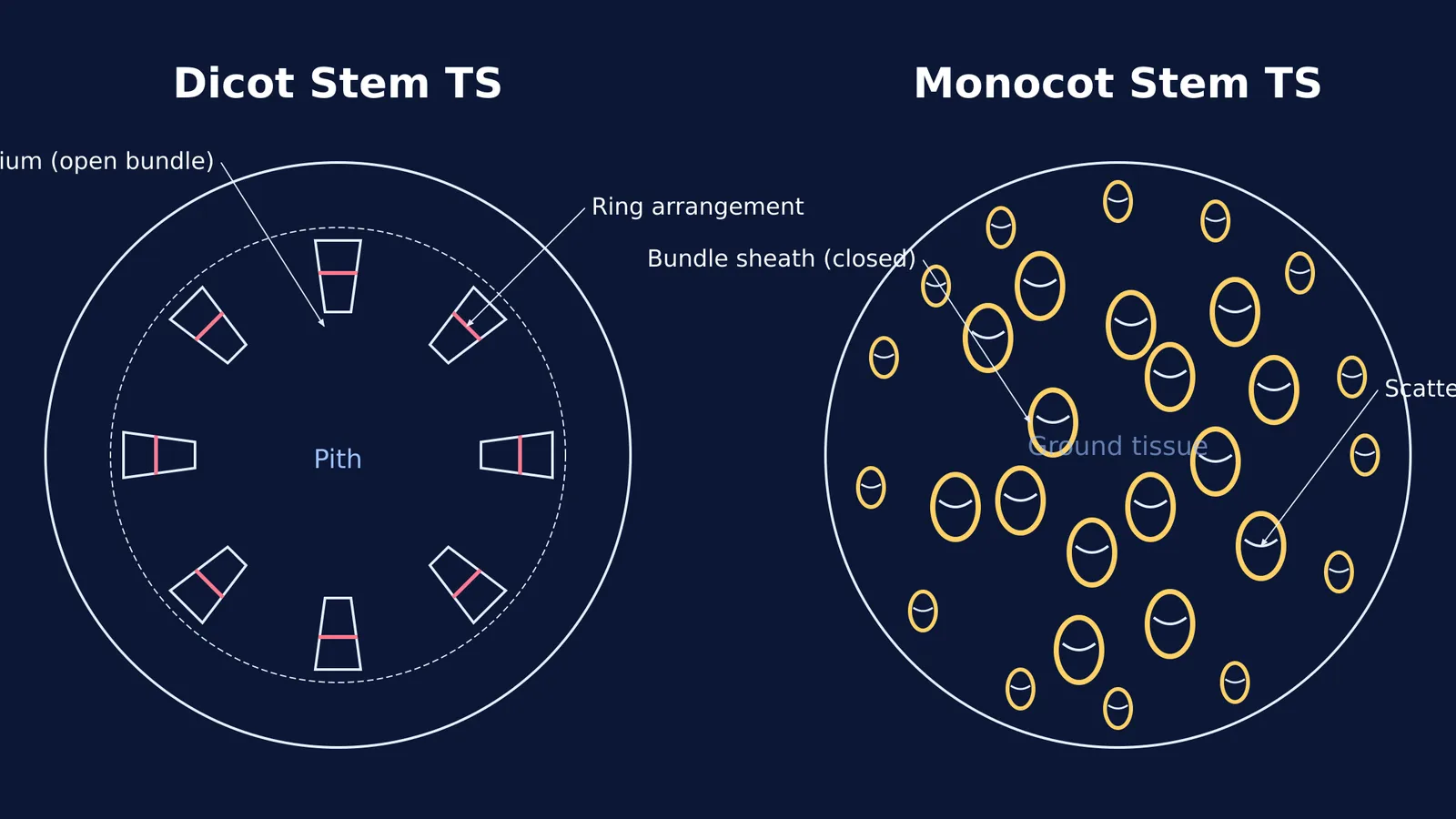
In a dicotyledonous stem, such as a sunflower, the vascular bundles are arranged in a neat, distinct ring around the centre [[1]](https://en.wikipedia.org/wiki/Plant_stem). This ring encloses a large, well-developed central region called the pith.
In contrast, a monocotyledonous stem, such as maize, lacks this orderly ring. Instead, its vascular bundles are scattered randomly throughout the entire ground tissue [[1]](https://en.wikipedia.org/wiki/Plant_stem). You will also notice that the bundles near the outer edge (periphery) of the monocot stem are usually smaller and more numerous than those towards the centre.
What is a bundle sheath, and which stem has it?
Zooming in on a single vascular bundle reveals another major clue: the bundle sheath.
In a monocot stem, every vascular bundle is completely surrounded by a tightly packed layer of cells called a bundle sheath [[2]](https://en.wikipedia.org/wiki/Vascular_bundle). This acts as rigid armour for the scattered bundles. Monocot bundles are described as "closed" because they lack a cambium layer between the xylem and phloem, meaning the plant generally cannot undergo secondary growth to widen its stem over time.
Dicot stems do not have a bundle sheath enclosing each vascular bundle. Their bundles are described as "open" [[2]](https://en.wikipedia.org/wiki/Vascular_bundle). They contain a strip of intrafascicular cambium between the xylem and phloem. This cambium layer is what allows a dicot tree to produce wood and grow thicker year after year.
How do the ground tissue and hypodermis differ?
The tissue layers just below the outer skin (epidermis) also look different between the two types of plants.
Right beneath the epidermis lies the hypodermis. In a dicot stem, the hypodermis is made of collenchyma cells, which provide flexible, bending support for the young stem. In a monocot stem, the hypodermis is composed of harder sclerenchyma cells for mechanical strength.
Past the hypodermis, a dicot stem's ground tissue is highly organised and differentiated into several layers: the cortex, a starch-rich endodermis (often called the starch sheath), the pericycle, and finally the central pith. A monocot stem's ground tissue is completely undifferentiated; it is just one continuous mass of parenchymatous cells filling the stem, with the vascular bundles embedded inside it.
If you are trying to picture how these structures fit together in three dimensions or how a plant grows, the Fermi Concept Library covers every concept in biology, each with its own lesson and its place in the map.
How do you identify a stem under the microscope?
When an examiner asks you to identify an unknown stem slide, tick off these four questions:
Vascular bundle arrangement: Are they in a ring (dicot) or scattered (monocot)?
Bundle structure: Are they open with cambium (dicot) or closed with a sheath (monocot)?
Pith: Is there a distinct central pith (dicot) or is it missing (monocot)?
Hypodermis: Is it flexible collenchyma (dicot) or tough sclerenchyma (monocot)?
By memorising this contrast checklist, you can confidently identify any transverse section in an exam. You can also test your memory of similar structural differences, such as the Monocot vs Dicot Seed Structure: Scutellum, Coleoptile, Aleurone, or practice How to sketch and label a chloroplast for NEET biology. If you want to compare wider plant groups, read how Fabaceae, Solanaceae and Liliaceae: Floral Characters Compared.


