On this page
Plant Physiology questions often turn on small details: a compartment, an enzyme, an ATP count done from memory. Learn three NCERT chapters as connected pathways, then practise the questions that test those details.
Which Plant Physiology chapters are in the NEET syllabus?
The latest official syllabus is the NMC syllabus for NEET (UG) 2026, issued by the National Medical Commission in a notice dated 22 December 2025. Its Biology Unit 4, Plant Physiology, lists three topics: photosynthesis, respiration, and plant growth and development. Transport in plants and mineral nutrition are not in that list. If a NEET 2027 syllabus is published, check it against this one before you plan.
Each topic is one chapter of the NCERT Class 11 Biology textbook (Reprint 2026-27):
Photosynthesis maps to Chapter 11, Photosynthesis in Higher Plants. The syllabus adds photophosphorylation, chemiosmosis, photorespiration, C3 and C4 pathways and factors affecting photosynthesis.
Respiration maps to Chapter 12, Respiration in Plants, including ATP counts, amphibolic pathways and respiratory quotient.
Plant growth and development maps to Chapter 13, including growth rates, differentiation and five growth regulators (auxin, gibberellin, cytokinin, ethylene, ABA).
What should you know cold in photosynthesis?
Read Chapter 11 sections 11.5 to 11.9 until you can draw each step without the book. Expect questions on these NCERT facts:
PS I and PS II are named in the order they were discovered, not the order they work; P680 belongs to PS II and P700 to PS I (section 11.5).
Non-cyclic flow uses both photosystems and makes ATP and NADPH; cyclic flow uses only PS I, makes only ATP, and probably happens in the stroma lamellae (11.6.2).
In the chloroplast, protons pile up in the thylakoid lumen; in the mitochondrion, they pile up in the intermembrane space (11.6.3).
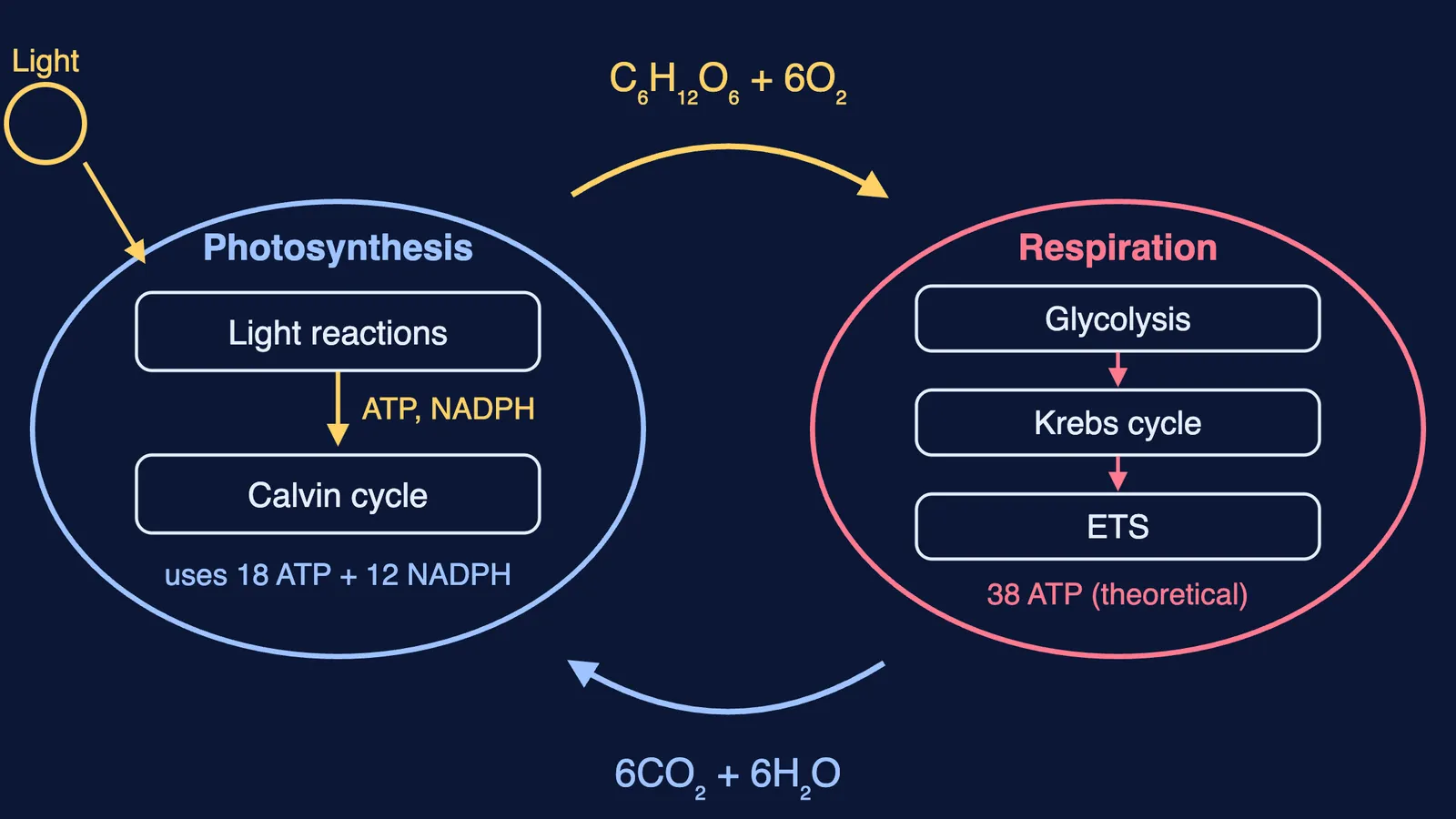
The Calvin cycle needs 3 ATP and 2 NADPH per CO2 fixed, so one glucose costs 18 ATP and 12 NADPH over six turns (11.7.2). See the Calvin cycle in numbers for the full table.
In C4 plants, mesophyll cells lack RuBisCO and bundle sheath cells lack PEPcase, so the Calvin cycle runs only in the bundle sheath (11.8).
In photorespiration, RuBisCO binds O2 and makes one phosphoglycerate and one phosphoglycolate; no ATP or NADPH is made, ATP is used and CO2 is released (11.9).
How do you count ATP in respiration for NEET?
Use the counting rule Chapter 12 gives in section 12.4.2: one NADH gives 3 ATP and one FADH2 gives 2 ATP. Then count per glucose:
Glycolysis: net 2 ATP and 2 NADH.
Pyruvate to acetyl CoA: 2 NADH.
Krebs cycle, two turns: 6 NADH, 2 FADH2 and 2 ATP.
Total: 10 NADH give 30 ATP, 2 FADH2 give 4 ATP, plus 4 ATP made directly, which is 38.
That matches the net gain of 38 ATP that NCERT gives in section 12.5, and NCERT stresses that this is a theoretical figure resting on assumptions that do not hold in a living cell. Fermentation nets only 2 ATP per glucose. For RQ, learn the three NCERT values with their reasons: 1 for carbohydrates, about 0.7 for the fat tripalmitin, about 0.9 for proteins (12.7). Our post on why net ATP from glycolysis is two does the spend-and-make arithmetic. When your total keeps coming out wrong, the Fermi Problem Library has worked problems with a step-by-step solver that explains the reasoning rather than printing an answer.
What do plant growth regulator questions test?
Often matching: regulator to effect, and the pairs that work against each other. Make one table from Chapter 13, section 13.4, with columns for discovery, main effects and farm use. Rows that trip students up:
Cytokinins help overcome apical dominance, which auxins from the shoot tip maintain. See our post on apical dominance and auxin.
2,4-D kills broad-leaved (dicot) weeds but spares mature monocots.
ABA generally works against gibberellins, closes stomata and is called the stress hormone.
Ethylene raises the respiration rate in ripening fruit and is supplied as ethephon.
Also learn the growth equations in section 13.1.4: arithmetic growth is linear, geometric growth gives the sigmoid curve with lag, log and stationary phases.
How should you practise Plant Physiology?
A two-week plan, about an hour a day:
Days 1-4: Chapter 11. Redraw the Z scheme, the Calvin cycle and the C4 pathway from memory, then compare with the NCERT figures.
Days 5-7: Chapter 12. Do the ATP count above on a blank page until it takes under three minutes.
Days 8-10: Chapter 13. Fill the regulator table without looking, then check it.
Days 11-14: mixed questions, including previous years' papers. Log every wrong answer by type: compartment, enzyme, count or regulator.
If one idea, such as chemiosmosis, will not stick, read it again in the Fermi Concept Library, which covers every concept in biology with its own lesson, then go back to the NCERT section.
Start with Chapter 11 today: draw the Z scheme from memory before you open the book.