

On this page
Ask a class how much ATP glycolysis makes and you will hear both "four" and "two". Both numbers are real. Four is what the pathway makes; two is what the cell keeps after paying back the ATP it spent at the start, as OpenStax Biology 2e sets out. If you can show where each ATP goes in and comes out, you are much less likely to mix them up in a board exam or in NEET-UG.
Where does glycolysis happen in the cell?
Glycolysis takes place in the cytoplasm of both prokaryotic and eukaryotic cells, as OpenStax Biology 2e states. It does not happen in the mitochondria, an easy slip to make in assertion-reason questions.
The same OpenStax chapter notes that glycolysis does not use oxygen directly, which is why it is called anaerobic. Because it needs neither oxygen nor mitochondria, it can run in cells that lack them. Mature mammalian red blood cells have no mitochondria, so glycolysis is their sole source of ATP (OpenStax Biology 2e).
If you want the location of every stage of respiration in one place, our post on where each step of respiration occurs in a cell maps them out.
Why is net ATP from glycolysis two, not four?
Glycolysis has ten steps in two halves, as laid out in OpenStax Biology 2e. The first half spends energy to trap glucose in the cell and get it ready to split. The second half pulls energy out of the pieces and stores it as ATP and NADH.
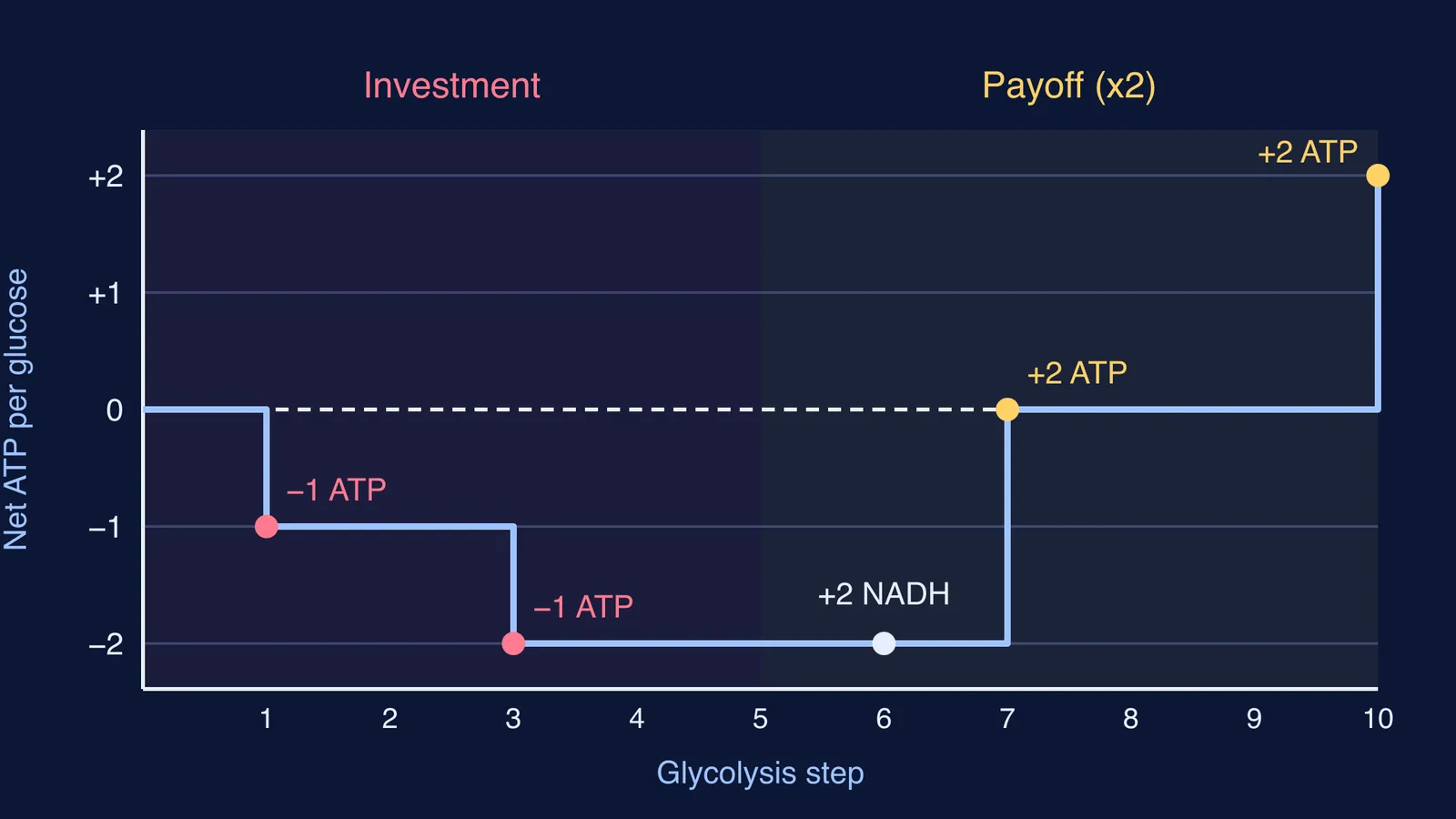
Per glucose, glycolysis produces two pyruvate, four new ATP and two NADH, but two ATP are used in the first half, so the net gain is two ATP and two NADH (OpenStax Biology 2e).
The key to the arithmetic is step 4. There, the enzyme aldolase cuts the six-carbon sugar into two three-carbon molecules: one glyceraldehyde-3-phosphate and one dihydroxyacetone phosphate. In step 5 an isomerase turns the dihydroxyacetone phosphate into a second glyceraldehyde-3-phosphate. From that point on, every reaction happens twice for each glucose.
How do you count the ATP step by step?
Here is the ledger we suggest writing out once by hand. Keep a running total in the margin. Every step below is described in the OpenStax glycolysis section.
Step 1, hexokinase: glucose is phosphorylated using one ATP. Running total: minus 1.
Step 3, phosphofructokinase: fructose-6-phosphate is phosphorylated using a second ATP. Running total: minus 2.
Steps 4 and 5, aldolase and an isomerase: the sugar splits and you end up with two glyceraldehyde-3-phosphate. No ATP changes hands, but the doubling starts here.
Step 6: each glyceraldehyde-3-phosphate is oxidised and NAD+ picks up the electrons as NADH. One per half, so two NADH.
Step 7, phosphoglycerate kinase: each half gives one ATP. Two halves, so plus 2. Running total: zero. You have only paid back your loan.
Step 10, pyruvate kinase: each half gives another ATP and becomes pyruvate. Plus 2 again. Running total: plus 2.
So the gross yield is four ATP (steps 7 and 10, twice each), the cost is two (steps 1 and 3), and the net is two. The ATP made at steps 7 and 10 comes from substrate-level phosphorylation, meaning a phosphate group is passed directly from a pathway intermediate (1,3-bisphosphoglycerate at step 7, phosphoenolpyruvate at step 10) to ADP.
What happens to the NADH from glycolysis?
The two NADH matter as much as the two ATP. Step 6 needs a steady supply of NAD+, and if NAD+ is not available, the second half of glycolysis slows down or stops (OpenStax Biology 2e). So the cell must keep turning NADH back into NAD+.
Without oxygen, fermentation does that job. Our post on alcoholic and lactic acid fermentation shows how yeast and muscle each regenerate NAD+. With oxygen, pyruvate and NADH feed the later stages of respiration, which is where the bigger totals come from. For that full count, see how many ATP one glucose molecule gives.
A quick checklist before your exam
Every figure below comes from the OpenStax glycolysis section.
Gross ATP: 4. Net ATP: 2. If the question says "net", the answer is 2.
ATP spent at steps 1 and 3; ATP made at steps 7 and 10.
NADH: 2 per glucose, made at step 6.
Location: cytoplasm, not mitochondria.
Oxygen: not used directly.
Common mistake: forgetting that steps 6 to 10 run twice per glucose.
If the counting still feels shaky, the Fermi Concept Library covers every concept in biology, each with its own lesson and its place in the map, so you can see how glycolysis connects to the rest of respiration. When you move on to mixed respiration questions, the Fermi Problem Library has worked problems with a step-by-step solver that explains the reasoning rather than printing an answer.
Next step: close this page and write the six-line ledger from memory. If your running total ends at plus 2, you have it.


