

On this page
When your muscle fibres contract violently during a sprint, or when baker's yeast grows in an airtight dough, oxygen runs short. Without oxygen acting as the terminal electron acceptor in the mitochondrial electron transport chain, oxidative phosphorylation halts. Glycolysis alone cannot sustain the cell in isolation.
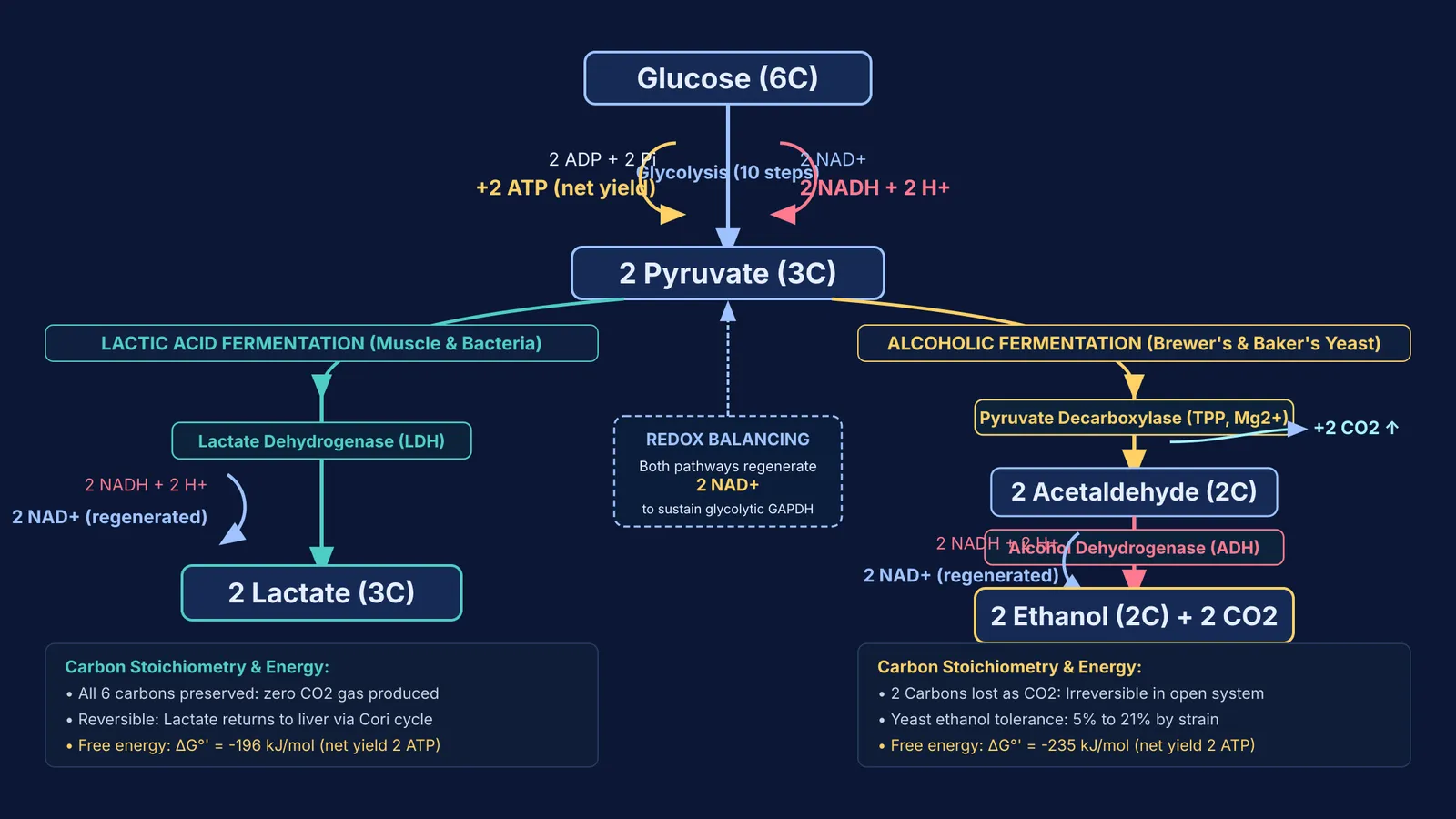
In glycolysis, glyceraldehyde-3-phosphate dehydrogenase (GAPDH) oxidises glyceraldehyde-3-phosphate to 1,3-bisphosphoglycerate, reducing NAD+ to NADH. As documented in Section 7.5 of OpenStax Biology 2e, each glucose consumes 2 NAD+ molecules to yield 2 NADH. Because cytosolic NAD+ is strictly limited, glycolysis halts within seconds if NADH is not re-oxidised. Fermentation exists to solve this redox bottleneck: it regenerates NAD+ in the cytoplasm so glycolysis can continue producing a net 2 ATP per glucose. Tracing these metabolic routes on the Fermi Concept Library shows how cells adapt when oxygen drops.
How does lactic acid fermentation work in human muscle?
In human skeletal muscle and red blood cells, NAD+ regeneration requires only one enzymatic step. As detailed in Section 16.1.9 of Berg, Tymoczko, and Stryer's Biochemistry, lactate dehydrogenase (LDH) transfers electrons from NADH directly to pyruvate:
Pyruvate + NADH + H⁺ ⇌ Lactate + NAD⁺
Three key features define this reaction:
No carbon is lost: 3-carbon pyruvate becomes 3-carbon lactate without producing carbon dioxide (CO₂).
Reversibility: when oxygen returns, lactate enters the bloodstream to be converted back into glucose by the liver; the foundational biochemical link between muscle exertion and lactic acid accumulation was uncovered in classic work on muscle glycolysis by Otto Meyerhof.
Capacity limits: a 2022 study in Molecular Cell (DOI: 10.1016/j.molcel.2022.07.007) by Wang and colleagues showed that cells ferment glucose to lactate whenever glycolytic flux outpaces mitochondrial NADH shuttles.
How does alcoholic fermentation work in yeast?
Brewer's and baker's yeast (*Saccharomyces cerevisiae*) use a two-step sequence using two distinct enzymes (Berg's Biochemistry):
Decarboxylation: pyruvate decarboxylase, aided by thiamine pyrophosphate (TPP) and Mg²⁺, cleaves the carboxyl group from 3-carbon pyruvate, releasing CO₂ gas to form 2-carbon acetaldehyde.
Reduction: alcohol dehydrogenase reduces acetaldehyde to 2-carbon ethanol, oxidising NADH back to NAD+.
This CO₂ release causes bread dough to rise and beer to foam. Unlike muscle cells, yeast cannot reverse this reaction because CO₂ escapes into the air. Yeast tolerance of ethanol varies from about 5% to 21% depending on the strain and environmental conditions, beyond which ethanol disrupts membrane integrity and arrests fermentation, as documented in Section 7.5 of OpenStax Biology 2e.
Why does fermentation release less than 7% of glucose's energy?
Complete aerobic respiration of one mole of glucose yields approximately -2870 kJ/mol of standard free energy (ΔG°'), as documented in Section 16.1.9 of Berg, Tymoczko, and Stryer's Biochemistry, providing 30 to 32 ATP molecules as detailed in our guide to how ATP is counted across cellular respiration.
In comparison, converting glucose to two lactate molecules releases only -196 kJ/mol, while conversion to two ethanol molecules and two CO₂ releases -235 kJ/mol (Berg's Biochemistry). Both pathways release less than 7% to 8% of glucose's stored energy:
No net carbon oxidation occurs in lactic acid fermentation: carbon's average oxidation state is 0 in both glucose (C₆H₁₂O₆) and lactic acid (C₃H₆O₃).
High energy remains stored in the C-C and C-H bonds of lactate and ethanol (which is why ethanol burns as fuel).
Synthesising 2 ATP from 2 ADP captures 61 kJ/mol (2 × 30.5 kJ/mol). That is about 31% of the free energy released during lactate fermentation, but just 2.1% of glucose's total combustion energy.
How do you compare fermentation pathways in exam questions?
Use this framework to navigate questions comparing both pathways, as detailed in Section 7.5 of OpenStax Biology 2e:
Carbon balance: lactic fermentation yields two 3-carbon molecules with zero CO₂. Alcoholic fermentation produces two 2-carbon ethanols and two 1-carbon CO₂ gases.
Electron flux: glycolysis reduces 2 NAD+ to 2 NADH, and fermentation oxidises 2 NADH back to 2 NAD+. Net change in cytosolic NAD+ across the whole cycle is zero.
ATP tally: gross yield is 4 ATP from substrate-level phosphorylation, 2 ATP are consumed upfront, and net gain is 2 ATP. Fermentation enzymes synthesize no ATP.
Substrate limits: fats and proteins feed into aerobic pathways via respiration as an amphibolic pathway, but they cannot undergo anaerobic fermentation because they require mitochondrial entry.
If you struggle balancing redox stoichiometry under exam pressure, the Fermi Problem Library has worked problems with a step-by-step solver that explains the reasoning rather than printing an answer. When preparing for timed tests, Fermi's AI tutor can work out what you already know and build a plan for the session, noticing where you get stuck between substrate-level and oxidative phosphorylation.


