

On this page
Pinch the top off a tulsi plant and it soon grows side shoots and turns bushier. That is apical dominance at work, and NCERT asks you to explain why decapitation is "widely applied in tea plantations and hedge-making". Here is the answer, the experiment behind it, and the part newer research has changed.
What is apical dominance?
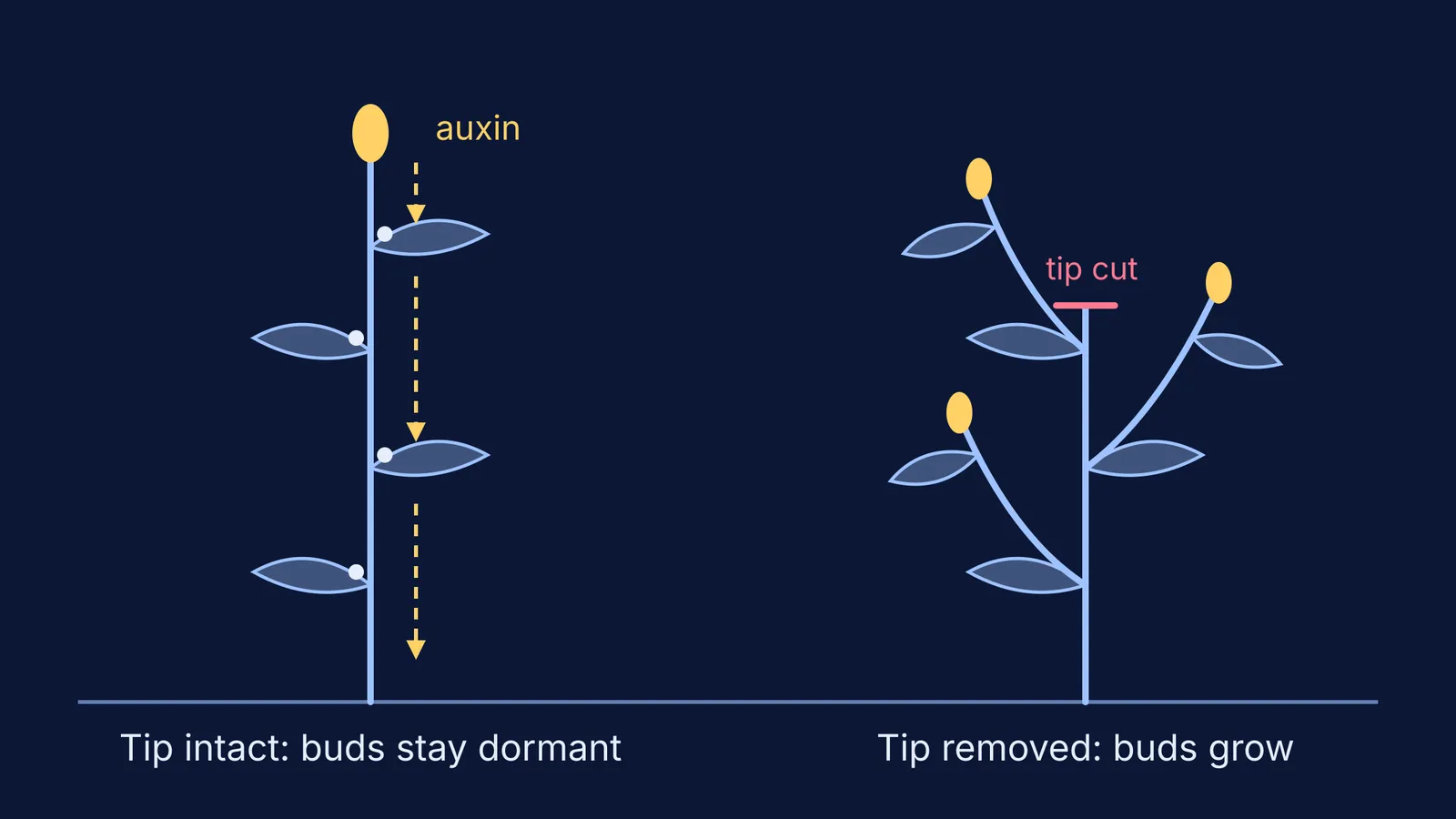
NCERT Class 11 Biology, Chapter 13, defines it: in most higher plants, the growing apical bud inhibits the growth of the lateral (axillary) buds, and removing the shoot tip (decapitation) usually results in the growth of lateral buds (NCERT, Plant Growth and Development).
The same chapter says auxins are generally produced by the growing apices of stems and roots and migrate from there to where they act. So the tip is both the leader and the source of the signal that keeps the buds below it quiet.
Why does removing the shoot tip make lateral buds grow?
The classic test came in 1933, when Kenneth Thimann and Folke Skoog worked with broad bean, *Vicia faba* (Thimann and Skoog, PNAS 1933). A later review in Annals of Botany sums it up: they showed that auxin applied to decapitated shoots of *Vicia faba* repressed the outgrowth of lateral buds (Cline 1996).
Learn the logic as three plants, because exam questions test each one:
Intact plant: tip present, lateral buds stay small.
Tip cut off: lateral buds grow into branches.
Tip cut off, auxin placed on the cut stump: lateral buds stay small again.
Plant 3 is the key. If a chemical can stand in for the missing tip, that chemical carries the tip's message. Cline's review also notes the experiment worked in most species tested but not in greenhouse-grown *Coleus* or *Arabidopsis*, a reminder that biology has exceptions.
NCERT adds the other half: cytokinins help overcome apical dominance and promote lateral shoot growth (NCERT, Plant Growth and Development). Auxin from the tip holds buds back; cytokinin pushes them to grow.
Is auxin the whole story?
For your board exam and NEET-UG, write the NCERT explanation. But scientists kept testing it. A 2014 study in PNAS found that apical dominance correlates strongly with sugar availability rather than with auxin supplied from the tip: the tip's intense demand for sugar limits how much reaches the buds (Mason et al., PNAS 2014).
Part of the evidence is timing. A 2023 review in the Journal of Experimental Botany notes that auxin depletion moves down a stem at about 1 cm per hour, while sugars can move at 100 cm per hour (Beveridge, Rameau and Wijerathna-Yapa, 2023). So buds far below a cut can respond before the drop in auxin reaches them.
The same review describes a network in which auxin, cytokinins, strigolactones and sugars all feed into the decision. Treat this as background, not material for a two-mark answer.
How do tea plantations and hedges use decapitation?
A tea estate sells young shoots, so it wants as many growing tips as possible at a height pickers can reach. Kerala Agricultural University's tea guide tells growers to cut the leader stem of young plants "to arrest the apical dominance and to induce the secondary branches", then tip the bush again at 35 cm and 50 cm to increase the density of plucking points (KAU Centre for e-Learning). The same guide says to harvest two to three leaves and a bud every 7 to 10 days in high cropping months, which keeps removing tips and keeps new side shoots coming.
Over years this builds the flat-topped "plucking table", which Washington State University's tea guide describes as a flat top at about waist or chest height, made by pruning that disrupts apical dominance and encourages bushy growth (WSU, Tea plant care and maintenance).
A hedge works the same way. Each trim removes many shoot tips at once, the buds below them grow out, and the hedge thickens instead of growing tall and bare at the base.
How should you write this answer in an exam?
Use this four-part frame for any "explain why" question on apical dominance:
Observation: the apical bud suppresses lateral buds.
Cause: auxin made at the shoot tip moves down and keeps the buds dormant.
Action: decapitation removes the auxin source, so lateral buds grow.
Use: tea bushes and hedges become dense, with more young leaves at a convenient height.
Two common slips: writing that auxin "kills" the buds (it keeps them dormant; they are alive and ready), and mixing up the hormones. Cytokinin works against apical dominance, gibberellin lengthens stems, and auxin also bends shoots toward light, as our phototropism simulation of how auxin bends a shoot shows. Revise the neighbours together with cytokinin and zeatin functions and gibberellin's role in bolting and sugarcane.
If plant hormones still blur together, the Fermi Concept Library gives every biology concept its own lesson and its place in the map, so you can see auxin, cytokinin and gibberellin side by side.
Tonight, draw the three-plant experiment from memory and label where the auxin comes from. If you can do that, you can answer this question in any form.


