

On this page
In the 1940s, scientists trying to grow plant tissue in a lab faced a frustrating problem: they could keep cells alive, but they could not get them to divide and form new tissue. This changed when researchers found that adding coconut milk to their nutrient medium caused the cells to divide rapidly. This observation led to the discovery of cytokinins, a crucial class of plant growth regulators. If you are preparing for exams like NEET, understanding how cytokinins work—and specifically the role of zeatin—is a standard part of the plant physiology syllabus.
How were cytokinins and coconut milk linked?
The story of cytokinins began with the search for substances that promote cytokinesis, or the physical division of a cell. In 1941, the researcher Johannes van Overbeek demonstrated that adding coconut milk to a culture medium allowed very young *Datura* embryos to survive and grow in vitro. The liquid endosperm of the coconut contained a powerful, but unidentified, cell division factor.
In the 1950s, F. Skoog and his co-workers were studying the growth of tobacco stem cells. They found that the tissue would only proliferate if the nutrient medium contained auxins along with extracts from yeast, vascular tissues, coconut milk or DNA. Skoog and Carlos Miller later identified and crystallised the first cytokinesis-promoting substance from autoclaved herring sperm DNA, naming it kinetin. However, kinetin does not occur naturally in plants.
What is zeatin and where is it found?
The discovery of kinetin spurred the search for a naturally occurring equivalent in plants. This search led to the isolation of zeatin. Zeatin was first extracted in 1963 by D.S. Letham from the milky endosperm of immature corn kernels (*Zea mays*). It is an adenine derivative and remains the most abundant natural cytokinin found in plants. Scientists later confirmed that zeatin and its derivatives are also the active cell-division factors in coconut milk.
Natural cytokinins like zeatin are synthesised in regions of the plant where rapid cell division is taking place. These regions include the root apices, developing shoot buds and young fruits. From the roots, cytokinins travel upwards through the xylem to the rest of the plant, where they regulate growth.
What are the main functions of cytokinins?
Cytokinins work alongside—and sometimes against—other plant hormones like auxins to control how a plant develops. Their primary effects include:
Promoting cell division: Their defining role is to trigger cytokinesis, which is why they are concentrated in growing roots and shoots.
Forming new organs: Cytokinins help plants produce new leaves, develop chloroplasts within those leaves, and form adventitious shoots.
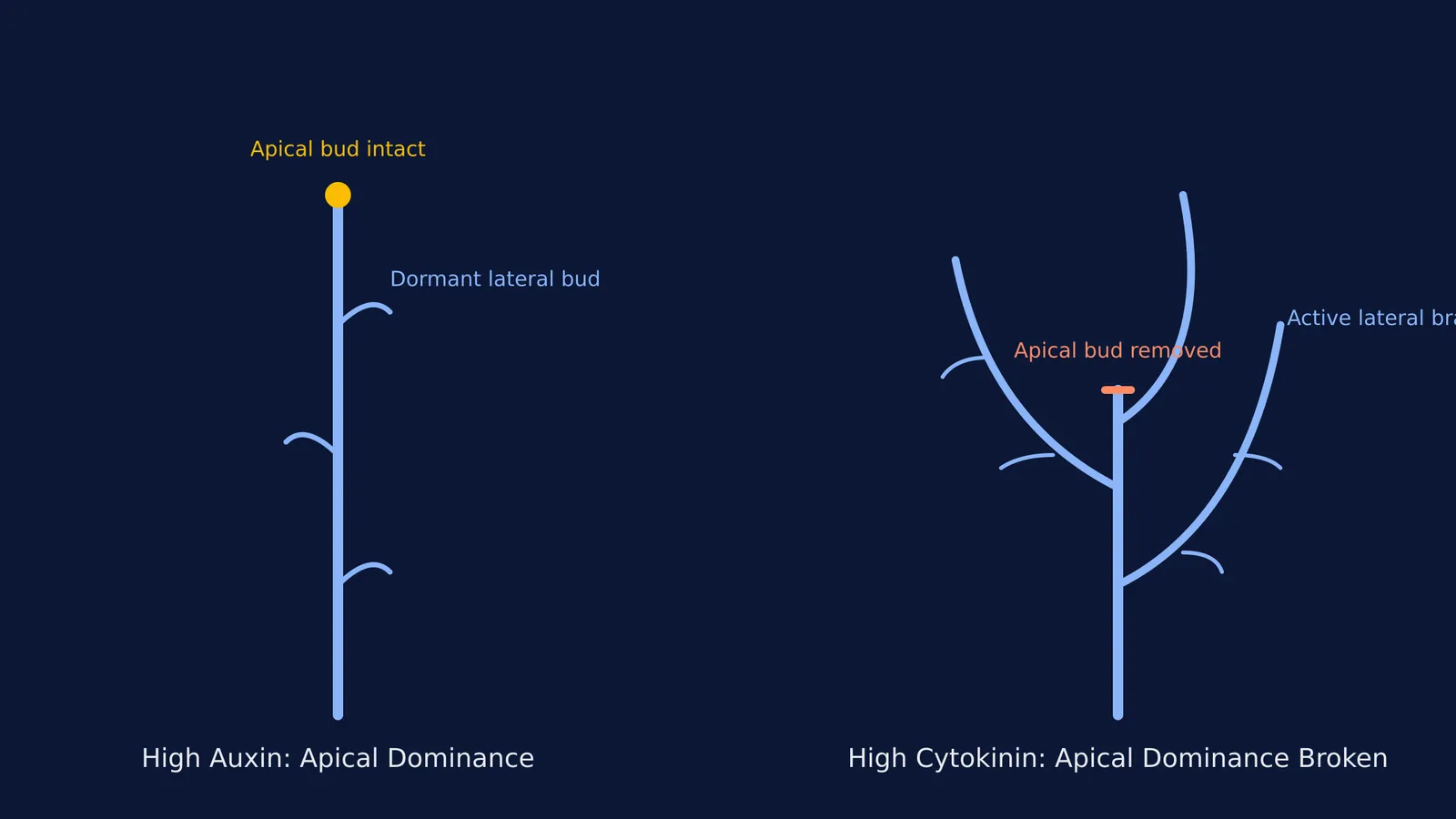
Breaking apical dominance: Auxins produced in the apical bud at the top of the plant inhibit the growth of lateral branches. Cytokinins moving up from the roots counteract this effect. By waking up dormant lateral buds, cytokinins help the plant become bushier.
Delaying leaf senescence: Cytokinins help keep leaves green and healthy for longer by promoting nutrient mobilisation and delaying the breakdown of chlorophyll. This delay in the aging process is known in biology as the Richmond-Lang effect.
If you are revising these functions, it helps to draw a simple diagram comparing a plant with high apical dominance (a tall, single stem driven by auxin) to one where apical dominance is broken (bushy, lateral branches driven by cytokinin). You can review more on this topic using the Fermi Concept Library, which gives every concept in biology its own lesson.
How can you remember plant hormones for exams?
When studying plant growth regulators, it is easy to mix up the functions of auxins, gibberellins and cytokinins. A practical way to remember cytokinins is to associate them directly with their name: *cyto* (cell) and *kinin* (division).
You can also tie each hormone to a physical location on the plant. Auxins dominate the tip of the shoot, while cytokinins are heavily synthesised in the meristems at the tip of the root and sent upwards.
When a gardener prunes the top of a plant, they are removing the source of auxin. This shifts the internal chemical balance in favour of the cytokinins, which then wake up the lateral buds and create a bushier plant. This same hormone balance is manipulated in plant tissue culture. By adjusting the ratio of auxins to cytokinins, scientists can coax an undifferentiated mass of cells to grow either new roots or new shoots.


