On this page
Plant tissue culture is one of the few topics where a single page of NCERT carries several exam facts: totipotency, explants, micropropagation, somaclones, virus-free meristems and somatic hybrids. It is also easy to blur them together. This post explains each step in order, adds the hormone experiment behind it, and works through the numbers of a micropropagation run.
Where does tissue culture appear in the syllabus?
The NEET (UG) 2026 syllabus lists "Application of Biotechnology in health and agriculture", and the current NCERT chapter on biotechnology and its applications covers tissue culture inside its section on agriculture. The same syllabus also lists "Differentiation, dedifferentiation and redifferentiation" and the plant growth regulators, which the NCERT chapter on plant growth links to tissue culture. The HBCSE syllabus for NSEB and INBO names "tissue culture" directly. Check the current year's syllabus for your exam.
What makes tissue culture possible?
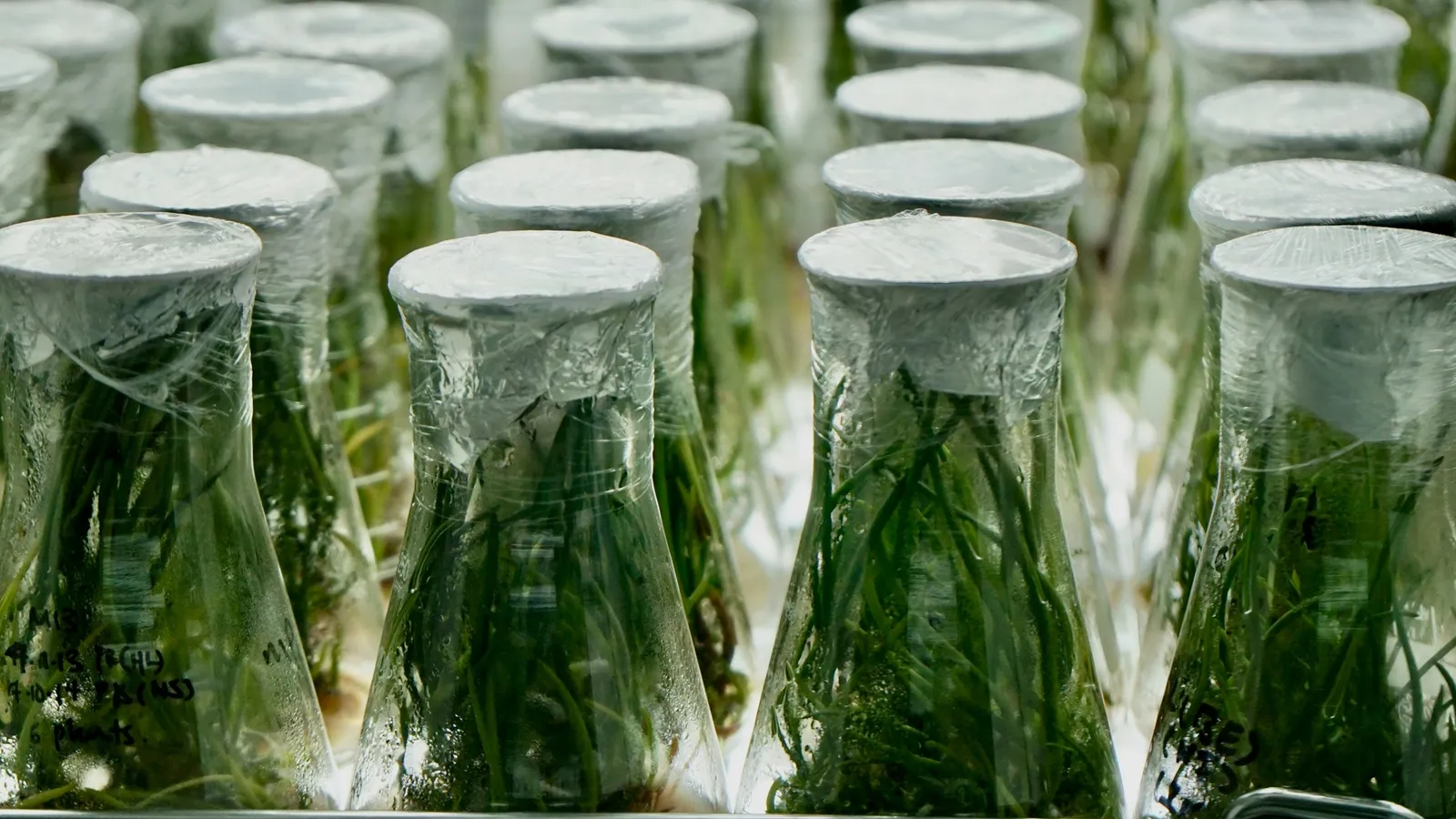
NCERT explains that scientists learnt in the 1950s that whole plants could be regenerated from explants: any part of a plant taken out and grown in a test tube under sterile conditions in a nutrient medium. The ability of a cell or explant to give rise to a whole plant is totipotency. The medium must supply a carbon source such as sucrose, inorganic salts, vitamins, amino acids and growth regulators such as auxins and cytokinins.
A widely used recipe is the medium published by Murashige and Skoog in 1962, developed for tobacco tissue cultures. You do not need its composition for the exam, but you will see "MS medium" in almost every protocol.
How do auxin and cytokinin decide what grows?
NCERT's plant growth chapter records that Folke Skoog and co-workers found tobacco stem callus grew only when the medium had auxin plus a second factor, later identified as kinetin, a cytokinin. A 2023 review of Skoog and Miller's 1957 work sets out what they found:
Both hormones were needed for cell proliferation.
High auxin with low cytokinin promoted roots.
High cytokinin with low auxin promoted buds and shoots.
High levels of both favoured callus, an undifferentiated mass of cells.
This is dedifferentiation and redifferentiation in action. Differentiated cells in the explant start dividing again and form callus; a change of hormone balance then makes them form shoots or roots.
What are the main applications?
Micropropagation. Producing thousands of plants quickly. NCERT notes the plants are genetically identical to the source plant, called somaclones, and that tomato, banana and apple have been produced commercially this way.
Virus-free plants. Even in an infected plant, the apical and axillary meristems are free of virus, so culturing a meristem gives healthy plants. NCERT names banana, sugarcane and potato.
Somatic hybrids. Cell walls are digested to give naked protoplasts, and protoplasts from two plants are fused. NCERT's example is the pomato, which it notes lacked the combination of characters needed for commercial use. The original report was Melchers and colleagues (1978), who regenerated somatic hybrid plants of potato and tomato from fused protoplasts.
Anther culture. Guha and Maheshwari (Nature, 1964) reported embryos produced in vitro from anthers of Datura.
The technique even reaches back in time. In 2012, Yashina and colleagues regenerated whole fertile plants of Silene stenophylla from fruit tissue about 30,000 years old, buried in Siberian permafrost, using tissue culture and clonal micropropagation.
Worked example: how many plants from one run?
The numbers here are invented for practice. A lab starts with 10 shoot-tip explants. After sterilisation, 2 are lost to contamination. Each healthy shoot produces 4 new shoots every 4-week subculture, and every shoot is subcultured again.
Healthy explants: 10 - 2 = 8.
After one cycle: 8 x 4 = 32 shoots.
After five cycles: 8 x 4^5 = 8 x 1024 = 8192 shoots.
Time taken: 5 x 4 = 20 weeks.
Rooting and hardening: if 90 per cent survive transfer to soil, 8192 x 0.9 = 7372.8, so about 7372 plants.
Starting from one cutting by conventional propagation, you would not come close in five months. That is the point NCERT makes about "a large number of plants in very short durations".
Common mistakes
Mixing up callus and meristem. Callus is undifferentiated tissue grown from an explant; a meristem is the tissue you culture to get virus-free plants.
Swapping the hormones. High cytokinin gives shoots, high auxin gives roots.
Calling somatic hybrids transgenic. Fusing protoplasts combines whole cells; no single gene is inserted.
Forgetting sterile conditions. Bacteria and fungi also thrive on a sugar-rich medium, which is why contamination is the first loss in any run.
A practice routine
From memory, write the medium components and check them against NCERT.
Draw the hormone grid: low and high auxin against low and high cytokinin, with the outcome in each box.
Rework the micropropagation example with 3 new shoots per cycle and 15 per cent contamination.
Link this to our post on plant growth regulators and write one line on what cytokinin does in a whole plant.
If you are not sure where this topic connects to the rest of plant physiology, the Fermi Concept Library covers every concept in physics, chemistry, biology, mathematics and computing, which helps you see what to read next.
Draw the hormone grid today and test yourself on it before your next biology session.