On this page
This chapter is names and examples: which flower has twisted petals, where a tomato's ovules sit, what wraps a maize radicle. Learn each term with NCERT's own example, and draw every arrangement until you can do it from memory.
Which parts of the chapter are in the NEET syllabus?
The NMC syllabus for NEET (UG) 2026 (dated 22 December 2025, linked from neet.nta.nic.in) lists, in Biology Unit 2, morphology and modifications of the root, stem, leaf, inflorescence (cymose and racemose), flower, fruit and seed. It names five families: Malvaceae, Cruciferae, Leguminoceae, Compositae and Graminae. No 2027 syllabus is on the NEET site yet.
The matching text is Chapter 5 of the NCERT Class 11 Biology textbook (Reprint 2026-27). Two points about the current chapter matter:
It has no sections on root, stem or leaf modifications; only passing lines remain, such as stems that store food and, in the summary, roots modified for storage, support or respiration.
It describes one family in full, Solanaceae, with no Fabaceae or Liliaceae section, plus the floral formula of mustard (Brassicaceae).
Since the syllabus names more than the book covers, ask your teacher how your practical course handles the five families.
What should you know about roots, leaves and inflorescences?
From the NCERT chapter:
Roots: a tap root grows from the radicle (mustard); a fibrous system replaces a short-lived primary root (wheat); adventitious roots grow from other parts (grass, Monstera, banyan).
Phyllotaxy: alternate (china rose, mustard, sunflower), opposite (Calotropis, guava), whorled (Alstonia).
Compound leaves: pinnate, leaflets on a rachis (neem); palmate, leaflets from the petiole tip (silk cotton). Buds sit in the petiole's axil, never a leaflet's.
Racemose vs cymose: in racemose, the main axis keeps growing and flowers form in acropetal order; in cymose, the axis ends in a flower and flowers form in basipetal order.
How do you learn aestivation and placentation?
Aestivation is how sepals or petals of one whorl are arranged in the bud; placentation is how ovules are arranged in the ovary (NCERT Chapter 5).
Valvate: edges meet without overlap (Calotropis).
Twisted: each petal overlaps the next in one direction (china rose, lady's finger, cotton).
Imbricate: overlap in no fixed direction (Cassia, gulmohur).
Vexillary: the large standard covers two wings, which cover two keel petals (pea, bean).
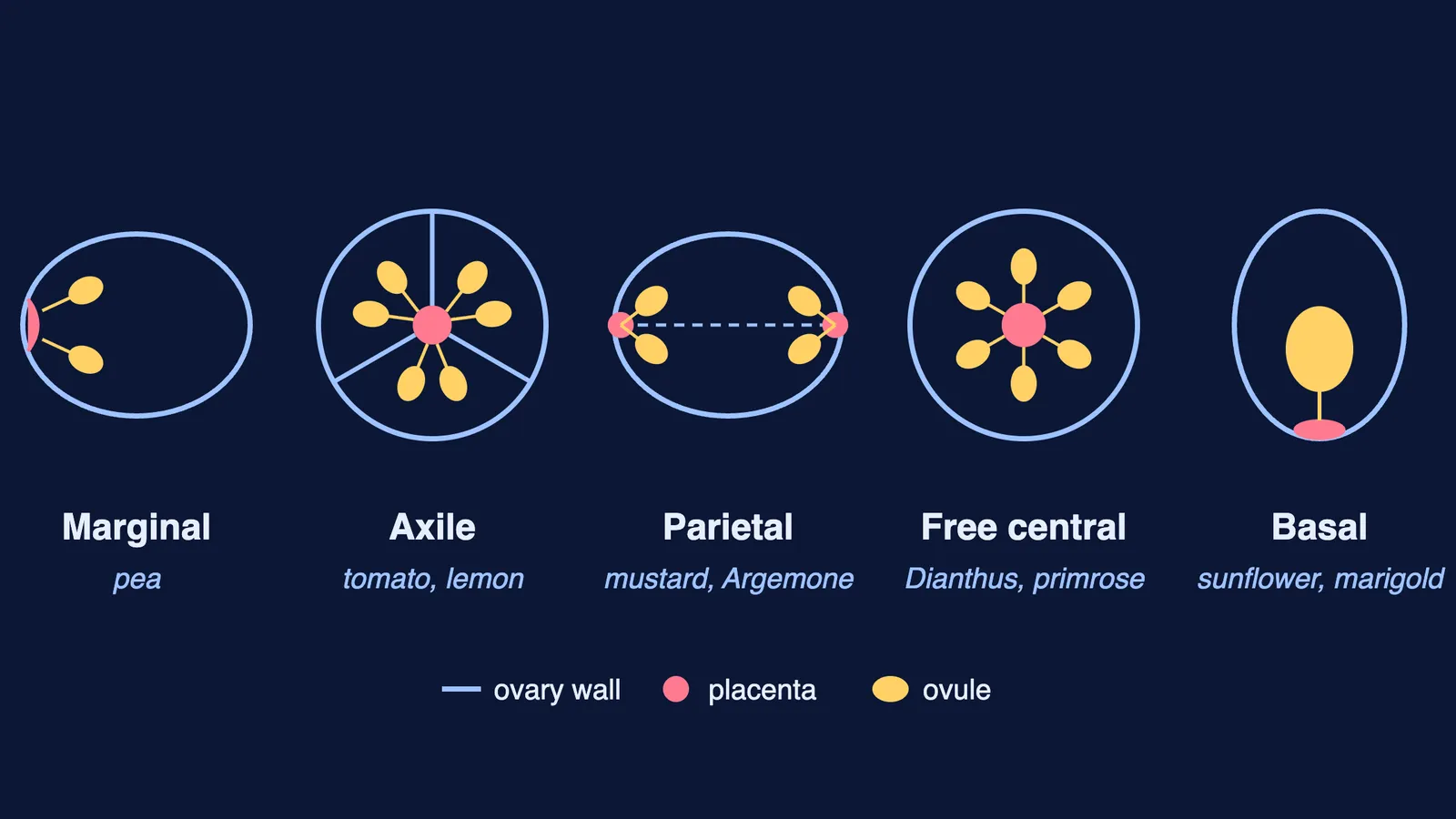
Placentation (see image):
Marginal: the placenta runs as a ridge on the ventral suture, carrying two rows of ovules (pea).
Axile: ovules on a central axis in a many-chambered ovary (china rose, tomato, lemon).
Parietal: ovules on the ovary wall; a false septum makes one chamber into two (mustard, Argemone).
Free central: ovules on a central axis with no septa (Dianthus, primrose).
Basal: one ovule at the base of the ovary (sunflower, marigold).
How do you read a floral formula?
In NCERT's notation, Br means bracteate, K calyx, C corolla, P perianth, A androecium and G gynoecium (NCERT section 5.8). A line under G marks a superior ovary and a line over G an inferior one. ⊕ marks an actinomorphic flower. Brackets show fused parts, and a line drawn over two symbols shows adhesion between whorls.
Mustard: ⊕ ⚥ K2+2 C4 A2+4 G(2), with G underlined for a superior ovary.
Solanaceae: ⊕ ⚥ K(5) C(5) A5 G(2), with an arc joining C and A because the stamens are epipetalous, and G underlined.
Read it as a sentence: five fused sepals, five fused petals, five stamens on the petals, two fused carpels in a superior ovary. NCERT adds valvate aestivation in calyx and corolla, axile placentation, and a berry or capsule fruit.
What should you remember about fruits and seeds?
A fruit is a ripened ovary, and a fruit formed without fertilisation is parthenocarpic (NCERT sections 5.6 and 5.7). Mango and coconut are one-seeded drupes from a monocarpellary superior ovary; mango has a fleshy edible mesocarp and stony endocarp, coconut a fibrous mesocarp.
Dicot seed: seed coat of testa and tegmen, a hilum scar with the micropyle above it, and two cotyledons. Castor keeps its endosperm; bean, gram and pea do not.
Monocot seed (maize): seed coat fused with the fruit wall, an aleurone layer around the endosperm, a shield-shaped cotyledon (scutellum), and sheaths called coleoptile (over the plumule) and coleorhiza (over the radicle). Orchid seeds lack endosperm.
How should you practise this chapter?
A two-week plan on the chapter:
Days 1-3: read sections 5.1 to 5.5; list every term beside its NCERT example.
Days 4-6: draw the aestivation and placentation types daily, from memory.
Days 7-9: write both floral formulas from memory and say each aloud.
Days 10-12: draw and label a gram seed and a maize seed.
Days 13-14: cover the examples column, test yourself, redo misses.
Pairing terms with sketches is explained in dual coding notes. Check any AI-given example against NCERT before learning it. If pericarp or scutellum still feels vague, the Fermi Concept Library has every concept in physics, chemistry, biology, mathematics and computing, each with its own lesson and its place in the map.
Next, try Plant Physiology for NEET.