On this page
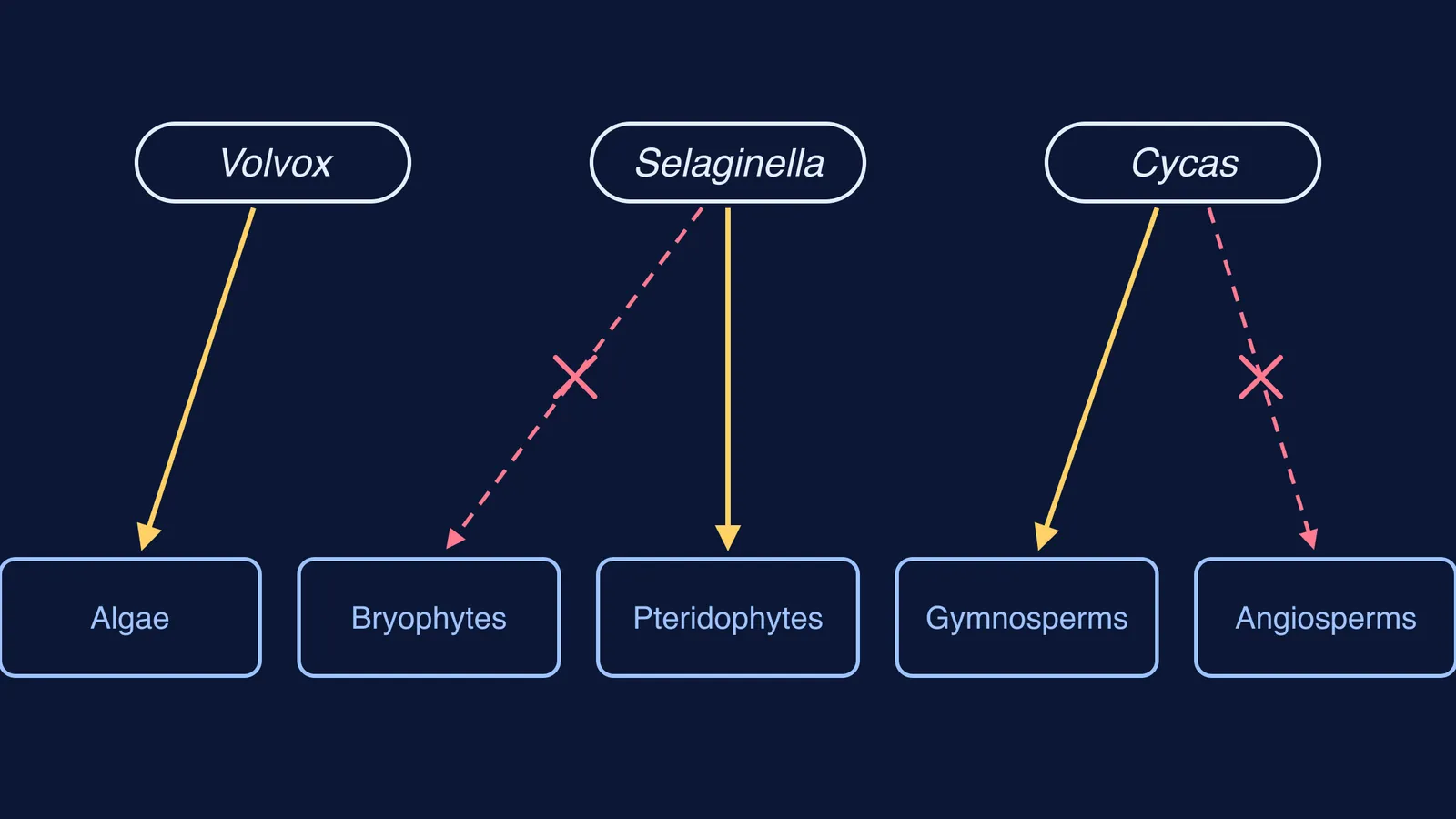
You ask a chatbot for three examples of pteridophytes and three of bryophytes. The answer looks neat, but Selaginella sits under mosses and Cycas is called a palm. Copy that into your notes and you will learn the mistake as carefully as the facts. The fix needs only Chapter 3, Plant Kingdom, of the NCERT Class 11 Biology textbook.
Why does AI put Volvox, Selaginella or Cycas in the wrong group?
The first reason is how these models are built. A 2025 paper by Adam Tauman Kalai and colleagues, Why Language Models Hallucinate, argues that language models "sometimes guess when uncertain, producing plausible yet incorrect statements instead of admitting uncertainty", because training and evaluation reward guessing over admitting uncertainty. A wrong plant group is exactly that kind of plausible guess.
The second reason is common names. Selaginella is commonly called "spike moss", but the Cambridge University Botanic Garden states plainly: "Despite the name, it is not a moss, but a lycophyte." Cycas revoluta is called the sago palm, yet NC State Extension notes that "it is not a true palm" and that it produces cones with exposed seeds, like pines. A model can follow the name instead of the plant.
The third reason is that classification has changed. NCERT's chapter says that cyanobacteria, once called blue-green algae, "are not 'algae' any more", and that fungi have been excluded from Plantae. Older sources may still mix these up, and so can an AI trained on them. For your exam, the NCERT list is the one that counts.
What are NCERT's examples of algae, bryophytes, pteridophytes and gymnosperms?
These are the genera named in the current reprint of NCERT Class 11 Biology, Chapter 3:
Green algae (Chlorophyceae): Chlamydomonas, Volvox, Ulothrix, Spirogyra, Chara
Brown algae (Phaeophyceae): Ectocarpus, Dictyota, Laminaria, Sargassum, Fucus
Red algae (Rhodophyceae): Polysiphonia, Porphyra, Gracilaria, Gelidium
Liverworts: Marchantia
Mosses: Funaria, Polytrichum, Sphagnum
Pteridophytes: Psilotum (Psilopsida); Selaginella and Lycopodium (Lycopsida); Equisetum (Sphenopsida); Dryopteris, Pteris and Adiantum (Pteropsida); Selaginella and Salvinia are the heterosporous examples
Gymnosperms: Cycas, Pinus, Cedrus, Ginkgo, and the giant redwood Sequoia
To drill them, try the blank-table method for NEET biology examples; for the life cycles behind them, see the plant kingdom overview from algae to gymnosperms.
How do you check an AI's example in two steps?
Find it under a heading. Open the NCERT PDF, search for the genus name, and write down the section heading it sits under (3.1.1 Chlorophyceae, 3.3 Pteridophytes and so on). The heading decides the group, not the page or a nearby figure.
Match one defining feature. Pick one feature NCERT gives for that group and confirm the chapter links it to your organism. If the AI's group and the feature disagree, the AI is wrong.
Here is the check run on the three usual troublemakers, using only the chapter's own lines:
Volvox. Step 1: listed among "commonly found green algae" under Chlorophyceae. Step 2: NCERT uses it as an example of a colonial form and of oogamous reproduction. Verdict: green alga.
Selaginella. Step 1: listed under Lycopsida in 3.3 Pteridophytes. Step 2: NCERT cites it for small leaves (microphylls), for strobili and as heterosporous, and says the pteridophyte plant body has true roots, stems and leaves with vascular tissue. Bryophytes, the chapter says, lack true roots, stem or leaves. Verdict: pteridophyte, not a moss.
Cycas. Step 1: listed in 3.4 Gymnosperms. Step 2: NCERT says its coralloid roots are associated with nitrogen-fixing cyanobacteria and that its male cones and megasporophylls grow on different trees; like all gymnosperms, it has naked seeds. Verdict: gymnosperm, not a palm.
You can make the AI do part of the work with this prompt: "Give examples only from NCERT Class 11 Biology Chapter 3. For each, name the section heading and quote one feature the chapter gives for it." Still run step 1 yourself, because a model can invent a heading as easily as an example. For why Selaginella counts as vascular, read why pteridophytes are the first vascular land plants.
What if the AI gives a name NCERT does not mention?
Don't memorise it for this chapter. It may be a real plant in the right group, but you cannot check it against the textbook. Park it in an "outside NCERT" corner of your notes, or leave it out.
If the real gap is the idea rather than the example, such as what heterospory is or why naked seeds define a gymnosperm, the Fermi Concept Library gives each biology concept its own lesson and its place in the map, so you can settle the feature before you sort the plants.