On this page
Most notes are walls of text that feel familiar on rereading but don't come back in the exam. Dual coding is a simple fix: for every idea you write down, you also draw it. Here is the method, a worked page on the nitrogen cycle, and a prompt for getting AI to check your sketch.
What is dual coding, and does it work?
Dual coding means putting the same information into your head in two forms, words and a picture, so that you have two ways to find it again. The theory comes from the psychologist Allan Paivio, who looked back on it in Dual coding theory: Retrospect and current status (1991).
A 2018 review by Yana Weinstein, Christopher Madan and Megan Sumeracki, Teaching the science of learning, names dual coding as one of six study strategies with strong research support. The other five are spaced practice, interleaving, retrieval practice, elaboration and concrete examples. The same review says visuals help most when a concept has several parts or steps, especially for students new to the topic. That is exactly what a biology cycle or a chemistry mechanism looks like.
Drawing it yourself seems to help too. In seven free-recall experiments, Jeffrey Wammes, Melissa Meade and Myra Fernandes (2016) found that words people drew were recalled better than words they wrote out. They tested word lists, not whole chapters, so treat this as a reason to sketch, not a promise of marks. For classroom research on words plus pictures, see our post on Richard Mayer's multimedia learning research.
How do you make dual coding notes?
The same review warns that busy, detailed pictures can distract. Keep it plain.
Draw a line down the page: words on the left, sketch on the right, one idea per row.
On the left, write the idea in your own words in one or two lines.
On the right, draw how the idea fits together: boxes for things, arrows for change.
Use the same labels on both sides, so each word has a matching mark in the sketch.
Next day, cover one side and rebuild it from the other. That turns your notes into retrieval practice, and you can make active recall cards from your notes with AI the same way.
What does a dual-coded nitrogen cycle page look like?
The nitrogen cycle is a set of steps that ends where it started, so it suits a sketch. The facts below come from OpenStax Biology 2e, section 46.3.
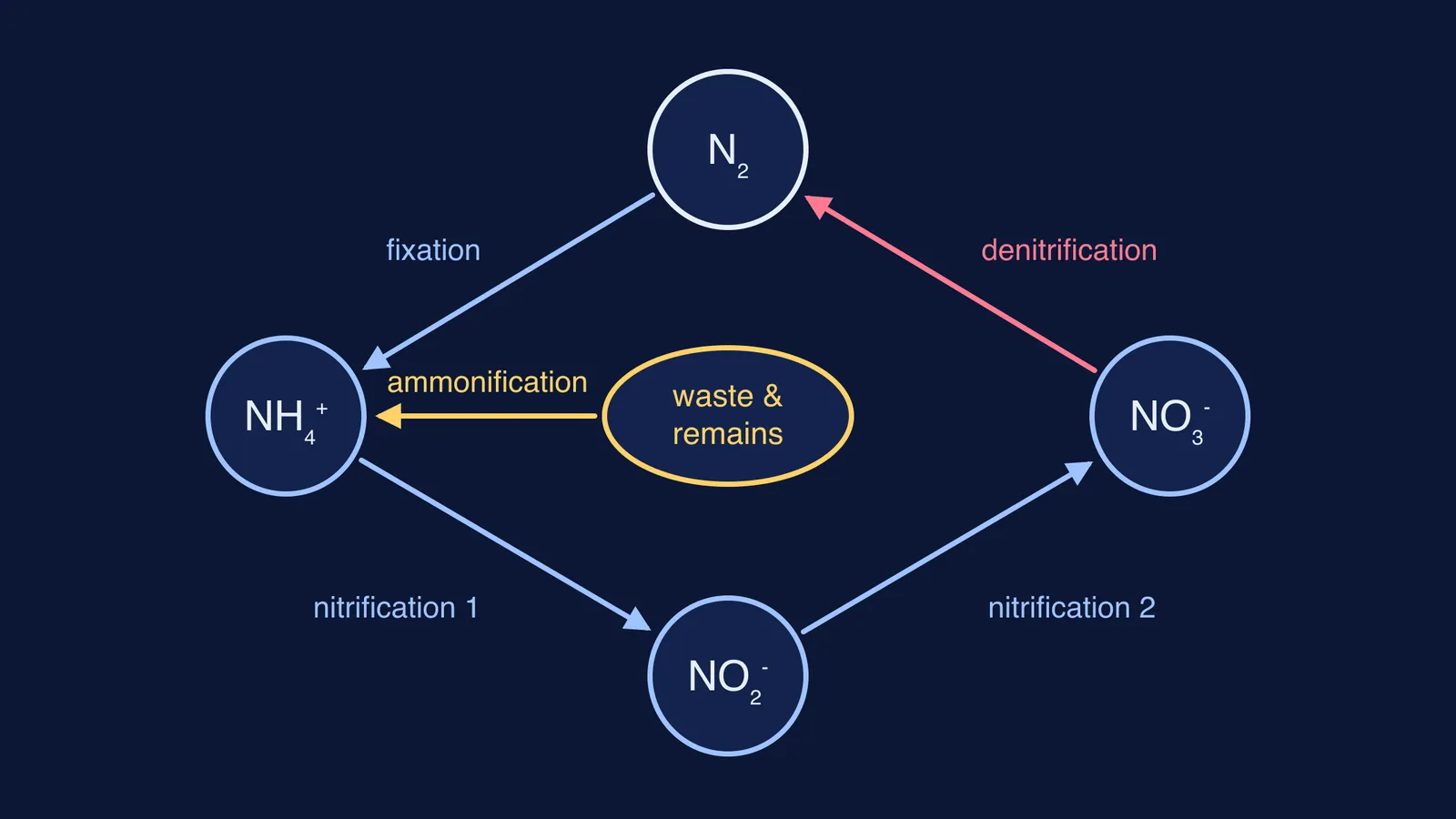
Row 1, fixation. Words: “N₂ is about 78 percent of the atmosphere, but plants and phytoplankton can't take it in directly. Free-living and symbiotic bacteria fix it.” Sketch: N₂ in a circle at the top of the page, with an arrow down to NH₄⁺ labelled “fixation, bacteria”.
Row 2, ammonification. Words: “Bacteria and fungi turn animal waste and dead remains into ammonium, NH₄⁺.” Sketch: a box marked “waste and remains” in the middle, with an arrow across to the same NH₄⁺ circle.
Row 3, nitrification. Words: “Nitrifying bacteria such as Nitrosomonas turn NH₄⁺ into nitrite, NO₂⁻. Similar organisms then turn nitrite into nitrate, NO₃⁻.” Sketch: two arrows in a row, NH₄⁺ to NO₂⁻ to NO₃⁻, along the bottom of the page.
Row 4, denitrification. Words: “Bacteria such as Pseudomonas and Clostridium turn nitrate back into nitrogen gas.” Sketch: one arrow from NO₃⁻ back up to N₂, which closes the loop.
The right-hand column should now be a closed loop you can redraw from memory, like the diagram at the top of this post. If you can't close the loop, you have found your gap. If one idea keeps slipping, the Fermi Concept Library gives each concept in biology and chemistry its own lesson and its place in the map.
How can AI check your sketch?
A typed description of your sketch is easier for a chatbot to check than a photo of handwriting, and turning the picture back into words is useful practice in itself. Paste this:
“Here is my dual-coded note on the nitrogen cycle. Words: [paste your left column]. Sketch, arrow by arrow: [for example, N₂ to NH₄⁺, labelled fixation, bacteria]. Please: 1) check each arrow points the right way and has the right label; 2) tell me where my words and my sketch disagree; 3) list anything my biology exam would expect that I left out. Don't redraw it for me. Ask me one question at a time so I fix it myself.”
Then check anything the AI adds against your textbook, because chatbots can be confidently wrong. For more ways to get feedback on visual notes, see getting AI feedback on your mind map.
If you would rather be taught a topic like this, Fermi's AI tutor draws the figure as it explains and checks your understanding as it goes. Start tonight: one page, two columns, one closed loop.