On this page
In a NEET or board question, Down syndrome usually comes with a karyotype and a list of features. Here is where the 47th chromosome comes from and what NCERT wants you to remember.
What is the karyotype of Down syndrome?
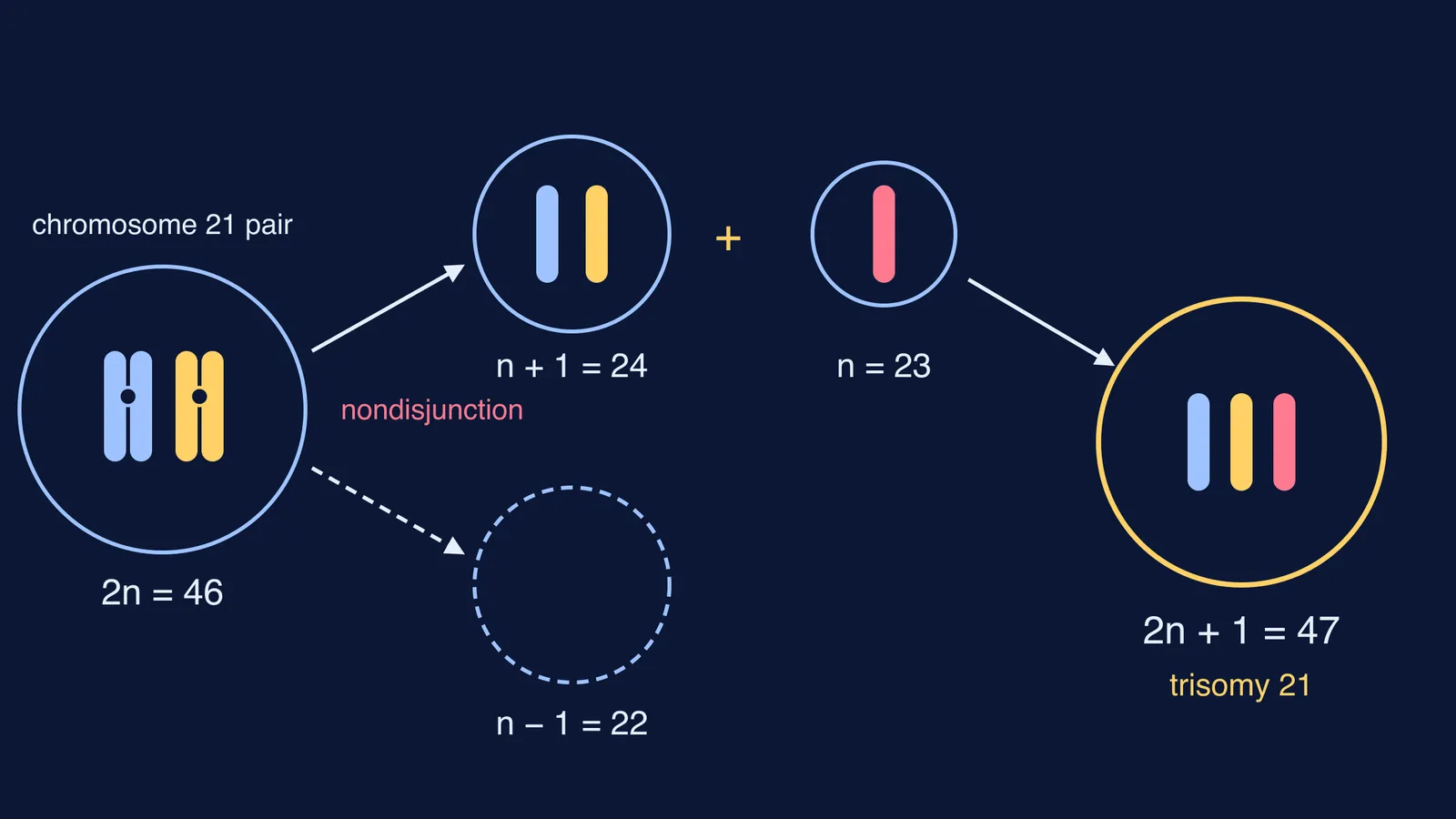
According to NCERT Class 12 Biology, Chapter 4, a normal human cell has 46 chromosomes in 23 pairs: 22 pairs of autosomes and one pair of sex chromosomes. NCERT says Down syndrome is caused by an additional copy of chromosome 21, which it calls trisomy of 21. That makes the total 47. In standard karyotype notation, a girl with Down syndrome is 47,XX,+21 and a boy is 47,XY,+21. The sex chromosomes are normal. The extra chromosome is an autosome.
NCERT calls the gain or loss of a chromosome aneuploidy and says it results from "failure of segregation of chromatids during cell division cycle".
How does non-disjunction give 47 chromosomes?
Non-disjunction happens when a chromosome pair, or two sister chromatids, fail to separate during meiosis, so one gamete gets both copies and the other gets none. MedlinePlus Genetics says this error usually happens while egg cells are forming, though it can also happen in sperm.
The counting goes like this:
A normal gamete has n = 23 chromosomes.
After non-disjunction of chromosome 21, one egg has 24 (n + 1) and its partner cell has 22 (n − 1).
A normal sperm with 23 fertilises the 24-chromosome egg, so the zygote has 47 (2n + 1).
Mitosis copies that zygote faithfully, so every cell in the body carries three copies of chromosome 21.
In a 1991 study of 200 families in the New England Journal of Medicine, researchers used DNA markers to trace the extra chromosome 21. It came from the mother in 95.3% of the children whose origin could be found and from the father in 4.7%.
The CDC says about 95% of people with Down syndrome have trisomy 21, about 3% have translocation Down syndrome and about 2% have mosaic Down syndrome. The chance rises with the mother's age, especially from 35, yet most babies with Down syndrome are born to mothers under 35, because younger women have many more babies. MedlinePlus puts the frequency at about 1 in 700 newborns.
For errors in meiosis I vs meiosis II, see our explainer on non-disjunction in meiosis I vs II.
What features of Down syndrome does NCERT list?
NCERT says the disorder was first described by Langdon Down in 1866. It lists these features:
short stature with a small, round head
furrowed tongue and partially open mouth
broad palm with a characteristic palm crease
physical, psychomotor and mental development that is retarded (delayed)
Figure 4.16 in the same chapter labels more features: a flat back of the head, a broad flat face, a big wrinkled tongue, many "loops" on the fingertips, the palm crease and congenital heart disease.
To learn how the extra chromosome was first found, read our piece on Marthe Gautier and trisomy 21.
How is Down syndrome different from Turner and Klinefelter syndrome?
NCERT names these three as common chromosomal disorders. They differ in which chromosome is affected and in the total count:
Down syndrome: 47 chromosomes, with an extra autosome (chromosome 21).
Klinefelter syndrome: 47, XXY, with an extra X chromosome. Development is masculine overall, with some feminine development such as gynaecomastia, and the person is sterile.
Turner syndrome: 45 with X0, because one X chromosome is missing. The person is female, the ovaries are rudimentary, other secondary sexual characters are missing, and she is sterile.
So Down and Klinefelter syndrome both have 47 chromosomes. What separates them is whether the extra chromosome is an autosome or a sex chromosome. Our Turner vs Klinefelter explainer covers the sex-chromosome disorders in more detail.
A 60-second check for any karyotype question
When a question gives you a karyotype or a list of features, ask these three questions in order:
Count. 47 means one extra chromosome (trisomy) and 45 means one missing (monosomy). With 46, look more closely: in translocation Down syndrome, part of chromosome 21 is attached to another chromosome, as MedlinePlus explains.
Which chromosome? An extra 21 means Down. An extra X alongside a Y means Klinefelter. A missing X means Turner.
Mechanism. Gaining or losing one chromosome is aneuploidy, caused by non-disjunction. Gaining a whole set is polyploidy, which NCERT links to failed cytokinesis.
Worked example: "A child has 22 pairs of autosomes plus an extra chromosome 21, and XY." Count: 44 + 1 + 2 = 47. The answer is Down syndrome, 47,XY,+21, caused by non-disjunction.
To practise more cases like this, try the Fermi Problem Library. Its worked problems use a step-by-step solver that explains the reasoning rather than printing an answer. If meiosis still feels shaky, the Fermi Concept Library gives each biology concept its own lesson and shows its place in the map.
This article is for exam study. If your family has questions about a real diagnosis or a pregnancy, talk to a doctor or a genetic counsellor.