

On this page
Turner and Klinefelter syndrome are the two sex-chromosome disorders in NCERT Class 12 Biology, and they are easy to swap in an exam. Both come from the same kind of error: one leaves a sex chromosome short, the other adds one.
What karyotypes do Turner and Klinefelter syndrome have?
A normal human cell has 46 chromosomes, 22 pairs of autosomes and one pair of sex chromosomes, according to section 4.8.3 of the NCERT Class 12 Biology chapter Principles of Inheritance and Variation.
Turner syndrome: 45, X0. NCERT says it "is caused due to the absence of one of the X chromosomes". The 0 marks the missing sex chromosome; it is not a chromosome.
Klinefelter syndrome: 47, XXY. NCERT says it is caused by "an additional copy of X-chromosome resulting into a karyotype of 47, XXY".
Both are examples of aneuploidy, which the NCERT chapter defines as the gain or loss of a chromosome caused by "failure of segregation of chromatids during cell division cycle". Turner has one sex chromosome where there should be two; Klinefelter has three. Medical references such as MedlinePlus Genetics list "45,X" as another name for Turner syndrome. Our guide on how to read a human karyotype chart walks through a full spread.
How does nondisjunction produce 45, X0 and 47, XXY?
Nondisjunction is a cell-division error in which chromosomes fail to separate as eggs or sperm form. For Klinefelter syndrome, MedlinePlus Genetics says "an egg cell or a sperm cell can also end up with an extra copy of the X chromosome". For Turner syndrome, MedlinePlus Genetics notes that "an egg or sperm cell may lose a sex chromosome as a result of nondisjunction".
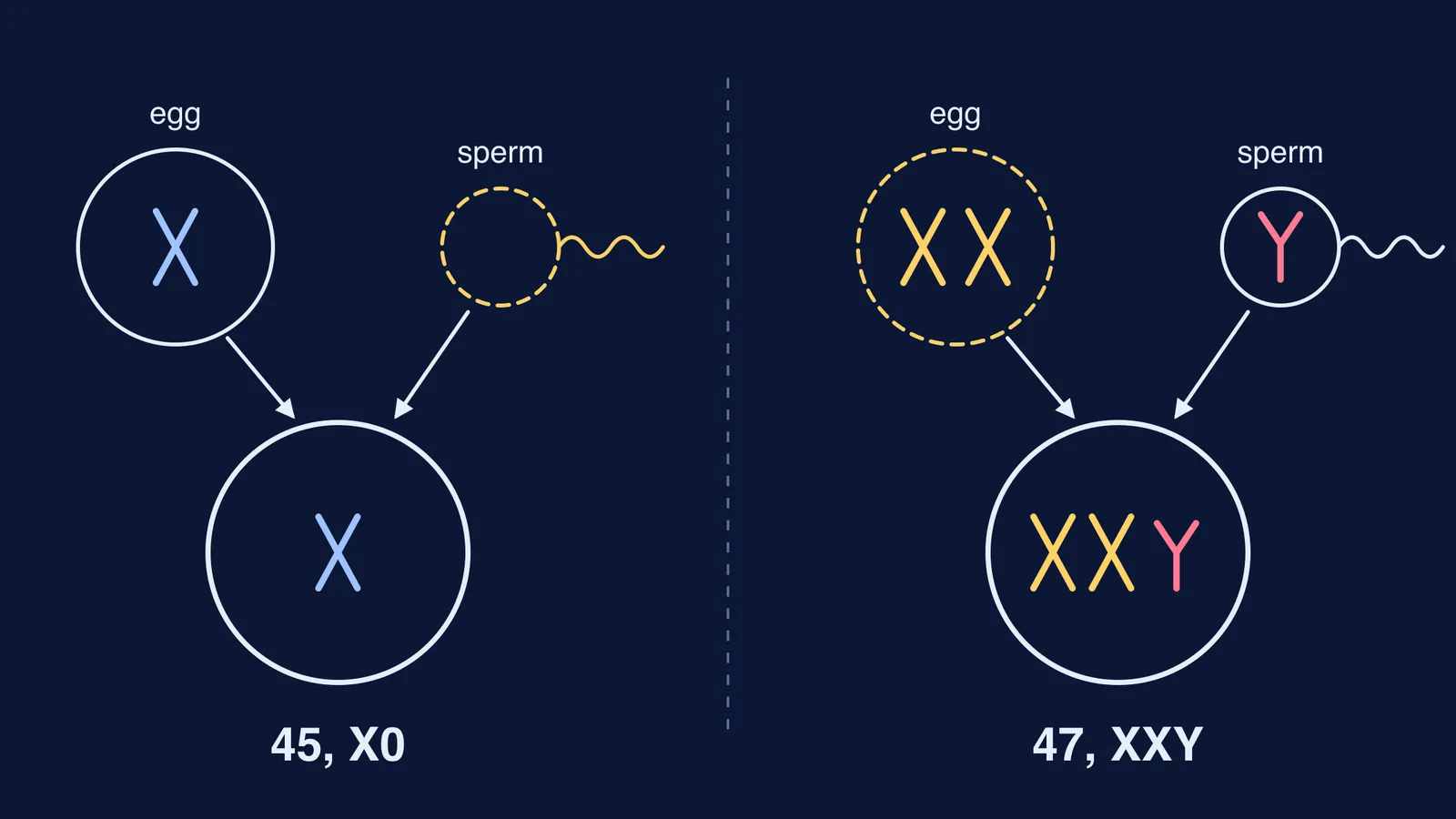
Normally every egg carries one X, and each sperm carries an X or a Y. Let one gamete be abnormal and fuse with a normal partner:
Egg with no sex chromosome + sperm with X = 45, X0 (Turner).
Normal egg with X + sperm with no sex chromosome = 45, X0 (Turner).
Egg with XX + sperm with Y = 47, XXY (Klinefelter).
Normal egg with X + sperm with both X and Y = 47, XXY (Klinefelter).
Line 4 is the one students miss. A sperm carries both X and Y only if they failed to separate in the father's first meiotic division, when homologous chromosomes part. So the error can be in either parent; MedlinePlus says the extra X arises "in one of an affected person's parents". For meiosis I vs meiosis II errors, see our post on nondisjunction in meiosis I vs II.
Beyond the syllabus, only about half of people with Turner syndrome have a single X in every cell (monosomy X); others are missing part of an X, have a rearranged X, or have the change in only some cells, called mosaicism (MedlinePlus Genetics). For NCERT and NEET-UG answers, write 45, X0.
What features does NCERT list for each syndrome?
These come from section 4.8.3 and Figure 4.17 of the NCERT chapter.
Turner syndrome (45, X0):
Sex: female
Cause: absence of one X chromosome
Fertility: sterile, because the ovaries are rudimentary
Other features: lack of other secondary sexual characters
Figure 4.17 label: short stature and underdeveloped feminine character
Klinefelter syndrome (47, XXY):
Sex: male, with "overall masculine development"
Cause: an additional copy of the X chromosome
Fertility: sterile
Other features: some feminine development, such as breast development (gynaecomastia)
Figure 4.17 label: tall stature with feminised character
MedlinePlus gives the frequencies: Turner syndrome occurs in about 1 in 2,000 female newborns (MedlinePlus Genetics: Turner syndrome), and Klinefelter syndrome affects about 1 in 650 male newborns (MedlinePlus Genetics: Klinefelter syndrome). Its signs vary and can be mild, and researchers believe up to 65 percent of people with Klinefelter syndrome are never diagnosed, the same page says.
How do you avoid mixing them up in an exam?
Run three checks:
Count. 45 means Turner; 47 with XXY means Klinefelter. Watch the trap: Down's syndrome is also 47, but the extra chromosome is chromosome 21, an autosome, as the NCERT chapter summary states. Our explainer on autosomes vs sex chromosomes covers that difference.
Look for a Y. A Y chromosome means male development, so XXY is Klinefelter. No Y and a single X is Turner.
Match the feature, not the sterility. NCERT calls both sterile, so sterility alone does not separate them. Tall stature and gynaecomastia point to Klinefelter; short stature and rudimentary ovaries point to Turner.
If the meiosis step is where it falls apart for you, the Fermi Concept Library gives every biology concept its own lesson and its place in the map, so you can step back from aneuploidy to meiosis. For practice, the Fermi Problem Library has worked problems with a step-by-step solver that explains the reasoning rather than printing an answer.
Tonight, write the four gamete combinations from memory and check them against the list.


