

On this page
A karyotype chart looks like a drawer of odd socks, but it follows a fixed order: pair the chromosomes, check the sex chromosomes, then count. This guide covers each step and ends with a chart for you to read.
What is a karyotype chart?
A karyotype is a lab image of a person's chromosomes from a single cell, arranged in numerical order (NHGRI glossary). Each human cell normally holds 23 pairs of chromosomes, 46 in total (MedlinePlus Genetics). Twenty-two pairs are autosomes; the 23rd pair is the sex chromosomes.
Many chromosomes have a pinched waist called the centromere, which separates a shorter p arm from a longer q arm (NHGRI fact sheet). The most widely used routine stain in US clinical cytogenetics is G-banding: chromosomes are treated with the enzyme trypsin and then stained with Giemsa. AT-rich regions stain dark and GC-rich regions stay pale (Clinical Cytogenetics guide). Both members of a pair carry the same stripes, like a barcode. For why labs photograph chromosomes at metaphase, see why metaphase is the best stage to study chromosome shape.
How do you sort chromosomes into pairs?
NHGRI says scientists arrange chromosomes using size, banding pattern and centromere position as guides (NHGRI). Use them in this order:
Size first. Line them up from longest to shortest. Chromosome 1 is the largest, at about 249 million base pairs (MedlinePlus).
Centromere next. Is the waist near the middle, off-centre, or almost at one end? Same length with waists in different places means not a pair.
Bands last. Match the dark and pale stripes one by one. This settles close calls such as 10, 11 and 12, which are nearly the same length.
Fill the slots. Put each finished pair in its numbered place so any gap or extra stands out.
One trap: the numbers are not a perfect size ranking. In the Ensembl GRCh38 human genome assembly, chromosome 21 is about 46.7 million base pairs and chromosome 22 is about 50.8 million. Chromosome 19 is also shorter than 20.
How do you tell if a karyotype is male or female?
Look at the 23rd pair. Two X chromosomes (XX) usually means female, and one X with one Y (XY) usually means male (MedlinePlus Genetics). In the Ensembl GRCh38 assembly, X is about 156 million base pairs, between chromosomes 7 and 8 in length. Y is about 57 million, close to chromosome 19. If the last "pair" is one medium chromosome and one small one, you are looking at XY.
How do you spot an extra chromosome, and what does it mean?
Gaining or losing chromosomes from the usual 46 is called aneuploidy. An extra chromosome is a trisomy and a missing one is a monosomy (MedlinePlus Genetics). Once you've sorted, look for a slot holding three chromosomes, or only one:
Three copies of 21: trisomy 21, the cause of most cases of Down syndrome, which occurs in about 1 in 700 newborns (MedlinePlus).
Three copies of 18: trisomy 18, in about 1 in 5,000 live-born infants (MedlinePlus).
Three copies of 13: trisomy 13, in about 1 in 16,000 newborns (MedlinePlus).
XXY, 47 in total: the most common pattern in Klinefelter syndrome, which affects about 1 in 650 male newborns (MedlinePlus).
One X and no second sex chromosome, 45 in total: monosomy X, found in about half of people with Turner syndrome, which affects about 1 in 2,000 female newborns (MedlinePlus).
MedlinePlus links the extra X of Klinefelter syndrome, and the random events behind most cases of trisomy 13, to nondisjunction, an error in cell division while eggs or sperm form. How nondisjunction in meiosis creates an extra chromosome walks through it. For broken or swapped pieces, see chromosomal aberrations: deletion, duplication and translocation.
Worked example: read the chart at the top of this page
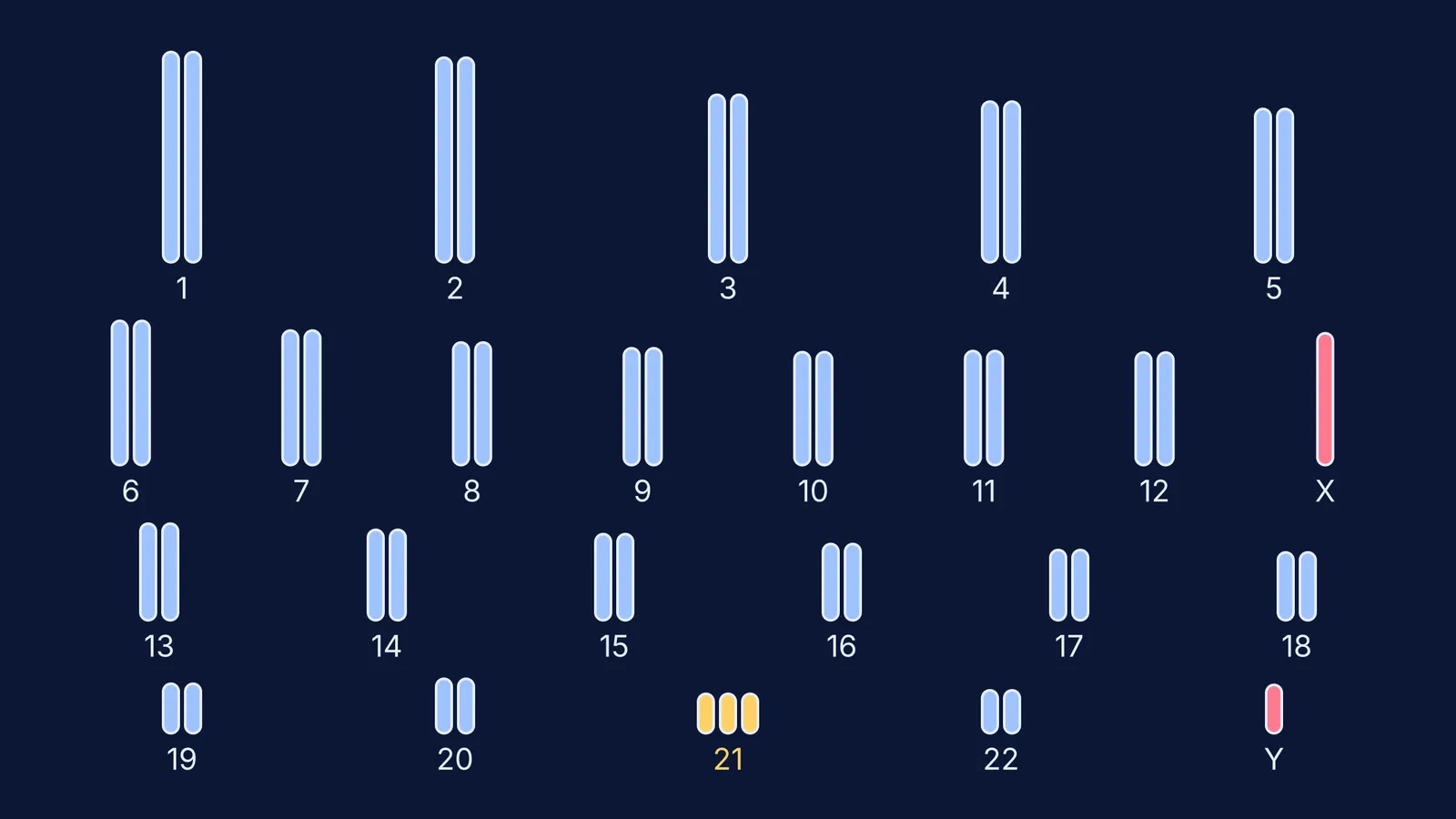
The diagram at the top draws each chromosome as a bar whose height is proportional to its Ensembl sequence length, without bands or centromeres. Read it like an exam question:
Count. Row one has 10 chromosomes, row two 15 (including an X), row three 12, and row four 10 (three 21s and a Y). The total is 47.
Sex. One medium X and one small Y, so this is XY: male.
Odd slot. Chromosome 21 has three copies.
Conclusion. This is 47 chromosomes, XY, with trisomy 21: the pattern behind most cases of Down syndrome.
Now swap the third 21 for a second X. You still count 47, but the sex chromosomes read XXY: the usual pattern of Klinefelter syndrome.
To make it hands-on, print a banded chart, cut out the chromosomes, shuffle them and time yourself pairing them. Then hide one extra for a friend to find. Beyond biology charts, the Fermi Simulation Lab has interactive simulations for ideas that are easier to see than to read. If meiosis still feels shaky, the Fermi Concept Library has a lesson for every biology concept, so you can revise it before your next chart.


