

On this page
Think of the human genome as an enormous library of instructional manuals. If a point mutation is a single misspelt word on one page, a structural chromosomal aberration is tearing out an entire chapter, photocopying it twice, or gluing it into the wrong book entirely.
When preparing for exams like NEET-UG or studying genetics at university, understanding the scale of these errors is crucial. They are not minor typos; they are massive architectural shifts that can disrupt human development or drive the uncontrollable growth of cancer cells.
What are structural changes in chromosomes?
Chromosomes are tightly packed structures that carry your genetic information. Each one contains a single, incredibly long molecule of DNA wrapped around proteins, housing hundreds or thousands of genes. You can review how these structures are classified in our guide to chromosome types by centromere position: metacentric to telocentric.
Structural changes—also known as chromosomal aberrations—occur when this architecture breaks. Typically, during cell division (such as meiosis or mitosis) or following severe DNA damage, a chromosome can snap. If the cell's repair machinery joins the broken ends back together incorrectly, the sequence of genes is permanently altered. Because chromosomes are so dense, even a microscopically small physical break can affect millions of base pairs of DNA.
Deletion, duplication and translocation: how do they happen?
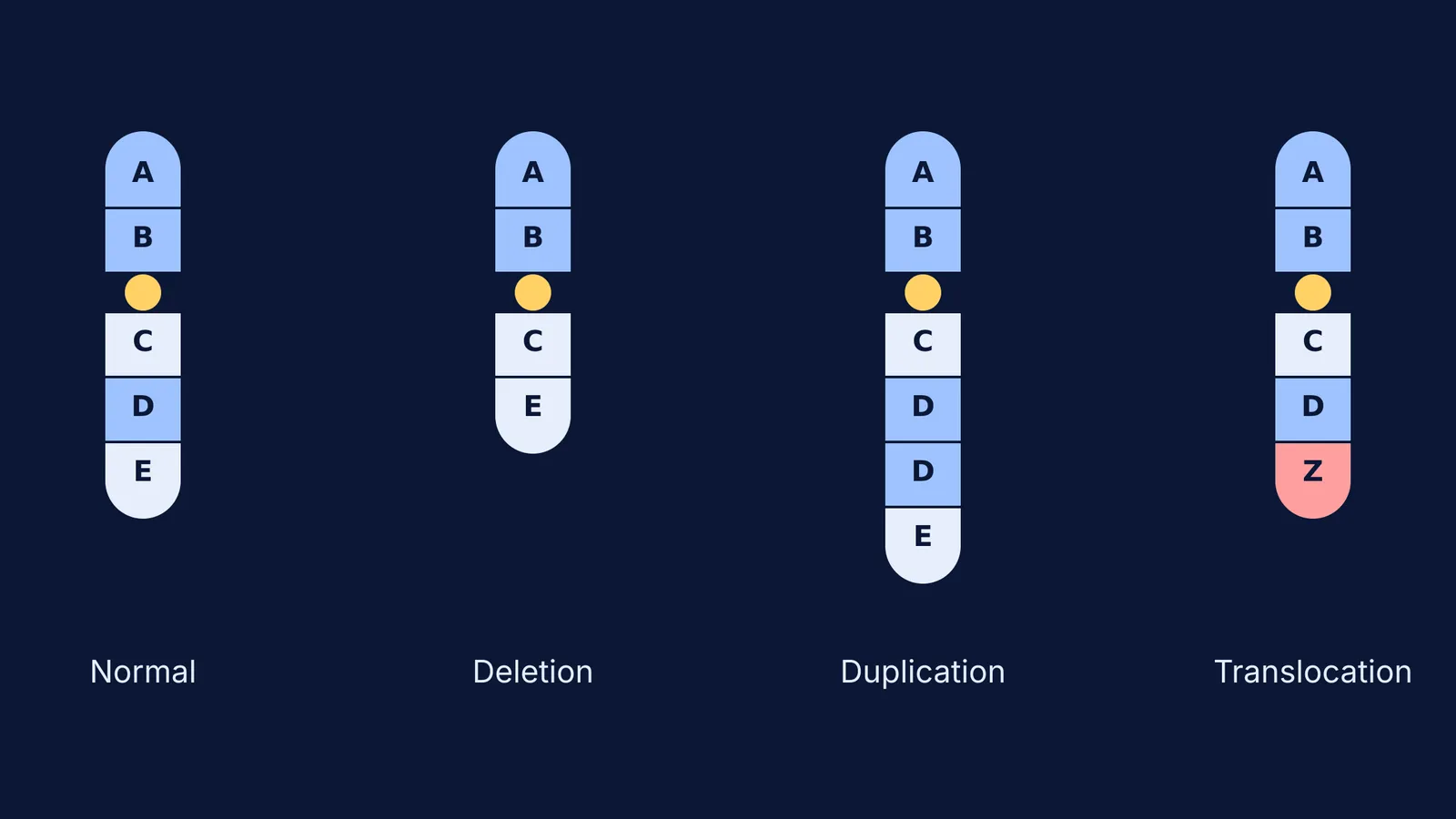
When a chromosome breaks and re-forms, it can take several faulty shapes. The three most common structural aberrations are deletions, duplications, and translocations.
Deletion: A segment of the chromosome is completely lost. Every gene located in that block is permanently erased from the cell's genetic code.
Duplication: A segment of the chromosome is copied and inserted twice. This gives the cell extra copies of the genes in that region, leading to an overproduction of the proteins they encode.
Translocation: A segment from one chromosome breaks off and attaches to a different, non-homologous chromosome. Sometimes this is a reciprocal swap, where two different chromosomes trade pieces. This can take a gene from its normal environment and place it next to a new "control switch" that keeps it turned on permanently.
How do chromosomal aberrations differ from point mutations?
The primary difference lies in the scale of the error and the number of genes affected.
A point mutation involves a chemical change to a single nucleotide base (an A, T, C, or G) in the DNA sequence. This small-scale change usually affects only one specific gene. For example, replacing a single base pair in the gene for haemoglobin causes sickle-cell anaemia, a condition we cover in detail in our post on Mendelian disorders: sickle-cell anaemia, thalassemia and PKU.
In contrast, a structural chromosomal change moves, removes, or duplicates thousands to millions of base pairs. Instead of tweaking one protein, an aberration can simultaneously alter the dosage or function of hundreds of different genes.
Why are chromosomal aberrations linked to cancer cells?
Cancer is fundamentally a disease of uncontrolled cell division, and massive genetic rearrangements are often what remove the cell's natural brakes.
The scale of this issue is immense. The Pan-Cancer Analysis of Whole Genomes project, a landmark study that sequenced over 2,600 whole cancer genomes across 39 distinct tumour types (DOI: 10.1101/162784), confirmed that structural variations and large-scale genetic rearrangements are universal drivers of cancer development.
These aberrations drive cancer primarily through two mechanisms:
Removing brakes (Deletions): Tumour suppressor genes are responsible for stopping damaged cells from dividing. A chromosomal deletion that removes a tumour suppressor gene leaves the cell unable to halt its own division.
Pressing the accelerator (Duplications and Translocations): Oncogenes are genes that promote cell growth. A duplication can create extra copies of an oncogene, flooding the cell with growth signals. Alternatively, a translocation can fuse an oncogene with an active promoter, creating a hyperactive protein (like the famous Philadelphia chromosome in chronic myeloid leukaemia).
A framework for exam preparation
When students plateau in genetics, it is often because they try to memorise lists of diseases without understanding the underlying physical changes to the DNA.
If you are struggling to build a clear picture of these concepts, Fermi's AI tutor works out what you already know and builds a plan for the session, so you sit down to a clear next step instead of staring at a blank page. If you need to trace the exact physical structure of DNA and how it breaks, you can explore the Fermi Concept Library, where every concept in physics, chemistry, biology, mathematics and computing has its own lesson and its place in the map.
Finally, when you are ready to test your knowledge against actual exam numericals or pedigree charts, the Fermi Problem Library has worked problems with a step-by-step solver that explains the reasoning rather than just printing an answer.


