

On this page
Drawing a mind map before a chemistry exam feels productive. You spread out coloured pens, write "Electrochemistry" in the centre of a blank page, and branch outward into galvanic cells, Nernst equations, conductance, and electrolysis. But when test scores arrive, the illusion collapses: numericals get tangled, sign conventions flip, and formulas fail.
The flaw is rarely effort; it is the map's architecture. As educational psychologists have observed since Joseph Novak formalized concept mapping at Cornell University (Novak, 1990), isolated keywords branching like a tree do not build an integrated mental model. Genuine mastery lives in the linking phrases between ideas and the cross-links tying separate branches together.
Instead of letting a passive diagram sit in your notebook, you can use an AI tutor to audit your knowledge. By dictating your branches as explicit propositions, you prompt the AI to find every broken rule, inverted sign, and missing conceptual bridge.
Why do your mind maps need structural feedback?
When you review a handwritten diagram, your brain naturally fills gaps from short-term memory. You glance at the word "Anode" and assume you understand how it behaves in every context.
A meta-analysis synthesizing 142 effect sizes across 11,814 students by Noah Schroeder and colleagues (Schroeder et al., 2018) demonstrated that actively constructing concept maps produces an average learning gain of g = 0.72, compared to g = 0.43 for simply studying existing maps. Earlier synthesis across 55 studies by John Nesbit and Olusola Adesope (Nesbit and Adesope, 2006) confirmed that map construction significantly boosts retention and transfer. However, these gains require connecting ideas accurately.
In STEM subjects, errors often hide in plain sight. In an introductory electrochemistry study (Wong et al., 2024), researchers found students consistently struggle conceptually, and scaffolded mapping exercises help externalize key relationships and uncover misconceptions. Without prompt feedback, an erroneous link written down becomes reinforced in memory.
How do you describe a mind map to an AI tutor?
Photographs of handwritten diagrams often cause vision models to misread text or offer vague praise. The most effective approach is active verbalization: translate your diagram into text using the Branch-Proposition-Query (BPQ) framework.
Root and main branches: State the chapter title and your 3 to 5 primary branch headings.
Explicit propositions: Write each connection as a three-part statement: `[Concept A] -> (action/linking phrase) -> [Concept B]`. Avoid bare nouns.
Targeted query: Ask the AI specifically to diagnose invalid propositions, reversed mechanisms, and missing cross-links between distant branches.
You can dictate or paste this prompt directly into your AI tutor:
"I am building a concept map for Class 12 Electrochemistry with four branches:
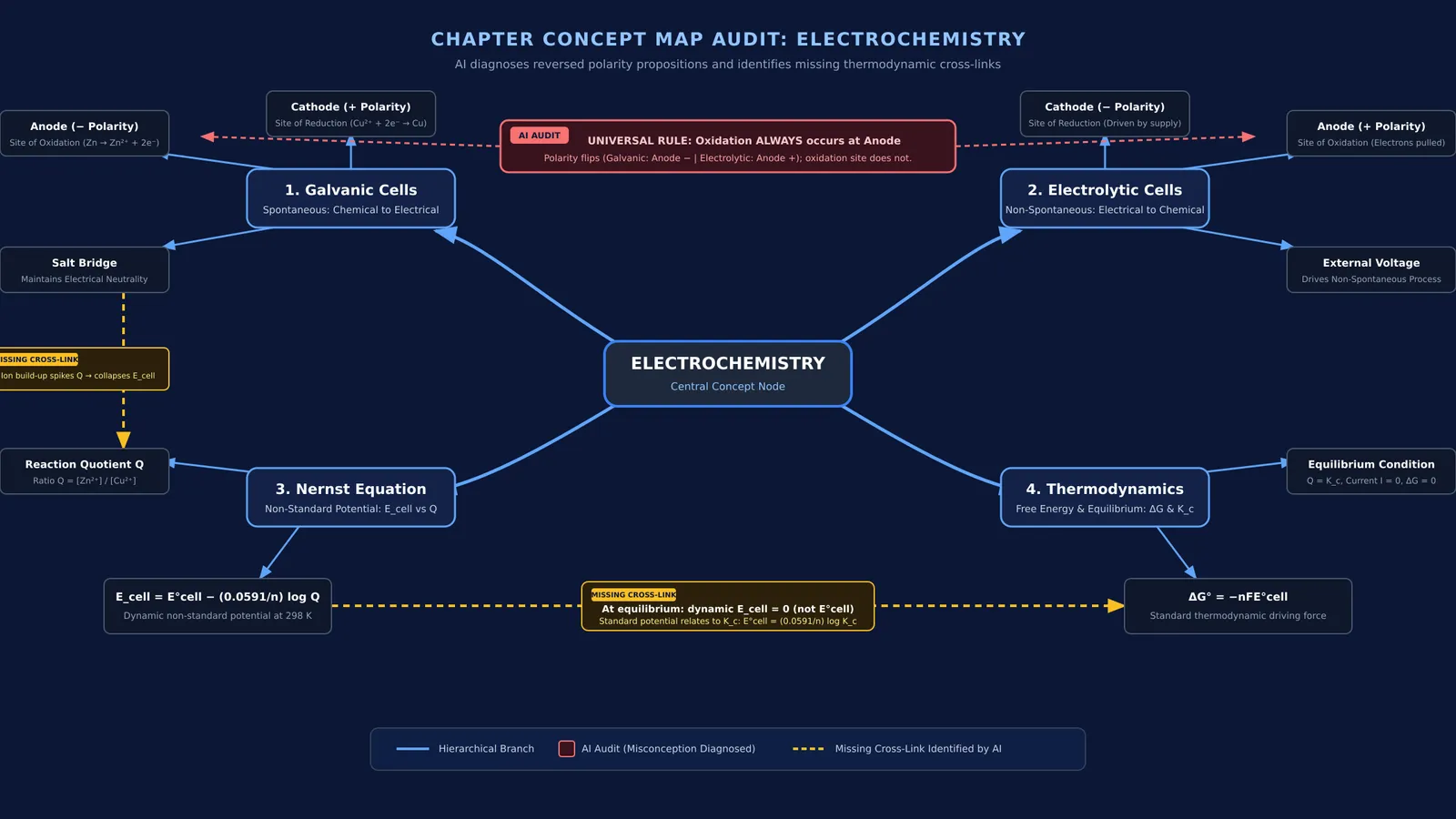
Galvanic Cells: Anode is negative and oxidizes; Cathode is positive and reduces; Salt bridge maintains neutrality.
Electrolytic Cells: External voltage drives non-spontaneous reaction; Anode is positive; Cathode is negative.
Nernst Equation: Calculates cell potential E_cell = E°cell − (0.0591/n) log Q at 298 K.
Thermodynamics: Standard Gibbs energy ΔG° = −nFE°cell; At equilibrium, reaction stops.
Which links are scientifically wrong or ambiguous, and which vital cross-links between branches did I miss?"
What does an AI audit look like in electrochemistry?
When an AI tutor reviews the prompt above, it diagnoses three structural weaknesses in your reasoning:
Electrode polarity versus oxidation site: Students often treat "Anode = Negative" as a universal rule. In electrolytic cells, external voltage reverses polarities: the anode is positive and the cathode is negative. If your map does not explicitly state that oxidation always occurs at the anode regardless of cell type, you will mispredict products during competitive electrolysis.
The equilibrium thermodynamic bridge: The student notes that "at equilibrium, reaction stops," but omits potentials. Many mistakenly assume standard potential E°cell drops to zero. The AI catches this error: at equilibrium, dynamic potential E_cell drops to 0 (and ΔG = 0), while standard potential E°cell remains a fixed thermodynamic constant: E°cell = (0.0591 / n) log₁₀ K_c. For standard versus non-standard potential rules, review cell notation and the Nernst equation.
The salt bridge mechanism gap: The draft lists the salt bridge as an isolated component under galvanic cells. The AI connects it to the Nernst equation: without counter-ion migration, Zn²⁺ accumulates at the anode while Cu²⁺ depletes at the cathode. This charge buildup spikes reaction quotient Q, collapsing cell potential to zero. To structure these links from the start, read how to build a concept map for science.
How can an AI tutor test your new connections?
Once your AI tutor identifies these missing bridges, do not just redraw your diagram. Ask the AI to test your updated mental model with targeted questions.
For example: "If I increase zinc ion concentration in a Daniell cell, how does that shift the reaction quotient Q, and what happens to cell potential E_cell and free energy change ΔG?" Answering requires synthesizing separate branches, locking the revised connections into long-term memory.
While conventional chatbots simply return textbook definitions, specialized platforms guide you through reasoning step by step. Fermi's AI tutor works out what you already know, notices where your reasoning is stuck, and decides whether to explain, ask, or show the concept. When visualizing spatial mechanisms—such as ion migration toward electrodes—you can explore the Fermi Simulation Lab to observe transport dynamics in real time. Every concept also connects into the knowledge graph inside the Fermi Concept Library, giving each topic its place in the map.
By replacing passive sketching with active, AI-guided audits, you transform decorative notes into exam-ready mastery. You can also explore our analysis of AI tutors that teach versus chatbots that give answers to see how interactive dialogue deepens retention.


