On this page
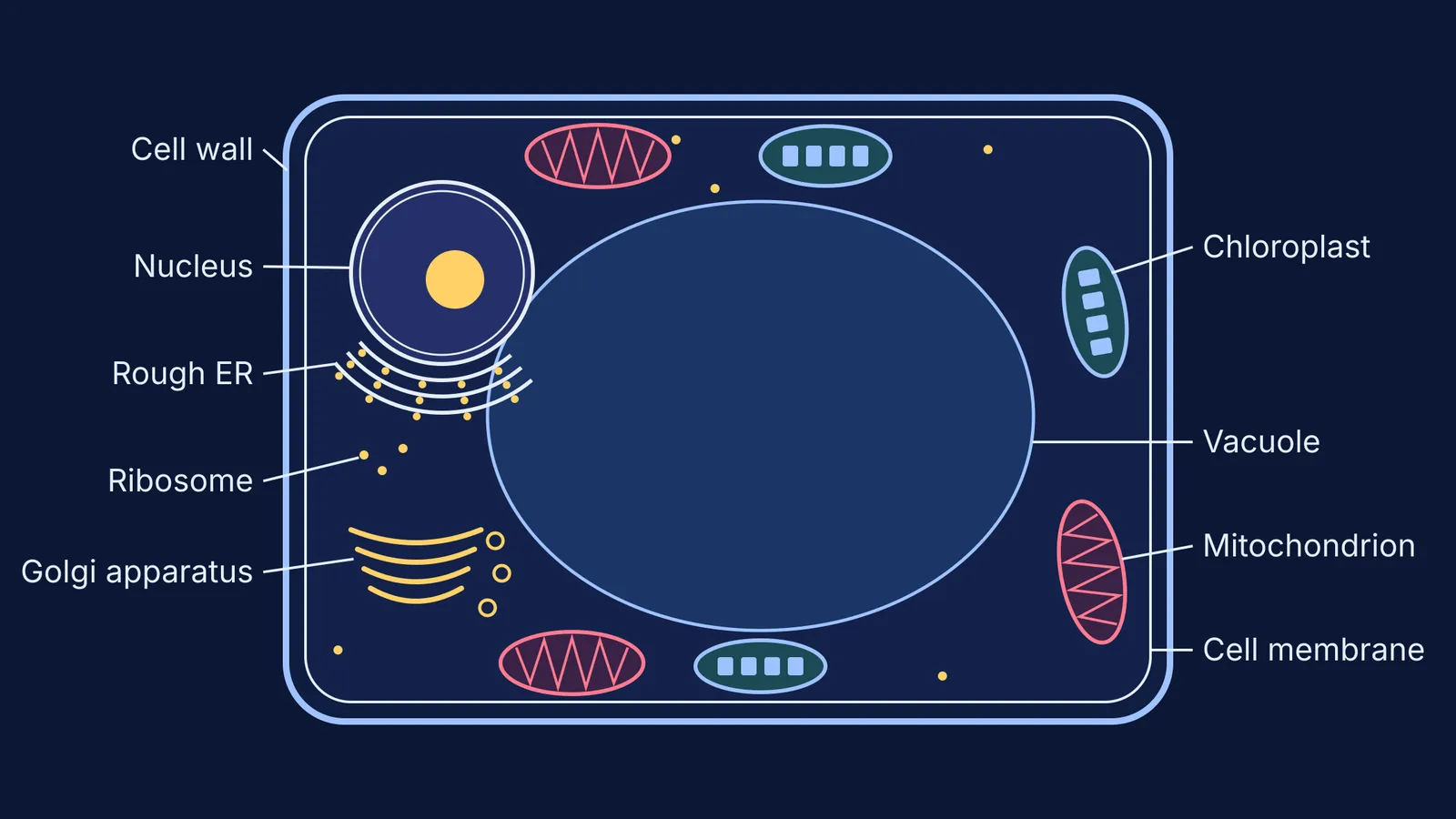
The new NCERT Class 9 science textbook, Exploration, describes the cell as "a tiny living factory, with each of its part doing a specific job" in its chapter Cell: The Building Block of Life. The picture helps you remember the parts, but it hides things examiners ask about. Here is one line per organelle, then each classroom analogy and where it stops being true.
What does each cell organelle do, in one line?
Every line follows the NCERT Class 9 cell chapter; the college textbook OpenStax Biology 2e gives the same functions in more detail.
Cell membrane: a thin, selectively permeable boundary that lets some substances in and out and blocks others.
Cell wall (plants, fungi, bacteria): a rigid outer layer, made mostly of cellulose in plants, that keeps the cell's shape and still lets water through.
Nucleus: holds the chromosomes, whose DNA carries the information passed from parents to offspring.
Nucleolus: the dense round body inside the nucleus where ribosome subunits are made.
Ribosomes: tiny sites of protein synthesis, floating free in the cytoplasm or attached to the ER.
Rough ER: makes and secretes proteins; it looks rough because ribosomes stud its surface.
Smooth ER: makes and stores fats and hormones.
Golgi apparatus: modifies, sorts and packages proteins and lipids into vesicles for transport, secretion or making lysosomes.
Lysosomes: sacs of enzymes that break down unwanted molecules and worn-out parts of the cell.
Mitochondria: break down glucose in cellular respiration and store the released energy as ATP, the cell's energy currency.
Plastids: chloroplasts make food by photosynthesis, chromoplasts colour flowers and fruits, and leucoplasts store starch, oils or proteins.
Vacuoles: store water, minerals, sugars and waste; in a plant cell, one large central vacuole keeps the cell firm.
The ER, Golgi and lysosomes work as one connected system, which we explain in which organelles belong to the endomembrane system.
Which analogies do teachers use, and where do they break down?
In a 1993 case study of a Grade 10 optics class, Allan Harrison and David Treagust point out that analogies "can engender alternative conceptions" when students picture them differently from the teacher (Journal of Research in Science Teaching). Their advice: name the shared features and the unshared ones. Here are the unshared ones, checked against the NCERT chapter.
Nucleus as "house of coded instructions" or "the brain": it stores instructions; it does not think. Mature human red blood cells have no nucleus, yet they carry oxygen and survive about 120 days.
Ribosomes as "protein factories": a factory is a big building, but a ribosome has no membrane at all. Bacteria have no membrane-bound organelles and still have ribosomes.
ER as a "manufacturing factory": the smooth ER makes fats and hormones, not proteins, and the ER is joined to the nuclear envelope rather than standing apart.
Golgi as the "post office": a post office does not change your parcel. The Golgi modifies proteins before sending them, and it also forms lysosomes.
Lysosomes as the "clean-up system": the breakdown products are reused in the cytoplasm, so "recycling" fits better than "dustbin".
Mitochondria as the "powerhouse": the phrase goes back to Philip Siekevitz's 1957 Scientific American article Powerhouse of the Cell. Mitochondria release energy stored in food rather than creating it, and a 2023 paper in Nature Metabolism notes that they "perform dozens of interconnected functions" (Monzel, Enríquez and Picard).
Chloroplast as the cell's "kitchen": only one kind of plastid makes food. Leucoplasts in potato cells store starch and do not carry out photosynthesis.
Cell membrane as a "wall" or "gate": a wall blocks everything, but the membrane is fluid and selective. Our post on cell wall vs cell membrane compares the two.
Vacuole as a "storage tank": a tank holds nothing up, but the vacuole's water pressure keeps a plant cell firm; lose it and the plant wilts.
For the same approach in physics and chemistry, read how to use analogies without picking up misconceptions.
How should you revise cell organelles before a test?
Use a three-column drill.
Fold a page into three columns: organelle, one-line function, where the analogy breaks.
Fill column two from memory, then check it against the list above.
Cover the page and say each line aloud, as if explaining it to a younger cousin.
Fill column three only for rows you got right, and start tomorrow with the rows you missed.
A worked answer to a typical short-answer question, "Why are mitochondria called the powerhouse of the cell?": Mitochondria break down glucose during cellular respiration and store the released energy as ATP, which the cell uses for most activities.
If a row stays blank after two tries, the gap may be in the concept rather than your memory. The Fermi Concept Library gives every biology concept its own lesson and its place in the map, so you can see where the ER, Golgi and lysosomes fit. Fermi's AI tutor can also talk it through, checking your understanding as it goes.
Tonight, try the three columns for just the nucleus, ER and Golgi.