

On this page
The endomembrane system is a coordinated network of organelles in eukaryotic cells that work together to produce, package, and transport proteins and lipids. But which parts of the cell are actually on this assembly line?
According to NCERT Class 11 Biology, an organelle is only part of the endomembrane system if its function is strictly coordinated with the rest of the network (BYJU'S). This rule splits the cell's organelles into two camps: those inside the system, and those outside it.
Which organelles are part of the endomembrane system?
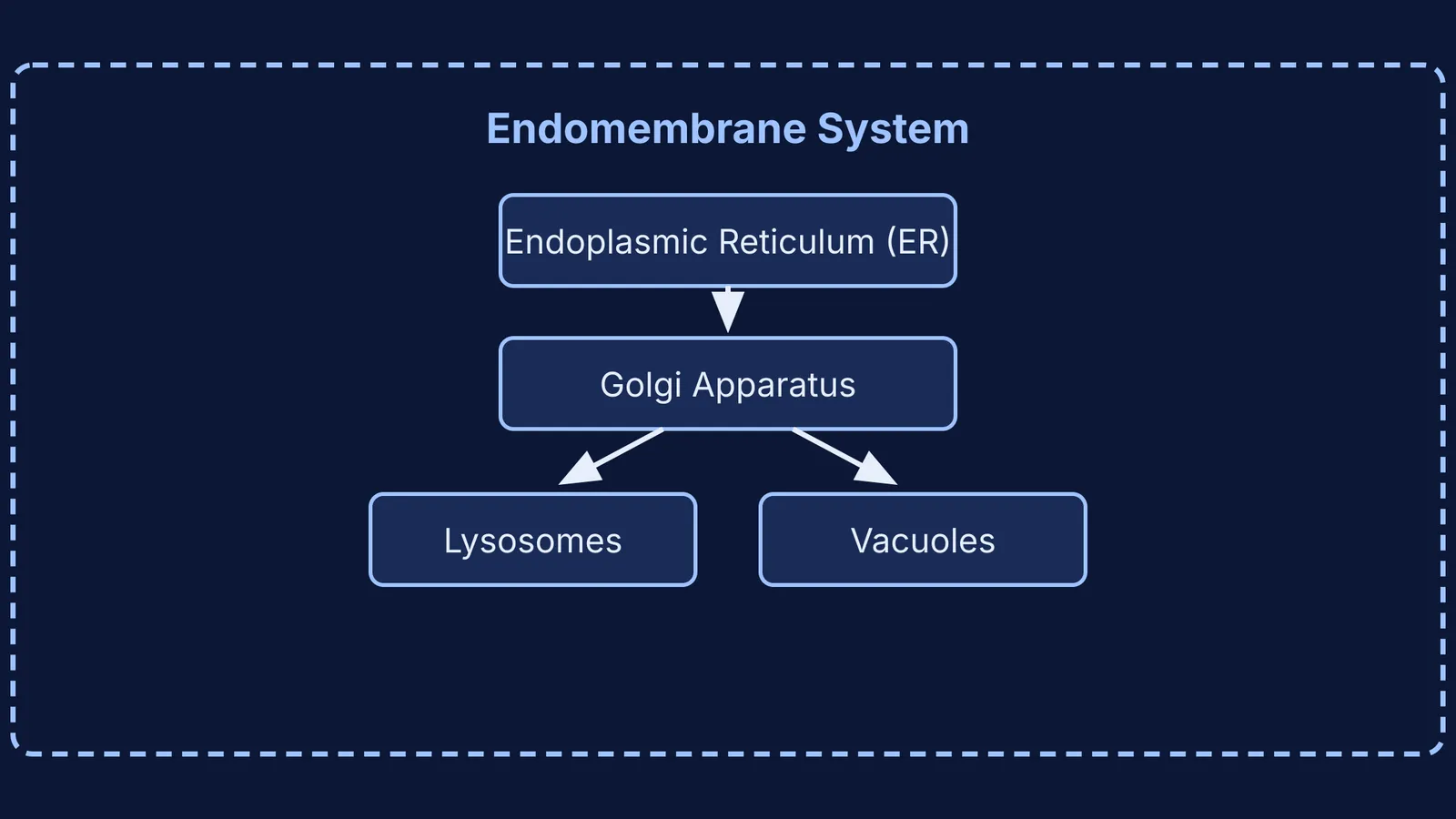
The endomembrane system acts as the cell's manufacturing and shipping department. It includes four main organelles (BYJU'S):
Endoplasmic Reticulum (ER): The starting point. The rough ER synthesises proteins, while the smooth ER handles lipids. (You can read more about the discovery of these protein factories in our post on George Palade and the ribosomes in the cell's protein factory.)
Golgi Complex: The packaging centre. It receives proteins and lipids from the ER, modifies them (for example, by adding sugar chains to make glycoproteins), and packs them into vesicles.
Lysosomes: The waste disposal units. These membrane-bound sacs are pinched off from the Golgi apparatus and contain hydrolytic enzymes to digest cellular waste.
Vacuoles: The storage spaces. Especially prominent in plant cells where they can occupy up to 90% of the volume (BYJU'S), vacuoles store water and sap. Their formation is tied to the ER and Golgi.
Because material flows continuously between these four structures—often carried by transport vesicles—their functions are tightly coordinated.
Why are mitochondria, chloroplasts, and peroxisomes excluded?
It is tempting to think that any organelle with a membrane belongs to the endomembrane system. However, mitochondria, chloroplasts, and peroxisomes are strictly excluded.
Why? Because their functions are not coordinated with the ER and Golgi network.
Mitochondria and Chloroplasts: These are semi-autonomous organelles. They produce their own energy (ATP) and have their own DNA and ribosomes. They do not wait for the Golgi apparatus to send them packages in order to function.
Peroxisomes: While they break down fatty acids and detoxify chemicals, they do not receive their enzymes via vesicles from the Golgi, nor do they participate in the ER-Golgi transport pathway. (Interestingly, peroxisomes do team up with chloroplasts and mitochondria during specific processes, which you can explore in Photorespiration: why RuBisCO wastes energy in C3 plants).
If you find it hard to visualise how these separate systems operate side by side, the Fermi Simulation Lab features interactive simulations for the ideas that are easier to see than to read.
How do you remember the endomembrane system for NEET?
Questions about the endomembrane system appear frequently in exams like NEET, often disguised as "Assertion-Reason" or "Find the incorrect statement" problems.
A common trap is a list of organelles asking you to pick the odd one out. If you see the endoplasmic reticulum, Golgi, lysosomes, and vacuoles grouped together, they form a complete set. If a chloroplast is thrown into the mix, it is the odd one out.
To lock this down, try this simple revision script:
Ask yourself: "Does this organelle share vesicles with the Golgi?"
If yes (like a lysosome), it is in.
If no (like a mitochondrion), it is out.
If you are reviewing the entire chapter on cell biology and want to make sure you have not missed any subtle distinctions, the Fermi Concept Library has every concept in physics, chemistry, biology, mathematics and computing, each with its own lesson and its place in the map. And if you find yourself stuck, Fermi's AI tutor can work out what you already know and build a plan for the session.


