

On this page
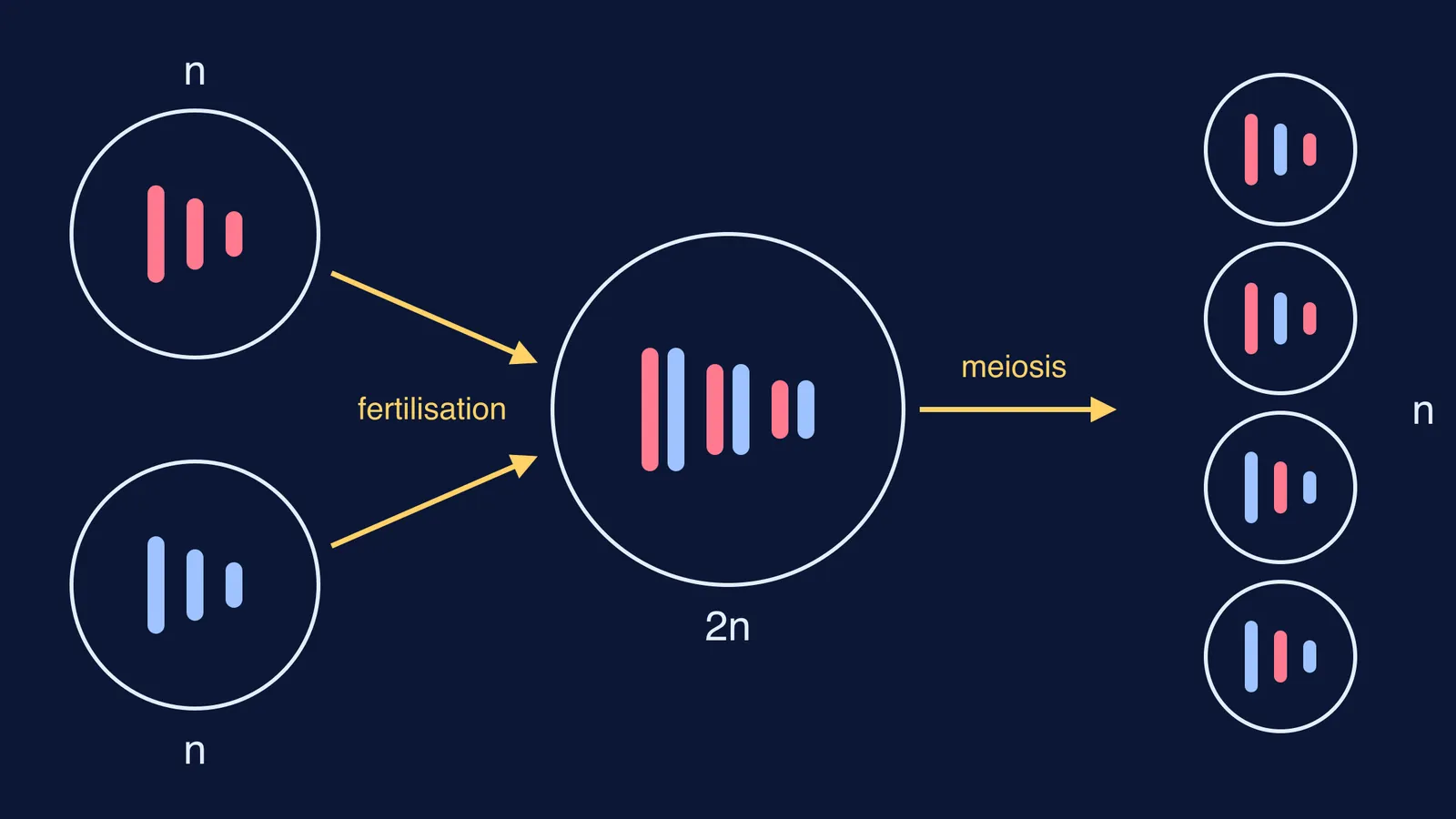
Ploidy questions are easy to get wrong by guessing. You see "synergid" in a question, half-remember, and pick 2n. You don't need a long list to memorise. Count chromosome sets, and track when meiosis halves them and fertilisation adds them back.
What is the difference between haploid and diploid cells?
Haploid means "the presence of a single set of chromosomes in an organism's cells", according to the NHGRI genetics glossary. Diploid means two complete sets, with each parent contributing one chromosome to each pair (NHGRI).
Most human body cells hold 46 chromosomes in 23 pairs: 22 pairs of autosomes and one pair of sex chromosomes (NHGRI). So for humans, n = 23 and 2n = 46. The letter n always stands for the number in one set. It is not "the number in this cell".
Meiosis is "the nuclear division that forms haploid cells from diploid cells", and fertilisation joins two gametes into a zygote with two sets again (OpenStax Biology 2e).
Which human and animal cells are haploid?
Animals have a diploid-dominant life cycle: "the only haploid cells produced by the organism are the gametes" (LibreTexts, Boundless Biology/11%3A_Meiosis_and_Sexual_Reproduction/11.06%3A_Sexual_Reproduction_-_Life_Cycles_of_Sexually_Reproducing_Organisms)). For humans:
Haploid (n = 23): sperm and egg.
Diploid (2n = 46): the zygote, and the body cells that grow from it by mitosis, such as skin, muscle, liver and nerve cells.
Most fungi are the reverse: the zygote, which goes straight into meiosis, is their only diploid stage (same source).
What is the ploidy of pollen, the embryo sac and endosperm?
Plants alternate between two generations. "Diploid sporophytes produce haploid spores by meiosis", and "haploid gametophytes produce gametes by mitosis" (OpenStax). In mosses and other non-vascular plants "the sporophyte stage is barely noticeable", so the gametophyte is the plant you see. In ferns, "the dominant stage of the life cycle of a fern is the sporophyte" (OpenStax). In flowering plants the sporophyte dominates too: the whole tree or herb you see is 2n.
Here is what happens inside a flower, following OpenStax on plant reproductive structure and angiosperms:
Microspore mother cell (2n) divides by meiosis into four microspores (n).
Pollen grain (n) contains two cells, a generative cell and a pollen tube cell.
Megaspore mother cell (2n) undergoes meiosis to make four megaspores (n), and only one survives.
The surviving megaspore divides by mitosis three times, giving eight nuclei in seven cells: the embryo sac.
Egg, two synergids and three antipodal cells are all n. The central cell holds two polar nuclei, each n.
The diploid megasporangium tissue of the ovule (the nucellus) and the integuments, which become the seed coat, belong to the parent plant: 2n.
Then comes double fertilisation. "One sperm fertilizes the egg cell, forming a diploid zygote; the other sperm fuses with the two polar nuclei, forming a triploid cell that develops into the endosperm" (OpenStax). So the zygote and embryo are 2n, and the endosperm is 3n.
For more on each part, see our guide to tracing the ploidy of endosperm, nucellus and the embryo sac.
How do you work out the ploidy of any cell?
Use these four questions, in order:
Whose tissue is it? Anything the parent builds around the gametophyte, such as the nucellus, integuments, seed coat or ovary wall, has the parent's ploidy.
Was it made by meiosis? Then it has half the chromosomes of the cell that divided.
Was it made by mitosis? Then it has the same ploidy as the cell it came from. That is why every nucleus in the embryo sac is n.
Was it made by fusion? Add up the sets that fused.
Worked example: a plant with 2n = 24. Say a flowering plant's leaf cells have 24 chromosomes. Then:
Megaspore mother cell: 24 (it is parent tissue, not yet divided).
Megaspore, egg, synergid, antipodal cell, each polar nucleus: 12 (after meiosis, then only mitosis).
Pollen generative cell and the two sperm it makes: 12.
Zygote and embryo: 12 + 12 = 24.
Endosperm: 12 + 12 + 12 = 36.
Nucellus and seed coat: 24 (the parent plant's own tissue).
Once you can trace sets, you can also read changes in them. Our explainers on how meiosis halves chromosomes and creates variation and on aneuploidy versus polyploidy take the next step.
If a step here still feels shaky, the Fermi Concept Library has every biology concept with its own lesson and its place in the map, so you can look up meiosis, the embryo sac and double fertilisation in one place. To practise the counting, the Fermi Problem Library has worked problems with a step-by-step solver that explains the reasoning rather than printing an answer.
Try the 2n = 24 example again with 2n = 16. If your endosperm comes out at 24, you've got it.


