

On this page
Every human cell—except for gametes (sperm and egg cells)—carries 23 chromosome pairs. If a gamete brought all 46 chromosomes to fertilisation, the resulting child would have 92 chromosomes. The next generation would have 184. To prevent this unsustainable doubling, sexually reproducing organisms rely on a specialised form of cell division: meiosis.
Meiosis serves two foundational purposes in biology. First, it halves the chromosome number across generations. Second, it shuffles the genetic deck, ensuring that no two offspring (barring identical twins) are genetically identical.
How does meiosis halve the chromosome number?
Meiosis is often called a "reductional division" because it reduces a diploid cell (with two complete sets of chromosomes) into four haploid cells (with one set each).
Before meiosis begins, the cell undergoes interphase, duplicating its DNA so that each chromosome consists of two identical sister chromatids attached at a centromere. The cell then enters two distinct division phases:
Meiosis I: During Anaphase I, the homologous chromosomes—the matched pairs inherited from each parent—are pulled apart into two different nuclei. The sister chromatids remain tightly bound together. This is the crucial step where the chromosome count is officially halved from diploid to haploid.
Meiosis II: Without copying its DNA again, the cell divides a second time. During Anaphase II, the sister chromatids separate into individual chromosomes, much like they do in a standard mitotic division.
The final result is four haploid daughter cells. When two haploid gametes fuse during fertilisation, the stable diploid chromosome number is immediately restored.
How does meiosis create genetic variation?
If meiosis only separated chromosomes, siblings would still look much more similar than they do. The immense diversity within a species comes from two genetic shuffling mechanisms that both occur during Meiosis I.
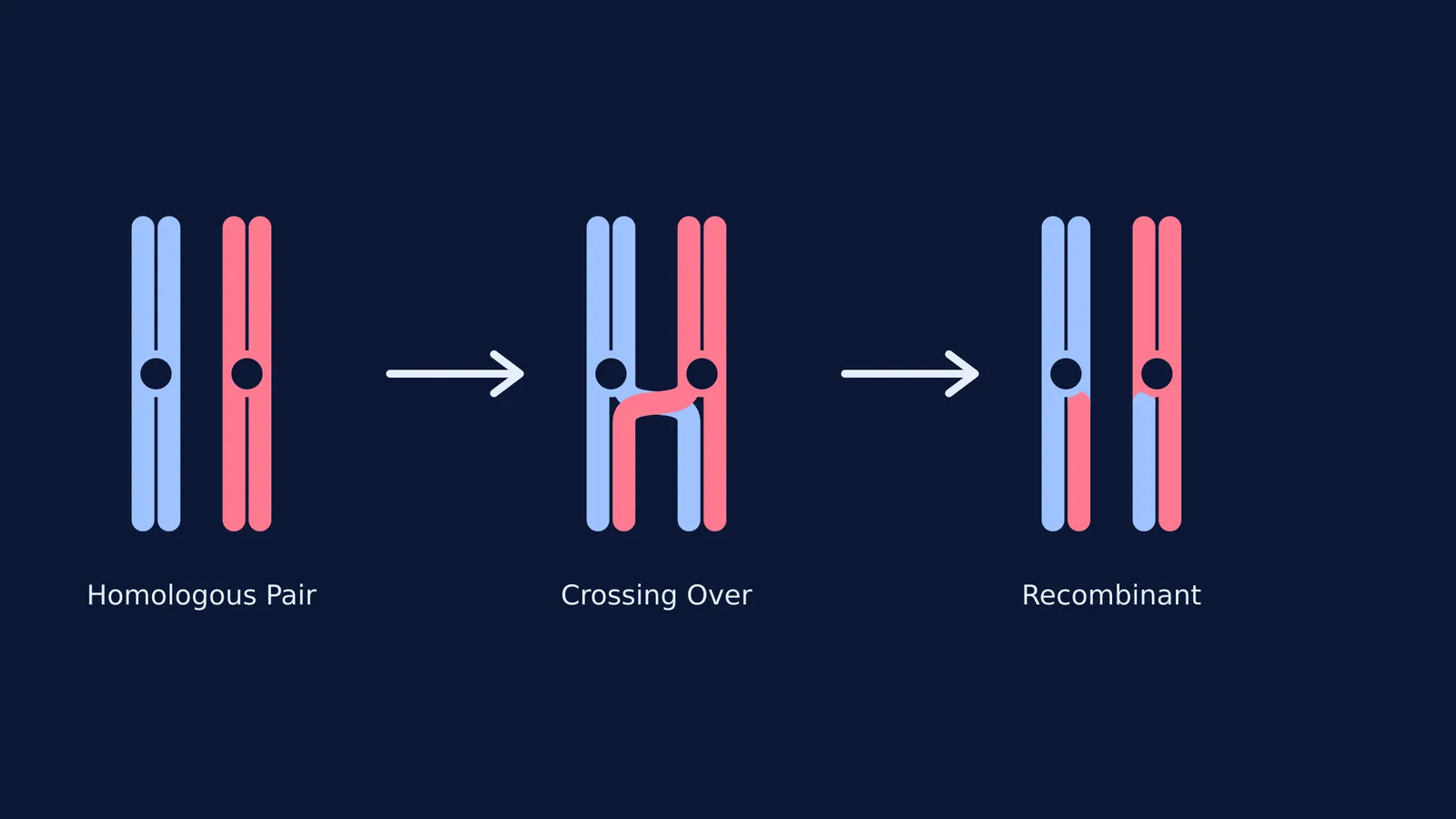
Crossing Over (Prophase I) As homologous chromosomes pair up tightly (synapsis), they are held together by a protein lattice. During this time, non-sister chromatids physically break and swap segments of DNA at points known as chiasmata. This exchange creates recombinant chromosomes that carry completely new combinations of maternal and paternal genes. For proper chromosome separation to occur, there must be at least one chiasma per chromosome, but there may be as many as 25 depending on the species and chromosome length.
Independent Assortment (Metaphase I) Once crossing over is complete, the paired homologous chromosomes line up along the cell's equator during Metaphase I. The orientation of each pair is entirely random. A maternally inherited chromosome has an equal chance of facing either pole, and its orientation does not affect how any other chromosome pair aligns. Because human cells contain 23 pairs of chromosomes, they can line up in a staggering number of unique arrangements.
Why is genetic variation significant?
The genetic variation introduced by meiosis is vital for survival. By constantly creating unique genotypes, meiosis ensures that a population contains diverse traits. This diversity gives a species a reproductive edge over close competitors, predators, or parasites. Evolutionary biologists often describe this arms race using the Red Queen hypothesis, which suggests that species must constantly adapt and evolve simply to maintain their current ecological standing against coevolving threats.
If a population relied solely on asexual reproduction and produced genetically identical clones, a single newly adapted pathogen could potentially wipe out the entire group. Because meiosis shuffles the genetic deck every generation, it increases the likelihood that at least some individuals will possess the unique traits necessary to survive a new biological challenge. This continuous generation of variation explains why sexual reproduction remains so essential and widespread across the natural world.
If you want to review the stages of cell division, visualise how chromosomes move, or practice predicting the outcomes of genetic crosses, the Fermi Concept Library explains the mechanics of meiosis and links them directly to Mendelian genetics.
Understanding meiosis gives you the foundation to explore Cell cycle, mitosis and meiosis: stages and chromosome counts, and to see the history behind Sutton, Boveri and how chromosomes explained Mendel's laws.


