

On this page
Chromosomes carry the genetic code, and their numbers must be carefully preserved during cell division. However, errors sometimes occur, leading to cells with an abnormal number of chromosomes. These errors fall into two main categories: aneuploidy and polyploidy. While both change the amount of genetic material in a cell, they happen in different ways and have very different effects.
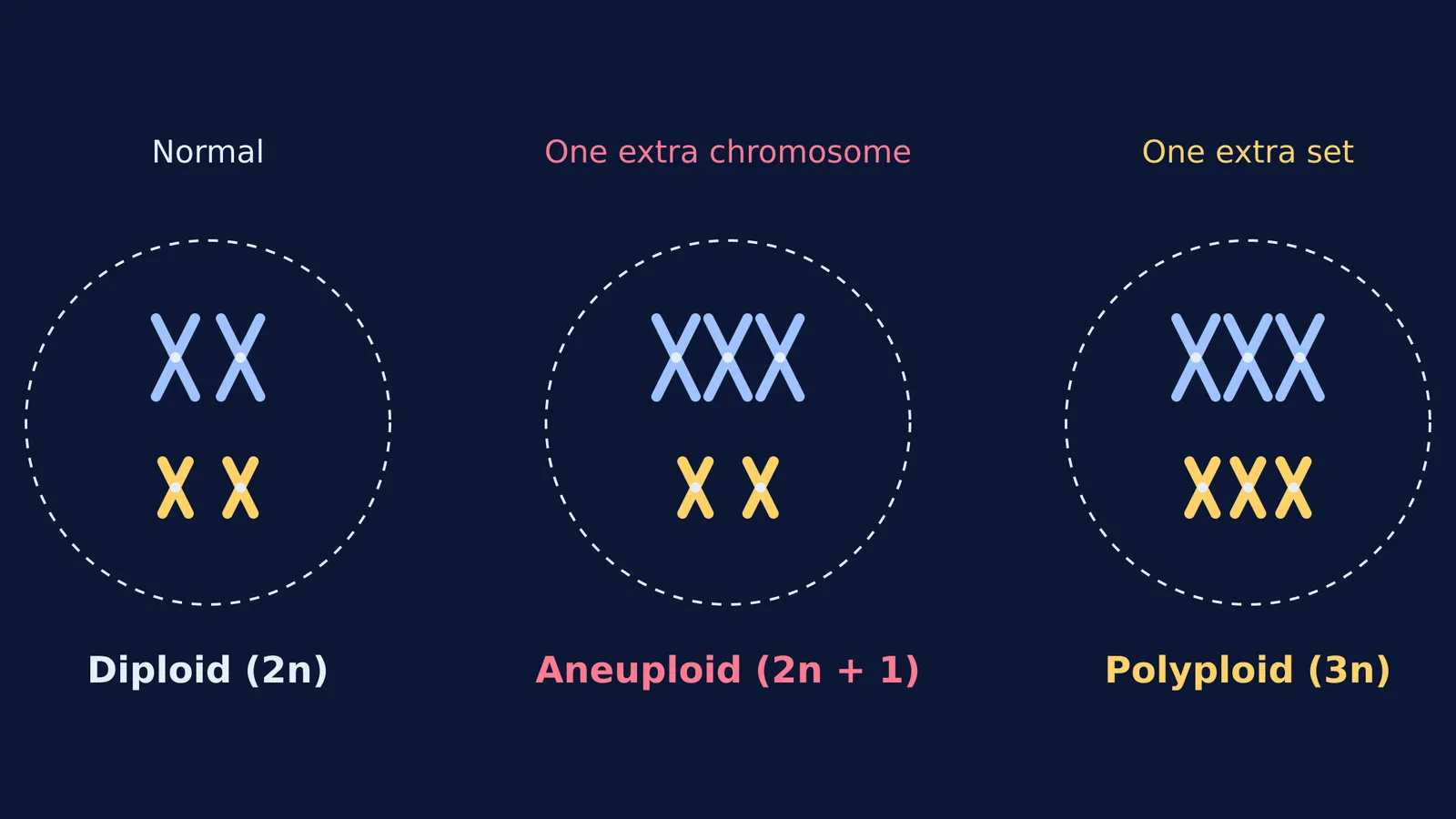
Aneuploidy is the gain or loss of one or a few single chromosomes, leaving the cell with an irregular number like 45 or 47 instead of the usual 46. Polyploidy, on the other hand, is the gain of one or more complete sets of chromosomes, changing the cell from diploid (2n) to triploid (3n), tetraploid (4n) or higher (Wikipedia).
What causes aneuploidy?
Aneuploidy originates during cell division when chromosomes or sister chromatids fail to separate properly, a mistake known as nondisjunction (Wikipedia). When this happens, one daughter cell receives an extra chromosome, and the other misses out.
If a gamete with an extra chromosome joins a normal gamete, the resulting zygote will have three copies of that chromosome instead of two. This condition is called trisomy. The most common extra autosomal chromosomes among live human births are 21, 18 and 13 (Wikipedia). Trisomy 21, for instance, results in Down syndrome. Conversely, if a gamete missing a chromosome fuses with a normal one, the zygote has only one copy, a condition known as monosomy. Turner syndrome, where a female has only one X chromosome, is a classic example of monosomy.
Chromosome abnormalities such as aneuploidy are detected in roughly 1 of 160 live human births (Wikipedia). Aneuploidy is also frequently found in cancer: about 68% of human solid tumours are aneuploid, reflecting a breakdown in their cell division controls.
If you are working through genetics problems involving inheritance and nondisjunction, you can review the rules of segregation in Sutton, Boveri and how chromosomes explained Mendel's laws.
How does polyploidy happen?
While aneuploidy involves isolated mistakes with individual chromosomes, polyploidy scales up the entire genome. Polyploidy is the result of a whole-genome duplication. This typically occurs through a failure of cytokinesis.
Cytokinesis is the final stage of cell division, where the cytoplasm splits to form two separate daughter cells (Wikipedia). If a cell successfully copies its DNA and separates its chromosomes during mitosis or meiosis (up to telophase) but then fails to divide its cytoplasm, the cell is left with twice the normal number of chromosome sets.
Polyploidy is relatively rare in animals because a massive change in gene dosage usually disrupts animal development. However, it is especially common in plants. Many crops we eat are polyploid. Because triploid plants have an odd number of chromosome sets, they cannot pair them up evenly during meiosis, which makes them seedless and sterile. This is why commercial bananas and seedless watermelons do not produce seeds.
What is the difference between aneuploidy and polyploidy?
To quickly tell them apart, remember:
Scope: Aneuploidy changes the count by one or two chromosomes (e.g., 2n + 1 or 2n - 1). Polyploidy multiplies the entire set (e.g., 3n, 4n).
Mechanism: Aneuploidy is driven by nondisjunction (failed chromosome segregation). Polyploidy is often driven by a failure of cytokinesis.
Occurrence: Aneuploidy happens in humans and causes genetic disorders or occurs in tumours. Polyploidy is a major driver of plant evolution and crop breeding.
Exam checklist: How do you identify the mutation?
When reading a multiple-choice question in an exam, use this mental checklist to decide if a mutation is aneuploidy or polyploidy:
Count the chromosomes: Does the question describe a change of +1 or -1 (like 47 or 45 in humans)? If yes, it is aneuploidy. Does it describe a multiple of the base number (like 69 or 92 in humans)? If yes, it is polyploidy.
Look for the mechanism: If the prompt mentions "nondisjunction" or "chromatids failed to segregate during anaphase", it points to aneuploidy. If the prompt mentions "failure of cytokinesis" or "colchicine treatment" (which stops cell division), it points to polyploidy.
Check the organism: Questions about human genetic disorders (Down syndrome, Klinefelter syndrome) are almost always testing aneuploidy. Questions about plant breeding (creating larger fruit or seedless varieties) usually test polyploidy.
If you are studying these mechanisms, you can explore lessons on cell division and chromosomal disorders in the Fermi Concept Library. By tracing how chromosomes align and separate, you can understand exactly where nondisjunction or failed cytokinesis alters the final count. You can also explore how these chromosomes are physically structured in Chromosome types by centromere position.


