On this page
Every point on the yz-plane has x = 0. So to find the ratio in which it divides AB, write the section point with a ratio k : 1, set its x-coordinate to zero, and solve for k. It is examinable: the JEE Main 2027 syllabus published by NTA lists "section formula" in Unit 11, Three Dimensional Geometry.
What is the section formula in 3D?
If P divides AB in the ratio m : n, then P = ((mx₂ + nx₁)/(m + n), (my₂ + ny₁)/(m + n), (mz₂ + nz₁)/(m + n)), the 2D formula with a z-coordinate added (Section formula, Wikipedia). Our explainer on the section formula in 3D for internal and external division covers the derivation.
For plane questions, use k : 1 instead of m : n. One unknown is easier than two, and the sign of k tells you the type of division. The section point becomes P = ((kx₂ + x₁)/(k + 1), (ky₂ + y₁)/(k + 1), (kz₂ + z₁)/(k + 1)).
How do you find the ratio in which the yz-plane divides a line segment?
Write P with the ratio k : 1.
Set its x-coordinate to zero: (kx₂ + x₁)/(k + 1) = 0.
Multiply by k + 1: kx₂ + x₁ = 0, so k = −x₁/x₂.
Read the sign: k > 0 is internal division, k < 0 is external.
For the point itself, put k into the y and z coordinates.
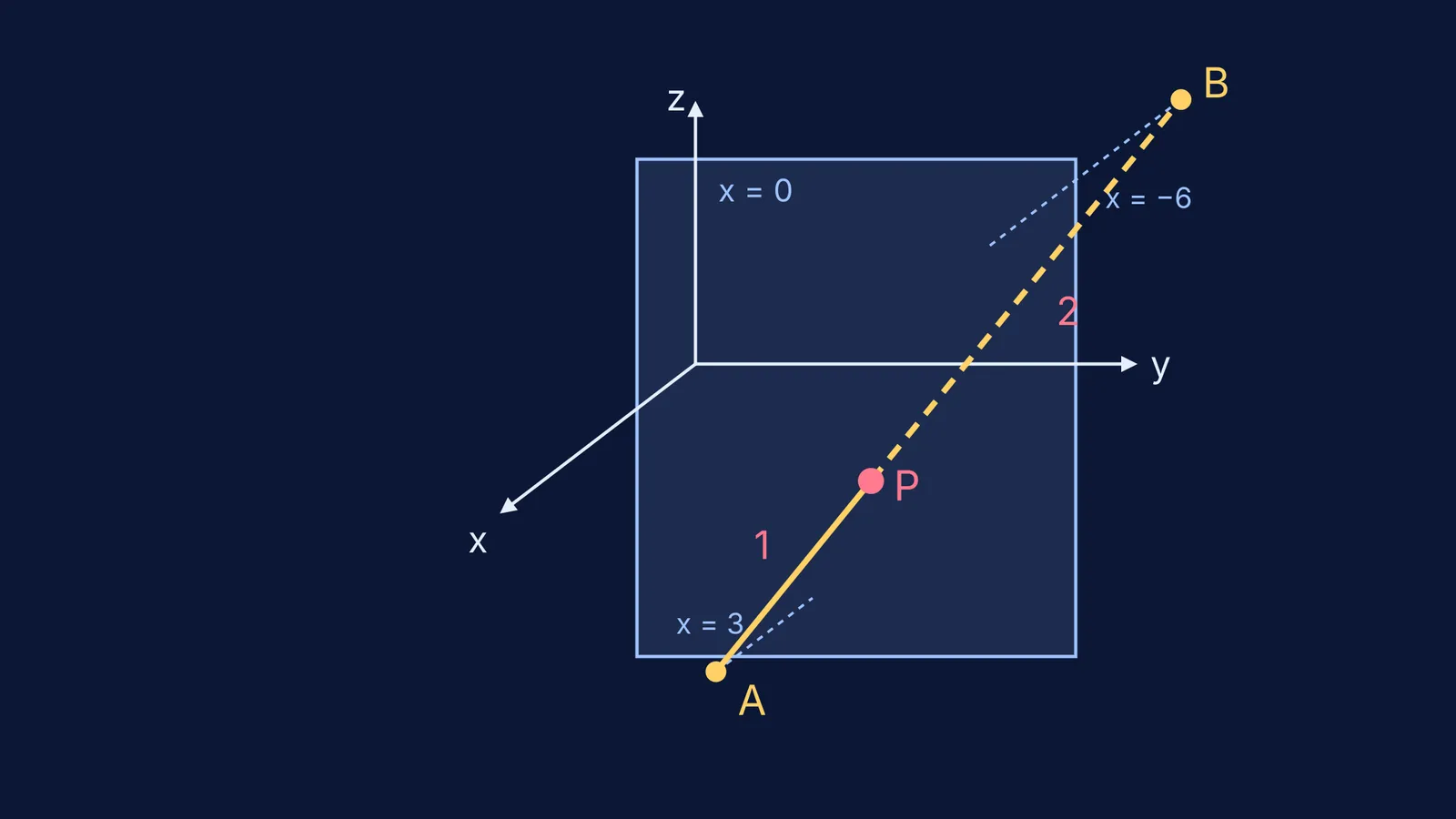
Worked example: take A(3, 2, −4) and B(−6, 5, 2). Set (−6k + 3)/(k + 1) = 0, so k = 1/2. The ratio 1/2 : 1 is 1 : 2, internally.
The point: y = (5 × 1/2 + 2)/(3/2) = 3 and z = (2 × 1/2 − 4)/(3/2) = −2, so P = (0, 3, −2).
Check: P − A = (−3, 1, 2) and B − P = (−6, 2, 4), exactly twice P − A. So AP : PB = 1 : 2.
The classic textbook version, A(−2, 4, 7) and B(3, −5, 8), gives (3k − 2)/(k + 1) = 0, so k = 2/3 and the ratio is 2 : 3 (full solution on Teachoo).
What does a negative ratio mean?
Take A(2, 1, 3) and B(4, −1, 5). Setting (4k + 2)/(k + 1) = 0 gives k = −1/2. Both points have positive x, so they lie on the same side of the yz-plane and the segment never touches it. The line through them meets the plane outside the segment, at P = (0, 3, 1), dividing AB externally in the ratio 1 : 2.
You can predict this before solving. If x₁ and x₂ have opposite signs, the division is internal; the same sign means external. If your answer disagrees, recheck your algebra.
Which special cases trip students up?
x₁ = 0: A lies on the plane, so k = 0.
x₂ = 0: B lies on the plane, and no finite k works.
x₁ = x₂ ≠ 0: AB is parallel to the plane. You get k = −1, which makes k + 1 = 0, so they never meet.
x₁ = x₂ = 0: the whole segment lies in the plane.
For any plane ax + by + cz + d = 0, substitute the k : 1 point into its equation instead; see where a line meets a plane, using the λ method. The 2D version is the k:1 method for the ratio in which the x-axis divides a segment.
The ten-second check matters. NTA's JEE Main 2027 Information Bulletin gives +4 for a correct answer and −1 for an incorrect one, in both multiple-choice and numerical-value questions.
How can you practise it?
A(4, −1, 2) and B(−2, 3, 5): the yz-plane ratio and point.
A(1, 2, 3) and B(4, 5, −6): the xy-plane ratio and point.
A(−3, 1, 2) and B(−1, 4, 0): the yz-plane ratio and point.
If your sign keeps coming out wrong, the Fermi Problem Library has worked problems with a step-by-step solver that explains the reasoning rather than printing an answer, so you can find the line where it flipped. If the gap is in coordinates in space or planes, the Fermi Concept Library has a lesson for each concept.
Next time: write k : 1, set one coordinate to zero, and check the signs.