

On this page
Class 11 maths takes coordinate geometry off the page and into space in NCERT's Chapter 11, Introduction to Three Dimensional Geometry. Two ideas come up again and again in its examples and exercises: the octant sign pattern, and the distance formula you use to prove points collinear or a triangle right-angled. If you know the distance and section formulae from Class 10 coordinate geometry, you only need to carry one extra coordinate.
What are the eight octants and their signs?
In the NCERT chapter, the three coordinate planes (XY, YZ and ZX) divide space into eight parts called octants, numbered I to VIII. The signs of a point's coordinates tell you its octant, following Table 11.1 of the chapter:
Octant I: (+, +, +)
Octant II: (−, +, +)
Octant III: (−, −, +)
Octant IV: (+, −, +)
Octant V: (+, +, −)
Octant VI: (−, +, −)
Octant VII: (−, −, −)
Octant VIII: (+, −, −)
The pattern is easier to remember than the list. Octants I to IV follow the four quadrants of the xy-plane in the usual order, with z positive. Octants V to VIII sit directly below them, in the same order, with z negative. NCERT's Example 2 shows this: (−3, 1, 2) lies in octant II and (−3, 1, −2) lies in octant VI.
Check for zeros first: a point such as (0, 4, −2) lies on the YZ-plane, not inside any octant.
How do you find the distance between two points in 3D?
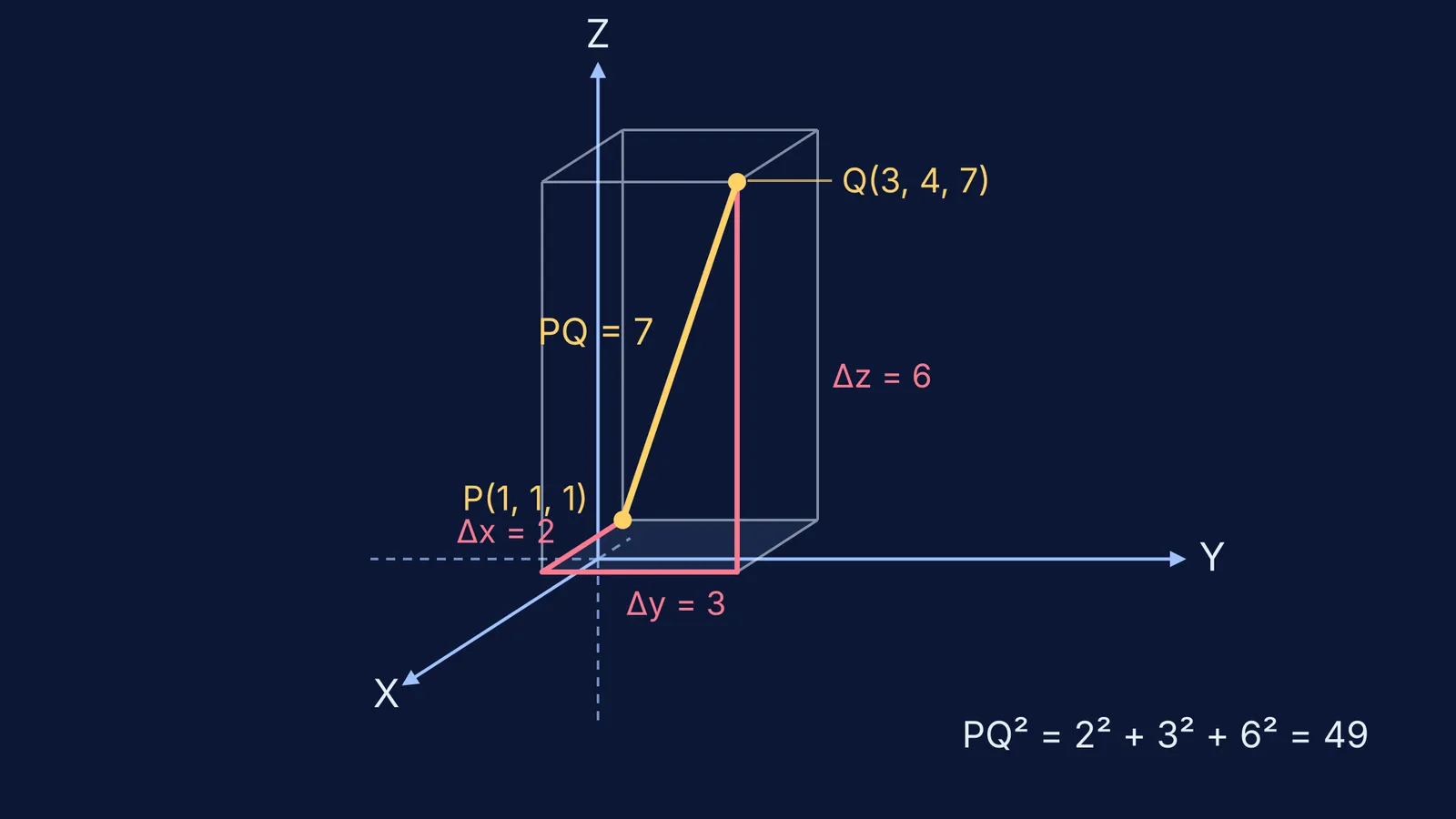
For P(x₁, y₁, z₁) and Q(x₂, y₂, z₂), the NCERT chapter gives PQ = √[(x₂ − x₁)² + (y₂ − y₁)² + (z₂ − z₁)²]. The proof makes PQ the diagonal of a box with edges parallel to the axes, then uses Pythagoras twice: once across the base, once up the vertical edge.
Take P(1, 1, 1) and Q(3, 4, 7), the box in the diagram above. The differences are 2, 3 and 6, so PQ = √(4 + 9 + 36) = √49 = 7.
Signs only matter when you subtract. For P(2, −1, 3) in octant IV and Q(−1, 3, 3) in octant II, the differences are −1 − 2 = −3, then 3 − (−1) = 4, then 0. So PQ = √(9 + 16 + 0) = 5. A common slip is writing 3 − 1 instead of 3 − (−1).
How do you show three points are collinear in 3D?
Work out all three distances. If the largest equals the sum of the other two, the points lie on one line. This is the method of NCERT's Example 4, which uses P(−2, 3, 5), Q(1, 2, 3) and R(7, 0, −1). Try it on a fresh set: A(1, 2, 3), B(3, 5, 9) and C(7, 11, 21).
AB = √(2² + 3² + 6²) = √49 = 7
BC = √(4² + 6² + 12²) = √196 = 14
AC = √(6² + 9² + 18²) = √441 = 21
Since 7 + 14 = 21, the points A, B and C are collinear, with B between A and C. The vector test for collinear points reaches the same answer with position vectors.
How do you prove three points form a right triangle?
Work in squared distances, with no square roots. If the largest square equals the sum of the other two, the right angle sits opposite the longest side.
Take P(1, 1, 1), Q(3, 2, 3) and R(3, −1, 0).
PQ² = 2² + 1² + 2² = 9
PR² = 2² + (−2)² + (−1)² = 9
QR² = 0² + (−3)² + (−3)² = 18
Since 9 + 9 = 18, the triangle has a right angle at P. PQ = PR, so it is also isosceles. In NCERT's Example 5, A(3, 6, 9), B(10, 20, 30) and C(25, −41, 5) give AB² = 686, BC² = 4571 and CA² = 2709, and 686 + 2709 is not 4571, so ABC is not a right triangle.
A checklist for 3D distance questions
Write the three differences in a column, with brackets around every negative coordinate.
Square, add, then simplify the surd before comparing anything.
Collinear: the largest distance equals the sum of the other two.
Right triangle: the largest squared distance equals the sum of the other two squares.
Octant: look for zeros first, then read the signs. The sign of z separates I to IV from V to VIII.
Next, the section formula in 3D divides a segment in a given ratio. If a step keeps going wrong, the Fermi Problem Library has worked problems with a step-by-step solver that explains the reasoning rather than printing an answer. To revise octants and coordinate planes with the rest of the topic, the Fermi Concept Library gives each mathematics concept its own lesson.
For practice, NCERT's Exercise 11.2 covers distances between pairs of points, a collinearity proof, isosceles and right-triangle checks, a parallelogram and two locus questions.


