On this page
Straight Lines is Chapter 9 of the current NCERT Class 11 Mathematics textbook, marked Reprint 2026-27. Here is what CBSE 2026-27 keeps, how the marks work, and worked examples.
Preparing for JEE Main too? Our Straight Lines guide for JEE Main follows the NTA syllabus. This post sticks to the school paper.
What does Straight Lines cover in Class 11 for 2026-27?
The CBSE 2026-27 Mathematics curriculum lists a recall of two-dimensional geometry, slope and angle between two lines, five forms of a line's equation, and the distance from a point to a line. The rationalised NCERT chapter follows that order:
Slope. m = tan θ, where θ ≠ 90° is the angle with the positive x-axis; through two points, m = (y₂ − y₁)/(x₂ − x₁).
Parallel and perpendicular. m₁ = m₂, or m₁m₂ = −1, for non-vertical lines.
Angle between lines. tan θ = |(m₂ − m₁)/(1 + m₁m₂)| gives the acute angle, with 1 + m₁m₂ ≠ 0.
Forms. Parallel to an axis (y = a, x = b), point-slope, slope-intercept (y = mx + c), two-point and intercept (x/a + y/b = 1).
Distance. From (x₁, y₁) to Ax + By + C = 0, d = |Ax₁ + By₁ + C|/√(A² + B²). NCERT extends it to two parallel lines.
How many marks is Straight Lines worth in Class 11?
Marks are printed per unit, not per chapter. Straight Lines sits in Unit III, Coordinate Geometry, which carries 12 of the 80 theory marks, plus 20 for internal assessment (CBSE curriculum, Class XI course structure). Conic Sections and Introduction to Three-dimensional Geometry share them. Under the table it adds: "No chapter/unit-wise weightage. Care to be taken to cover all the chapters."
How do you solve a Straight Lines question step by step?
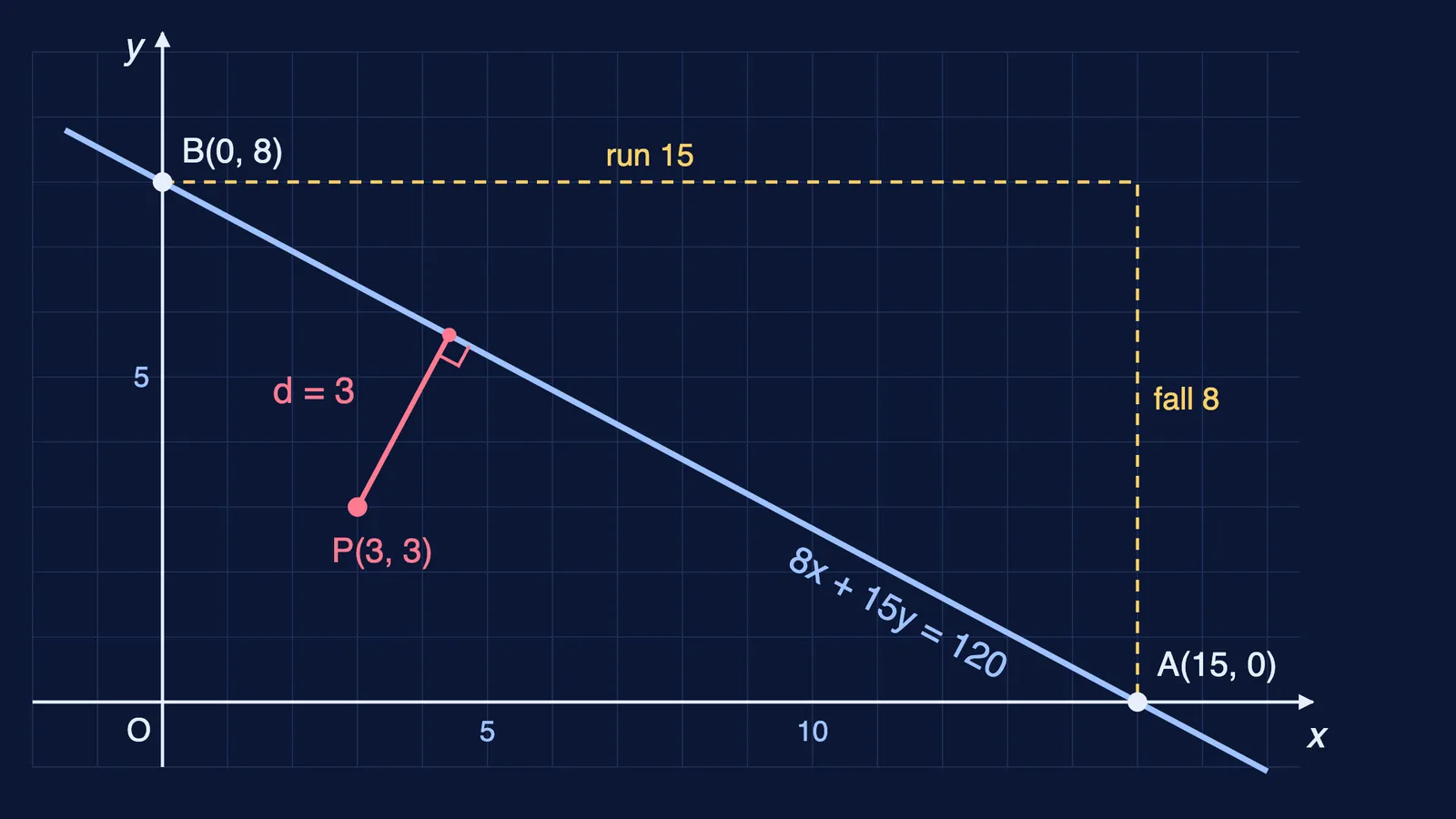
Our own numbers, checked by hand and by program; the diagram above draws Example 1 to scale. Mark splits are our suggestion, not CBSE's.
Example 1. A line meets the axes at A(15, 0) and B(0, 8). Find its equation, its distance from P(3, 3), and the perpendicular through P.
Slope: m = (8 − 0)/(0 − 15) = −8/15. [1 mark]
Intercept form: x/15 + y/8 = 1. So 8x + 15y − 120 = 0, or y = −(8/15)x + 8. [1 mark]
Distance: d = |8(3) + 15(3) − 120|/√(8² + 15²) = |−51|/17 = 3. [1 mark]
Perpendicular slope 15/8, since (−8/15)(15/8) = −1: y − 3 = (15/8)(x − 3), so 15x − 8y − 21 = 0. [2 marks]
Check: the lines meet at (75/17, 96/17), exactly 3 from P.
Example 2. Find the acute angle between y = 3x + 2 and y = −2x + 5.
m₁ = 3 and m₂ = −2, so tan θ = |(−2 − 3)/(1 + 3(−2))| = |(−5)/(−5)| = 1, and θ = 45°. [2 marks]
Check: the inclinations are about 71.6° (tan⁻¹ 3) and 116.6° (180° − tan⁻¹ 2), which differ by 45°.
Need a slower start? Read slope of a line through two points and point-slope and two-point form.
What questions can you practise for the school exam?
We wrote these. The mark labels are our suggestion; your school's paper may differ.
Find the slope of the line through (−4, 1) and (2, 4). [1 mark]
Using slopes, show that (−2, −5), (1, 1) and (4, 7) are collinear. [2 marks]
Find the equation of the line with intercepts 6 and −4 on the x- and y-axes. [2 marks]
Find the distance of (−2, 3) from the line 7x − 24y + 36 = 0. [2 marks]
Write the equation of the line passing through (2, −3) that is perpendicular to the segment joining (1, 4) and (5, 2). [3 marks]
Find the acute angle between y = x + 4 and y = (2 + √3)x − 1. [3 marks]
For the triangle A(1, 1), B(7, 3), C(3, 9), find the equation of BC, the length of the altitude from A, and the area of the triangle. [5 marks]
Answers: 1) 1/2. 2) Both slopes are 2. 3) 2x − 3y − 12 = 0. 4) |−50|/25 = 2. 5) 2x − y − 7 = 0. 6) 30°, since tan 75° = 2 + √3 and 75° − 45° = 30°. 7) 3x + 2y − 27 = 0; 22/√13; 22 square units.
How should you revise it before a test?
Write the slope, angle and distance formulas from memory.
Write one line in every listed form.
Redo Example 1 with your own point and check the distance a second way.
Not sure where to begin? Fermi's AI tutor can work out what you already know and build a plan for the session, so you start with a clear next step.