

On this page
A lot of Class 11 coordinate geometry comes down to one small job: writing the equation of a line from a point and a slope, or from two points. Both rest on the same idea, and both can be checked by substitution. That check catches sign slips.
What is the point-slope form of a line?
The point-slope form says that the line with slope m through the point (x₀, y₀) is y − y₀ = m(x − x₀) (NCERT Class 11 Mathematics, Chapter 9, section 9.3.2).
It comes straight from the meaning of slope. For any other point (x, y) on the line, (y − y₀)/(x − x₀) must equal m. Multiply both sides by (x − x₀) and you have the formula.
The same section makes the point that matters most for checking: a point lies on the line if and only if its coordinates satisfy the equation. If a given point does not fit your equation, your equation is wrong.
Worked example 1: a point and a slope
Find the line through (2, −1) with slope 3.
Write the form: y − (−1) = 3(x − 2).
Tidy it: y + 1 = 3x − 6, so y = 3x − 7, or 3x − y − 7 = 0.
Check the point: put x = 2 in, and y = 6 − 7 = −1. It matches.
Check the slope: put x = 3 in, and y = 2. Going from (2, −1) to (3, 2), y goes up by 3 while x goes up by 1, so the slope is 3. It matches. Step 3 alone proves only that the line passes through the point.
How do you find the equation of a line through two points?
NCERT gives the two-point form as y − y₁ = [(y₂ − y₁)/(x₂ − x₁)](x − x₁) for the line through (x₁, y₁) and (x₂, y₂) (NCERT, section 9.3.3).
It is point-slope form with the slope worked out first.
Worked example 2: two points
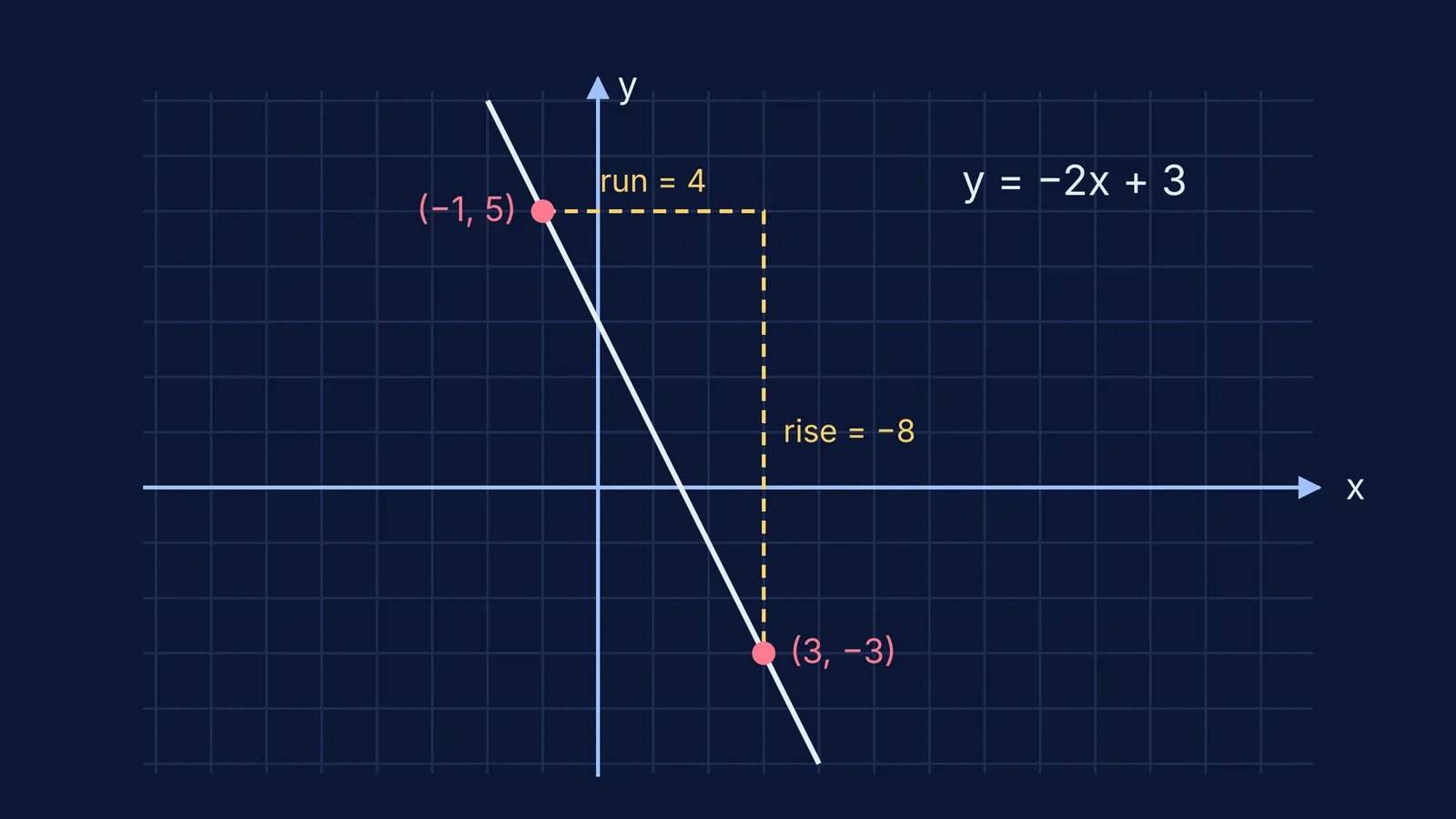
Find the line through (−1, 5) and (3, −3).
Slope: m = (−3 − 5)/(3 − (−1)) = −8/4 = −2.
Point-slope form with (−1, 5): y − 5 = −2(x − (−1)) = −2(x + 1).
Tidy it: y = −2x − 2 + 5, so y = −2x + 3, or 2x + y − 3 = 0.
Check the first point: x = −1 gives y = 2 + 3 = 5. It matches.
Check the second point: x = 3 gives y = −6 + 3 = −3. It matches.
If you start step 2 from (3, −3) instead, you get y + 3 = −2(x − 3), which also simplifies to y = −2x + 3. The same line from both points is a free extra check.
What if the line is vertical or horizontal?
NCERT notes that the slope of a vertical line is not defined (NCERT, section 9.2). So if x₁ = x₂, for example (4, 1) and (4, 7), the slope formula divides by zero. Every point on that line has x = 4, so the equation is simply x = 4.
If y₁ = y₂, the slope is 0 and the equation is y = y₁.
Which mistakes does substitution catch?
Sign slips with negative coordinates. For (−1, 5), x − (−1) becomes x + 1. Writing x − 1 fails when you put x = −1 back in.
Mixed order in the slope. (y₂ − y₁)/(x₁ − x₂) flips the sign of m, so the second point fails.
Slope upside down. (x₂ − x₁)/(y₂ − y₁) gives the reciprocal, and again the second point fails.
Errors while tidying. Slips often happen while expanding brackets, so check the final form, not your first line.
Parents can help without remembering any coordinate geometry: ask whether both points went back into the final answer.
A four-step routine for any line question
Write down what you are given: one point and a slope, or two points.
With two points, find m. If x₁ = x₂, stop: the answer is x = x₁.
Write y − y₁ = m(x − x₁) and simplify to the form the question asks for.
Put every given point into the final equation. With one point and a slope, also make a second point and check rise over run.
If your answer keeps failing the check, the Fermi Problem Library has worked problems with a step-by-step solver that explains the reasoning rather than printing an answer, so you can find the exact line where the sign flipped. If slope itself still feels shaky, the Fermi Concept Library gives each mathematics concept its own lesson.
Try one now: write the line through (0, 4) and (2, 0), then put both points back in. You should get 2x + y − 4 = 0.


