On this page
In Straight Lines each formula feeds the next: slope gives the equation, the equation gives the distance, the distance gives the foot and image. Learn it as one chain.
What does the JEE Main syllabus include for Straight Lines?
The NTA's Syllabus for JEE (Main) 2027 puts Straight Lines in Unit 10, Co-ordinate Geometry. The unit opens with the slope of a line, parallel and perpendicular lines and intercepts on the axes; its Straight line entry adds various forms of the equation of a line, intersection of lines, angles between two lines, concurrence of three lines, distance of a point from a line, and the centroid, orthocentre and circumcentre of a triangle.
The textbook match is Chapter 9, Straight Lines, of NCERT Class 11 Mathematics, Reprint 2026-27. It covers slope, the angle between lines, the point-slope, two-point, slope-intercept and intercept forms, the general equation, and distances from a point and between parallel lines. Foot, image and concurrency appear in its examples and exercises.
Two gaps. The normal form is not in the current NCERT chapter, but "various forms" can cover it, so learn it from the general form. Families of lines (L₁ + λL₂ = 0) are named in neither document; treat them as a shortcut, not a must.
How do you work one line through every formula?
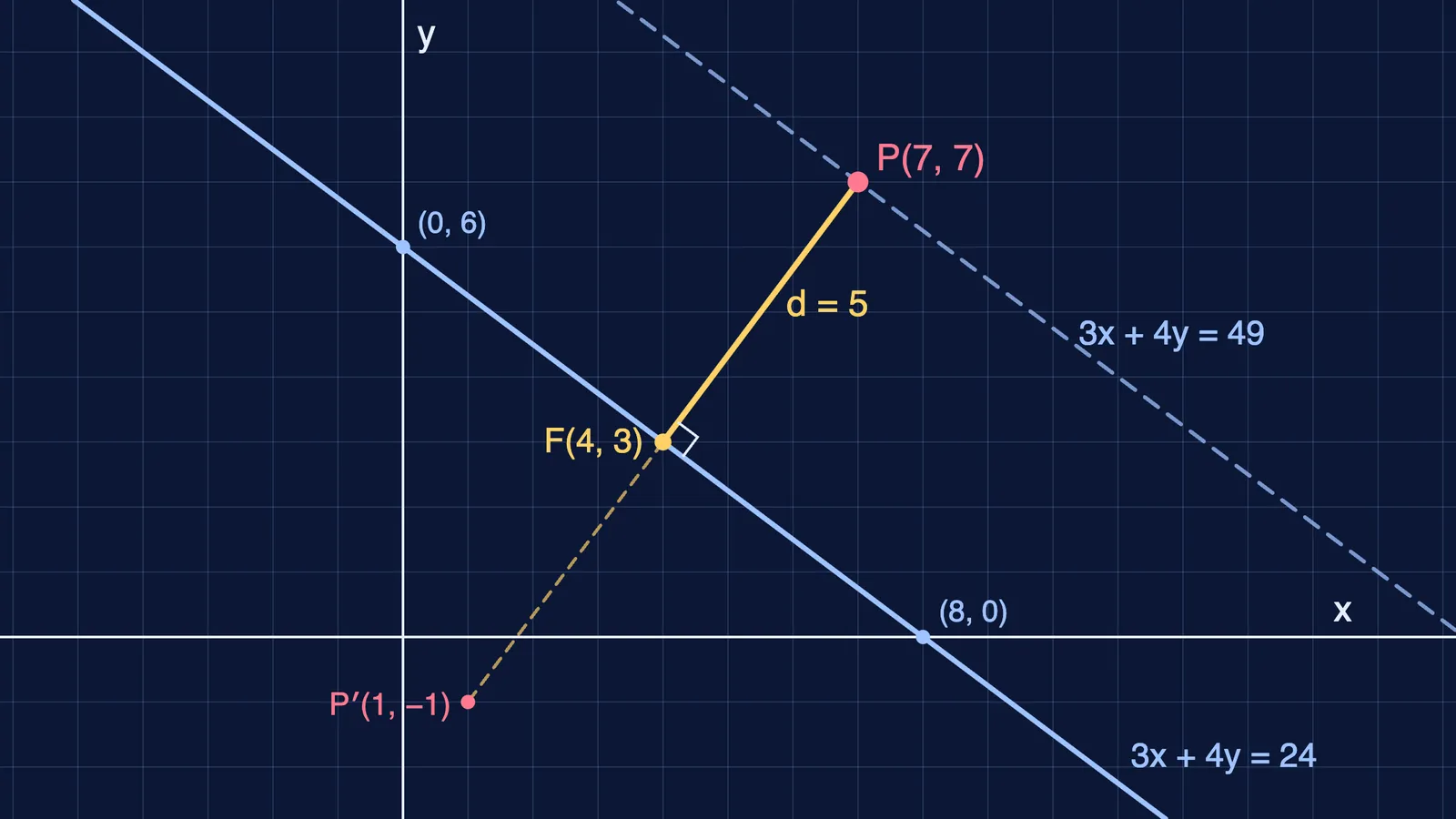
Take L: 3x + 4y − 24 = 0 and P(7, 7), drawn above. Each step has a second check.
Slope. Through (8, 0) and (0, 6): m = (6 − 0)/(0 − 8) = −3/4. Check: −A/B = −3/4.
Point-slope form. Through (4, 3): y − 3 = −(3/4)(x − 4), which simplifies to 3x + 4y = 24. Check: (8, 0) and (0, 6) satisfy it.
Intercept form. x/8 + y/6 = 1. Check: multiplying by 24 gives 3x + 4y = 24.
Normal form. Divide by √(3² + 4²) = 5: (3/5)x + (4/5)y = 24/5, so cos ω = 3/5, sin ω = 4/5, p = 4.8. Check: the origin is |−24|/5 = 4.8 from L.
Angle with slope 1/7. tan θ = |(m₂ − m₁)/(1 + m₁m₂)| = |(1/7 + 3/4)/(1 − 3/28)| = 1, so θ = 45°. Check: direction vectors (4, −3) and (7, 1) give cos θ = 25/(25√2) = 1/√2. Without the modulus you may get −1, which is the obtuse angle, 135°.
Perpendicular through P. Slope 4/3 gives 4x − 3y − 7 = 0. Check: (−3/4)(4/3) = −1, and A₁A₂ + B₁B₂ = 12 − 12 = 0.
Distance of P from L. d = |21 + 28 − 24|/5 = 5. Check: PF = √(3² + 4²) = 5.
Foot of the perpendicular. (x − 7)/3 = (y − 7)/4 = −25/25 = −1, so F = (4, 3). Check: solving L with 4x − 3y = 7 gives (4, 3).
Image of P. Double the factor to −2: P′ = (1, −1). Check: the midpoint of PP′ is F.
Parallel lines. The parallel through P is 3x + 4y − 49 = 0, at |−24 + 49|/5 = 5 from L. Check: it must equal d, since P lies on it.
Concurrency. For which k do L, 4x − 3y − 7 = 0 and x + ky − 10 = 0 meet at one point? The first two meet at (4, 3), so 4 + 3k = 10, k = 2. Check: the coefficient determinant, rows (3, 4, −24), (4, −3, −7), (1, 2, −10), is 132 + 132 − 264 = 0.
Which mistakes cost marks in Straight Lines?
The sign of C. Write 3x + 4y = 24 as 3x + 4y − 24 = 0 first, so C = −24.
Unequal coefficients. For 3x + 4y − 24 = 0 and 6x + 8y + 2 = 0, halve the second first. The distance is |−24 − 1|/5 = 5, not 26/5.
The modulus in tan θ. It gives the acute angle; check whether the question wants the obtuse one.
Which side. P gives +25 in 3x + 4y − 24 and P′ gives −25, so they lie on opposite sides.
If you keep picking the wrong method, the Fermi Problem Library has worked problems with a step-by-step solver that explains the reasoning rather than printing an answer.
How should you practise Straight Lines in two weeks?
Days 1-3: slope and every form of a line; redo the NCERT examples without looking.
Days 4-6: angles, parallel and perpendicular conditions, distance from a line.
Days 7-9: foot, image, concurrency, and the triangle centres the syllabus lists.
Days 10-12: timed mixed sets; log each wrong answer by its trap above.
Days 13-14: link forward. The distance formula returns in the length of a chord cut off by a line, and angle bisectors in the locus of points equidistant from two lines.
In the exam, our JEE Main attempt strategy in three passes shows where quick questions like these fit.
Start today: pick your own line and point, run all eleven steps, and check each answer twice.