On this page
Many ICSE loci questions turn on one word: equidistant. Equidistant from two points, or from two lines. Each of those phrases turns into exactly one construction you already know how to do with a compass. Once you see that, a long locus question becomes two short constructions and one point where they cross.
What is the locus of a point equidistant from two lines?
The CISCE Class 10 Mathematics syllabus states it directly: the locus of a point equidistant from two intersecting lines is the bisector of the angles between the lines.
Notice the plural, angles. Two intersecting lines make two pairs of opposite angles, so the full locus is two lines, which always meet at 90°, for the reason explained in our post on why the bisectors of a linear pair meet at 90°. In a triangle question you usually need only the bisector that runs inside the triangle, but say so in your answer.
Why does it work? Drop perpendiculars from a point on the bisector to each line. The two right triangles share a hypotenuse and have equal angles at the vertex, so they are congruent and the perpendicular distances are equal.
If the two lines are parallel, there is no angle to bisect. The locus is then the single line parallel to both and halfway between them.
What is the locus of a point equidistant from two points?
The same CISCE syllabus states it: the locus of a point equidistant from two given points is the perpendicular bisector of the line joining the points.
The reason is one congruence. Take any point P on the perpendicular bisector of AB, with M the midpoint. Triangles PMA and PMB share PM, have MA = MB, and both have a right angle at M, so PA = PB by SAS. In coordinates, our post on the equation of a perpendicular bisector shows the algebra gives the same line.
Why are these two the key loci?
They turn the word equidistant into a line you can draw with compasses and a ruler. The constructions behind them are old: Euclid's Elements gives them as Book I, Proposition 9, to bisect a given rectilinear angle, and Proposition 10, to bisect a given finite straight line.
A single locus gives a whole line of possible points. A question that asks you to find one point is really asking for two loci and where they cross. Read every condition in the question, match each to its locus, draw both, and mark the intersection.
How do you construct it step by step? A worked ICSE example
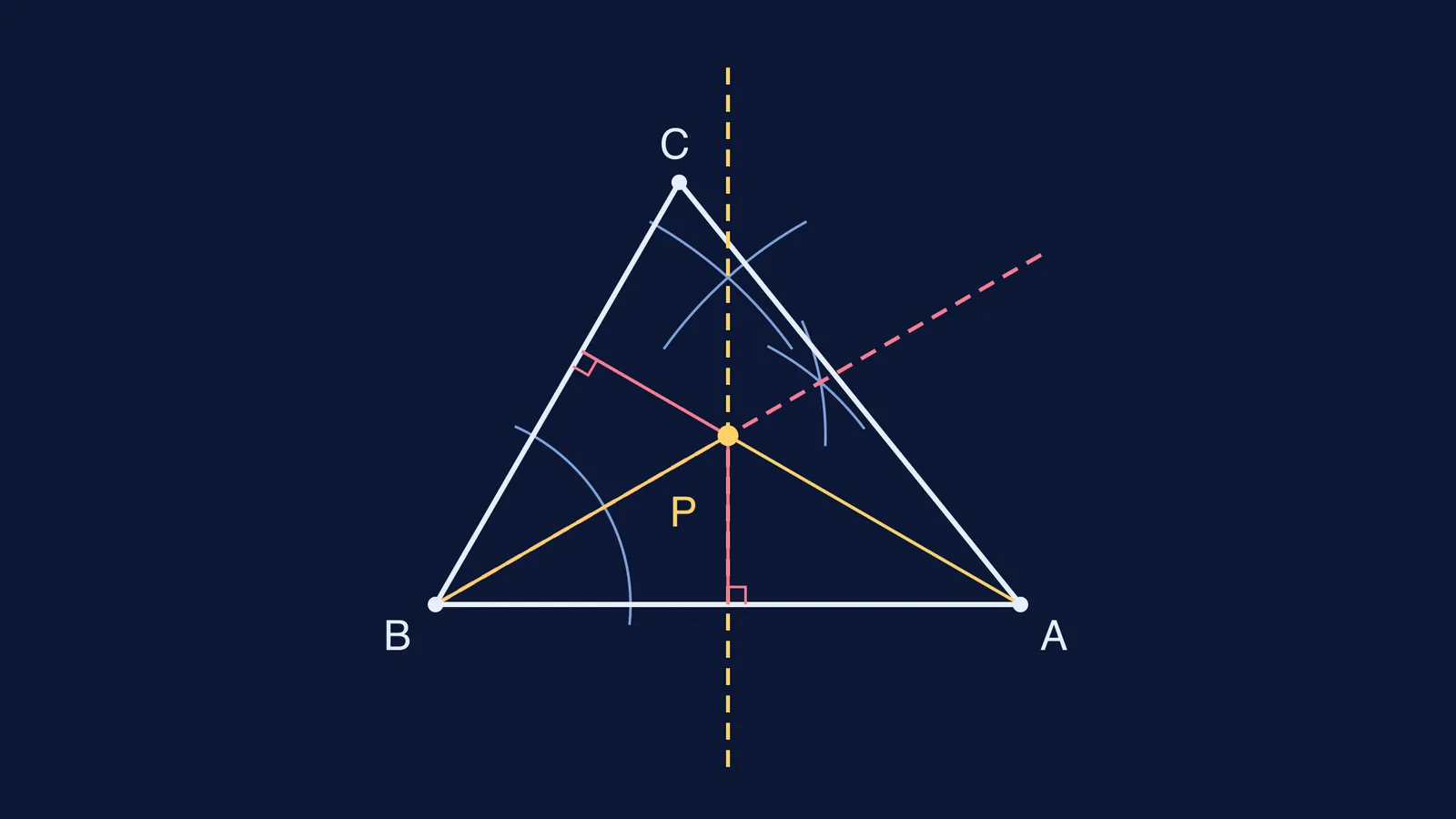
Question: Construct triangle ABC in which AB = 6 cm, BC = 5 cm and angle ABC = 60°. Construct the locus of points equidistant from A and B, and the locus of points equidistant from AB and BC. Mark P, the point that satisfies both, and measure PB.
Draw AB = 6 cm. At B, construct a 60° angle with compasses and mark C on that arm so that BC = 5 cm. Join AC.
For the first locus, open the compasses to more than half of AB (say 4.5 cm). Draw arcs above and below AB from A, then from B with the same radius. Join the two crossing points. This is the perpendicular bisector of AB.
For the second locus, put the compass point on B and draw an arc that cuts BA and BC. From those two cut points, draw arcs of equal radius that cross inside the angle. Join B to that crossing. This bisects angle ABC.
Mark P where the two lines meet.
Measure PB. You should get about 3.5 cm.
Why 3.5 cm? The perpendicular bisector meets AB at its midpoint M, so BM = 3 cm, and the bisector makes angle PBM = 30°. In right triangle PBM, PB = 3 ÷ cos 30° = 2√3, about 3.46 cm. PM = 3 × tan 30° = √3, about 1.73 cm, which is also P's perpendicular distance from BC.
What mistakes cost marks in loci constructions?
Rubbing out construction arcs. They show your method; keep them light but visible.
Measuring a slanted distance to a line instead of the perpendicular one.
Drawing only one angle bisector when the question involves two full lines rather than a triangle.
Forgetting to label the locus and the final point, or to write the measured length.
If loci are hard to picture, watch a point move and trace its path, as in our guide on how to visualise locus problems with a moving point. The Fermi Simulation Lab has interactive simulations for ideas that are easier to see than to read.
When your construction looks right but the answer does not match, the Fermi Problem Library has a step-by-step solver that explains the reasoning, so you can find the step that went wrong.