On this page
You have two points, A and B, and you need the line that cuts AB in half at a right angle. It appears in Class 11 coordinate geometry and inside bigger problems such as circumcentres and loci. Below, one example is worked both ways, and both give the same line.
What is the perpendicular bisector of a line segment?
The perpendicular bisector of a line segment is the line that meets the segment at its midpoint at a right angle (Wikipedia: Bisection).
The same source states the property that makes it useful: every point on the perpendicular bisector is equidistant from the two endpoints, so PA = PB for any point P on it. The first method below uses the definition. The second uses the equal-distance property.
If you have drawn this line with a compass, you have already used the second idea. The arcs in drawing a perpendicular bisector with a compass are just points that sit at equal distances from both ends.
How do you find the equation using the midpoint and slope?
You need three standard results, all set out in OpenStax College Algebra 2e and its section on linear functions:
Midpoint of (x1, y1) and (x2, y2): ((x1 + x2)/2, (y1 + y2)/2).
Perpendicular lines have slopes that are negative reciprocals, so m1 × m2 = −1.
Point-slope form: y − y1 = m(x − x1).
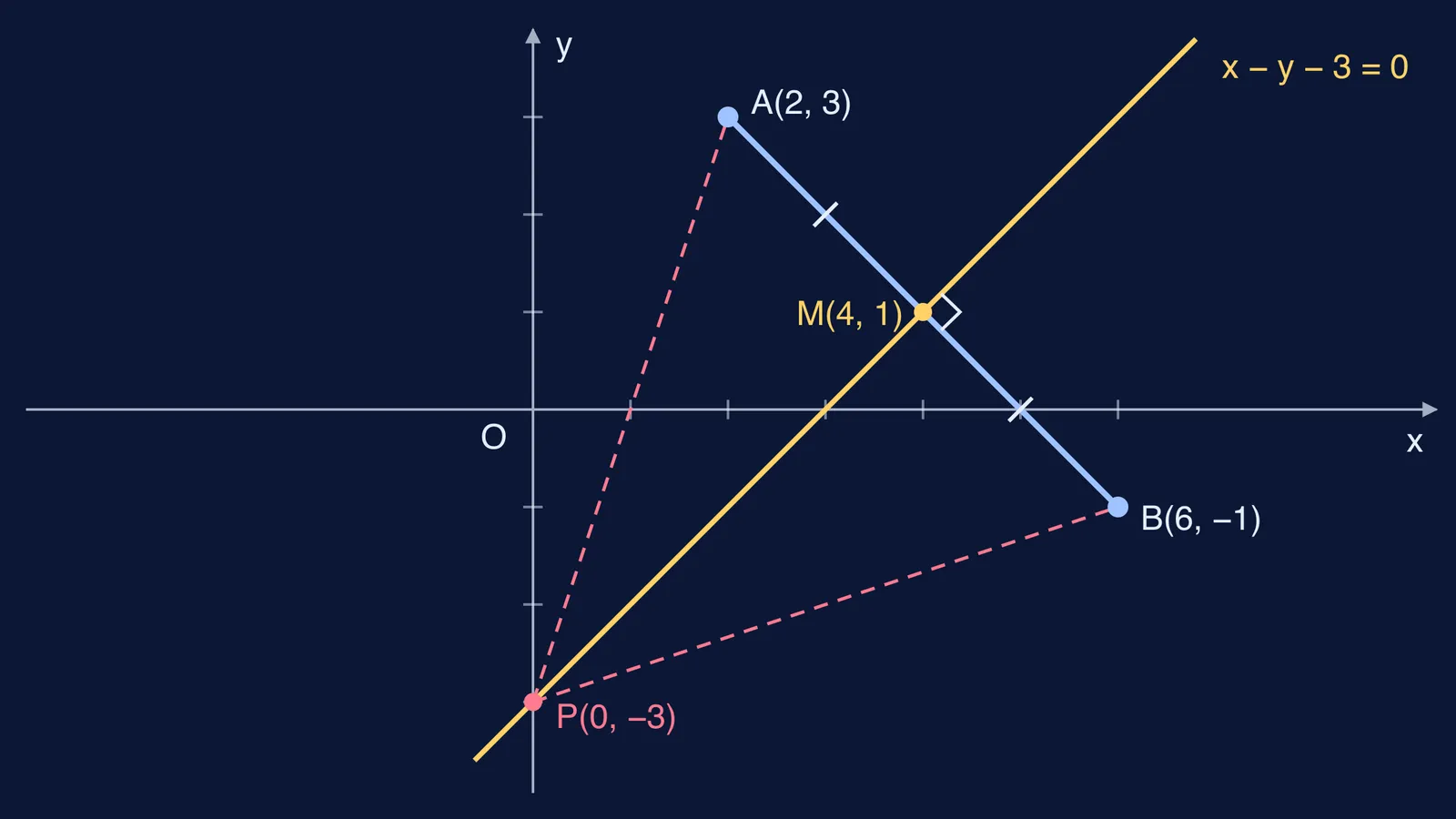
Worked example: A(2, 3) and B(6, −1).
Midpoint M = ((2 + 6)/2, (3 + (−1))/2) = (4, 1).
Slope of AB = (−1 − 3)/(6 − 2) = −4/4 = −1.
Slope of the bisector = negative reciprocal of −1, which is 1.
Point-slope form through M: y − 1 = 1(x − 4).
Tidy up: x − y − 3 = 0.
If the minus-one rule feels like something you memorised rather than understood, why the product of slopes of perpendicular lines is −1 walks through the reason.
How do you find it by equating distances?
Let P(x, y) be any point on the bisector. Then PA = PB. Square both sides to remove the roots, using the distance formula from OpenStax:
(x − 2)² + (y − 3)² = (x − 6)² + (y + 1)²
Expand both sides:
x² − 4x + 4 + y² − 6y + 9 = x² − 12x + 36 + y² + 2y + 1
The x² and y² terms cancel, which is why the answer is a straight line. What is left:
−4x − 6y + 13 = −12x + 2y + 37
8x − 8y − 24 = 0, so x − y − 3 = 0.
The same line as before, with no slopes involved. Doing the same algebra with letters gives a shortcut you can check against: 2(x2 − x1)x + 2(y2 − y1)y = (x2² + y2²) − (x1² + y1²). Here that is 8x − 8y = 37 − 13 = 24.
Which method should you use?
Midpoint and slope is quicker when the numbers are small and AB is neither horizontal nor vertical. Use it when the question already gives the midpoint or slope.
Equal distances is safer when AB is horizontal or vertical, because the negative reciprocal of 0 is undefined. It also works without changes in locus questions, where the condition is literally "equidistant from A and B".
For a circumcentre, find two bisectors with either method and solve them together. That is the method used in centroid, incentre and circumcentre in coordinate geometry.
Try the horizontal case: A(−3, 5) and B(7, 5). The slope of AB is 0, so the slope rule gets stuck. Equal distances gives (x + 3)² = (x − 7)², so 6x + 9 = −14x + 49 and x = 2. That is a vertical line through the midpoint (2, 5), exactly as it should be.
How do you check your answer quickly?
Run three checks before moving on. They catch most sign slips.
The midpoint satisfies it. For x − y − 3 = 0: 4 − 1 − 3 = 0. Correct.
The slopes multiply to −1. The bisector's slope is 1, AB's slope is −1, and 1 × (−1) = −1. Correct.
Another point is equidistant. Take P(0, −3) on the line. PA² = 4 + 36 = 40 and PB² = 36 + 4 = 40. Correct.
If a longer problem goes wrong and you cannot see where, the Fermi Problem Library has worked problems with a step-by-step solver that explains the reasoning rather than printing an answer. If the gap is further back, in slopes, distance or the forms of a line, each idea has its own lesson in the Fermi Concept Library.
Next time you see two points and the word "equidistant", write PA = PB first and let the algebra do the rest.