

On this page
Drawing a perpendicular bisector is one of the most common geometric constructions. Using just a compass and a straightedge, you can divide a line segment exactly in half while simultaneously creating a perfect 90-degree cross.
Whether you are bisecting a line in an exam or laying out a foundation for a woodworking project, this method guarantees precision without requiring you to measure any lengths or angles.
How to draw a perpendicular bisector with a compass?
To construct a perpendicular bisector for a line segment AB, you only need to draw two equal arcs. This method relies entirely on the steady pivot of your compass.
Set the compass width: Place the sharp metal point of your compass on endpoint A. Open the compass so its width is visibly more than half the length of the segment. If the compass is set to exactly half or less than half the length, the arcs will never meet (Wikipedia).
Draw the first arc: Keeping the point firmly anchored on A, draw a large arc that passes both above and below the line segment. Apply gentle pressure to ensure the compass width does not accidentally shift.
Draw the second arc: Without changing the compass width, move the sharp point to endpoint B. Draw a second arc that crosses the first one in two distinct places.
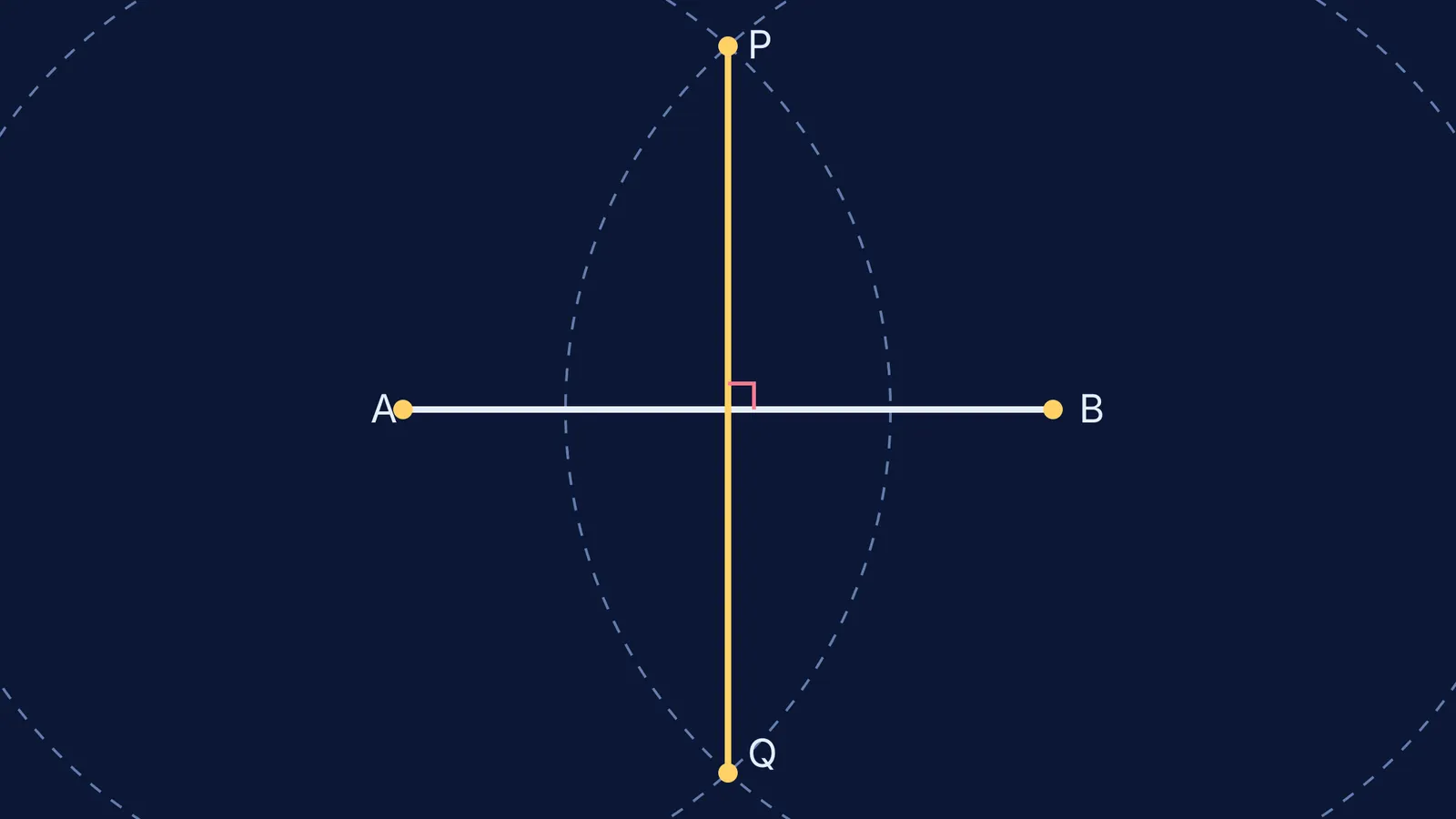
Connect the intersections: You will see two points where the arcs cross—one above the line and one below it. Use a straightedge or ruler to draw a straight line connecting these two intersection points.
This new line is the perpendicular bisector. It cuts the original segment into two equal halves (bisects it) and meets it at a perfect right angle (perpendicular). If you want to explore more geometry fundamentals that rely on these basic rules, review our guide to the Introduction to Euclid's geometry in Class 9: axioms and postulates.
Why does the compass method work?
This construction works flawlessly because drawing equal arcs from both ends creates an invisible rhombus. A rhombus is a four-sided quadrilateral shape where all sides are exactly the same length.
When you draw the arcs from endpoints A and B using the identical compass width, every point on those arcs is the same radial distance from its centre. The two points where the arcs intersect (let's call them P and Q) are therefore equidistant from A and from B.
If you were to draw straight lines connecting A to P, B to P, A to Q, and B to Q, you would form a shape with four equal sides—a rhombus. A fundamental geometric property of a rhombus is that its diagonals always bisect each other at exactly 90 degrees (Wikipedia).
In this construction, your original line segment AB acts as one diagonal, and the vertical line PQ you just drew is the second diagonal. By drawing the equal arcs, you trapped your line inside a rhombus, forcing the new line to be a perfect perpendicular bisector.
If you want to review the fundamental properties of a rhombus and other shapes, the Fermi Concept Library holds every concept in physics, chemistry, biology, mathematics and computing, each with its own lesson and its place in the map.
How to check a perpendicular bisector with a set square?
Once you have drawn the bisector, it is a good habit to verify your work. A set square, which has a built-in 90-degree corner, is the perfect tool for this check (Wikipedia). Here is a simple checklist to confirm your construction:
Align the base: Place the long edge of a standard ruler flat against your original line segment AB.
Slide the set square: Rest one of the shorter edges of the set square against the ruler. Slide the set square along the ruler until its vertical edge meets the intersection point on the line.
Check the angle: Your drawn bisector should line up perfectly flush with the vertical edge of the set square. If there is a gap, your angle is not exactly 90 degrees, which means your compass might have slipped during the drawing phase.
To verify the "bisector" part, use the markings on your ruler or set square to measure the distance from endpoint A to the intersection, and then from endpoint B to the intersection. The two distances must be identical. When you master these manual checks, your spatial intuition improves, helping you tackle complex geometry problems with greater confidence.


