

On this page
This result turns up in Class 9 geometry and in school exam proofs. The whole proof is one idea: halve a sum you already know.
Are the bisectors of a linear pair always perpendicular?
Yes, for every linear pair. A linear pair is two adjacent angles whose outer arms form one straight line, so together they make a straight angle.
Euclid proved that these two angles always add up to two right angles, or 180°, in Book I, Proposition 13 of the Elements: "If a straight line stands on a straight line, then it makes either two right angles or angles whose sum equals two right angles" (Euclid's Elements, Book I, Proposition 13, Clark University edition).
The bisectors' angle depends only on that 180°. It does not matter how the ray is tilted.
How do you prove it in three lines?
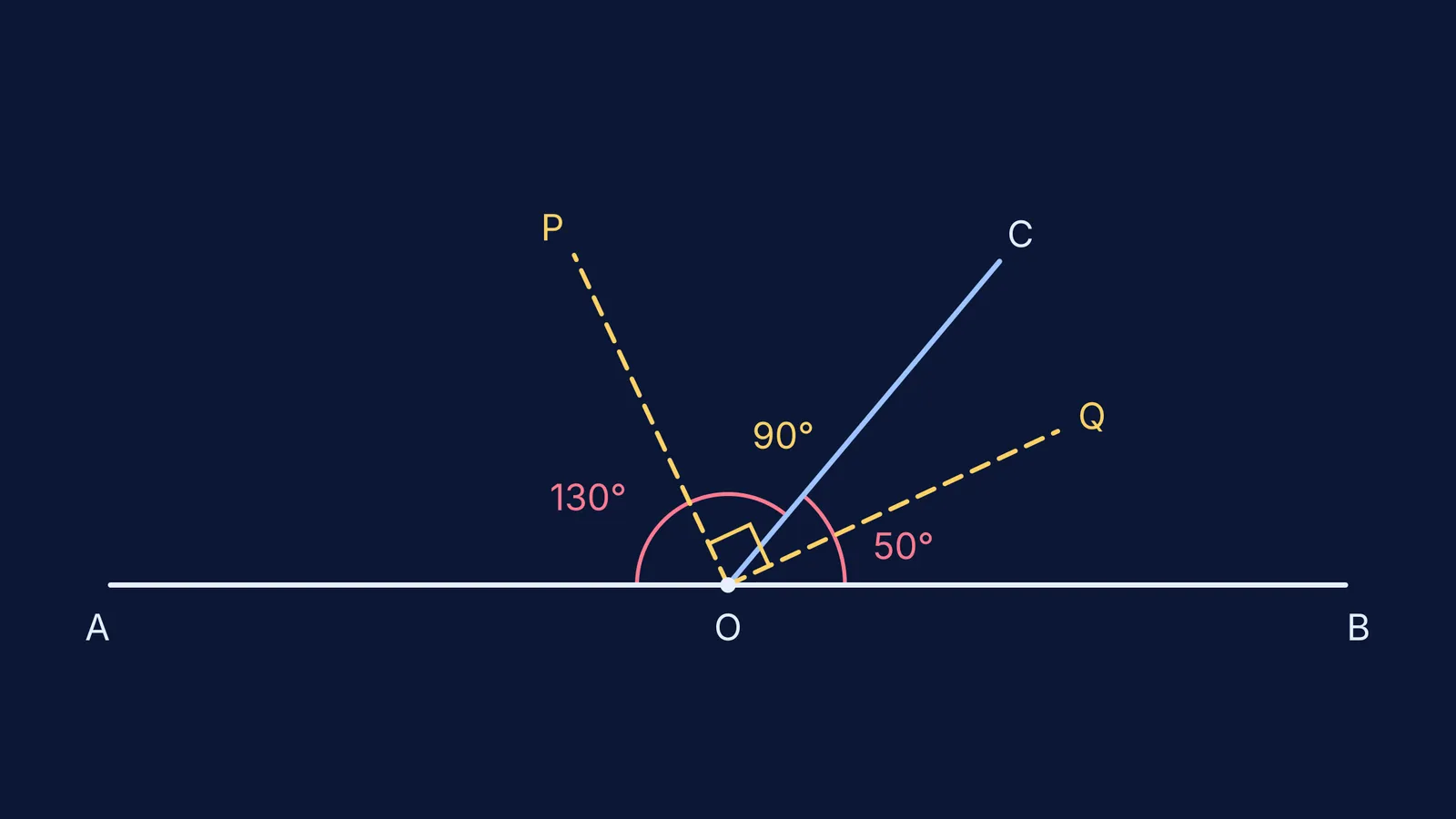
Let AOB be a straight line. Let ray OC stand on it, making the linear pair ∠AOC and ∠COB. Let OP bisect ∠AOC and OQ bisect ∠COB.
∠AOC + ∠COB = 180°, because they form a linear pair.
∠POC = ½∠AOC and ∠COQ = ½∠COB, because OP and OQ are bisectors.
∠POQ = ∠POC + ∠COQ = ½(∠AOC + ∠COB) = ½ × 180° = 90°.
So OP ⊥ OQ. In an exam, write the reason beside every line. The reasons are what turn the working into a proof.
Check it with numbers. Say ∠COB = 50° and ∠AOC = 130°. The halves are 25° and 65°, and 25° + 65° = 90°. Try 10° and 170°: the halves are 5° and 85°, which again add to 90°. The tilt changes how the right angle is split, but the right angle stays.
If the linear pair or supplementary angles still feel shaky, our explainer on complementary and supplementary angle pairs goes over the basics. The companion result, why vertically opposite angles are equal, uses the same linear-pair step.
Do bisectors of co-interior angles also meet at 90°?
Yes, when the two lines are parallel. Co-interior angles (also called interior angles on the same side of the transversal) are the two angles between the parallel lines on the same side of the line that crosses them.
Euclid's Book I, Proposition 29 says that a straight line falling on parallel lines makes "the sum of the interior angles on the same side equal to two right angles" (Euclid's Elements, Book I, Proposition 29, Clark University edition). So co-interior angles add up to 180°, just like a linear pair.
Here is the proof. Let AB ∥ CD, and let a transversal cut AB at E and CD at F. Let the bisectors of ∠BEF and ∠EFD meet at G.
∠BEF + ∠EFD = 180°, because they are co-interior angles and AB ∥ CD.
∠GEF + ∠GFE = ½(∠BEF + ∠EFD) = 90°, because EG and FG are bisectors.
In triangle EGF, ∠EGF = 180° − 90° = 90°, by the angle sum of a triangle.
The one new step is the triangle. In the linear pair, the two halves sit side by side at one point. Here they sit at two corners of a triangle, so the right angle appears at the third corner.
How can you check your own proof?
Before you move on, ask yourself these questions:
Did I name the known sum (180°) and give its reason: linear pair, or co-interior angles with parallel lines?
Did I write "bisector" as the reason when I halved each angle?
Did I add the halves at the right place: the common vertex for a linear pair, or the triangle for co-interior angles?
Did I test my answer with one pair of numbers, such as 130° and 50°?
Three follow-up problems to try:
Prove that the bisectors of a pair of alternate interior angles are parallel. Hint: halves of equal angles are equal, and they form alternate angles.
Prove that the four bisectors of the interior angles formed by a transversal across two parallel lines enclose a rectangle.
∠AOC is three times ∠COB in a linear pair. Find the angle between each bisector and line AB.
In coordinate geometry, the same fact returns: see finding the angle bisectors of two lines.
If you get stuck on a step and are not sure which reason applies, the Fermi Problem Library has worked problems with a step-by-step solver that explains the reasoning rather than printing an answer. To revisit lines and angles from the start, the Fermi Concept Library gives each mathematics concept its own lesson.


