

On this page
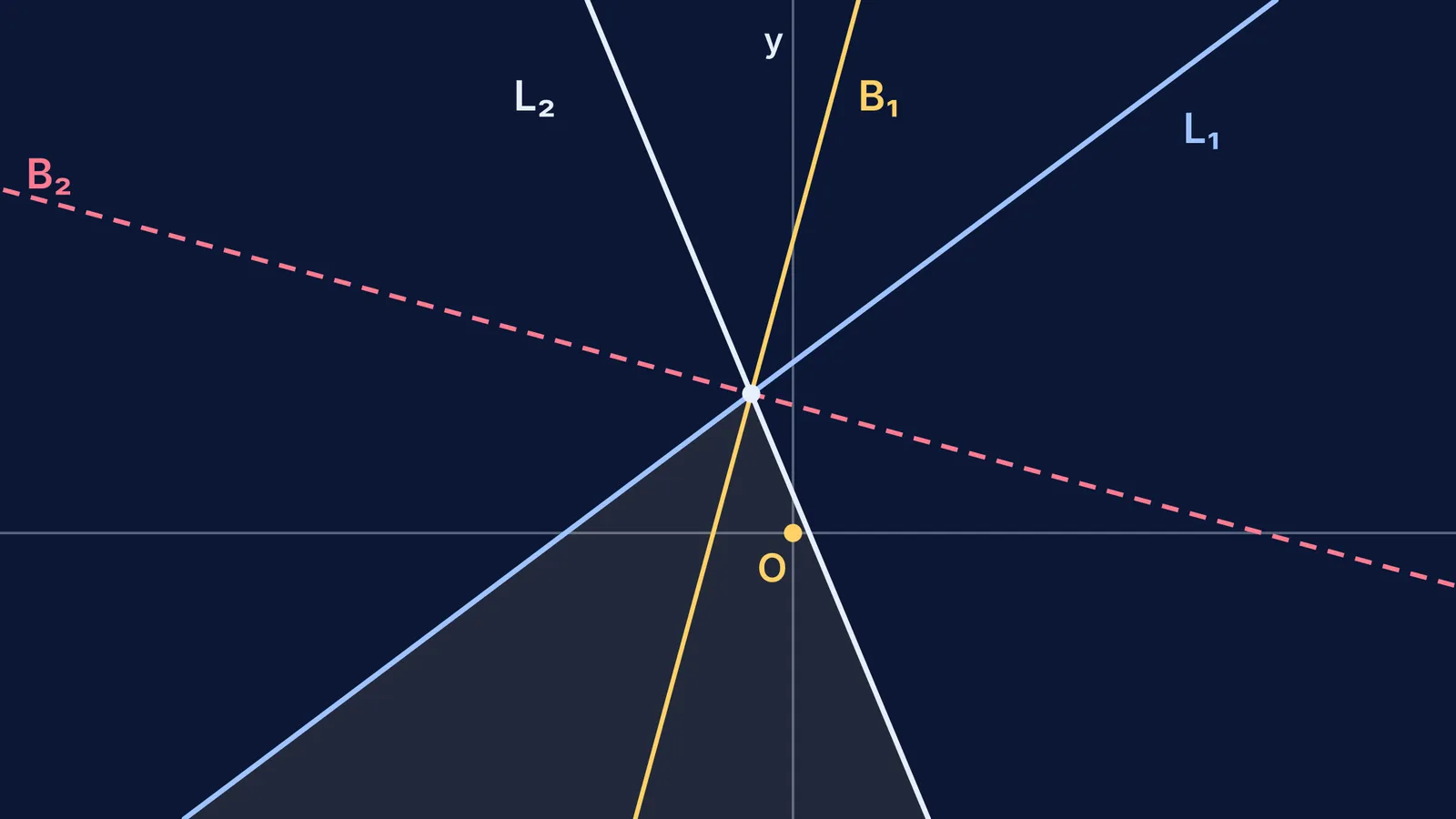
Two crossing lines make two pairs of equal angles, so there are always two bisectors, and they are perpendicular. Exam questions usually want just one of them: the acute bisector, the obtuse one, or the one through the angle that contains the origin. Here is one method for all three, with a fully worked example.
What is the equation of the angle bisector between two lines?
Each point of an angle bisector is equidistant from the sides of the angle (Wikipedia: Bisection).
The perpendicular distance from a point (x₀, y₀) to the line ax + by + c = 0 is |ax₀ + by₀ + c|/√(a² + b²) (Wikipedia: Distance from a point to a line).
Set the two distances equal and drop the modulus signs, which leaves a ± sign (the same form is given on the Wikipedia bisection page):
(a₁x + b₁y + c₁)/√(a₁² + b₁²) = ±(a₂x + b₂y + c₂)/√(a₂² + b₂²)
One sign gives each bisector, and the two bisectors are perpendicular (Wikipedia: Bisection). The real work is choosing the sign the question wants.
How do you find the bisector of the angle containing the origin?
Rewrite each line so its constant term is positive, multiplying by −1 where needed. At the origin, both left-hand sides now equal c/√(a² + b²), which is positive.
Every point in the origin's angle is on the origin's side of both lines, so both expressions stay positive there. On that angle's bisector the two signed distances are equal, not opposite. So the + sign gives the bisector of the angle containing the origin.
The same works for any point (h, k): arrange the signs so both expressions are positive at (h, k), then take +. If a line passes through the origin (c = 0), test a different point.
Which bisector is the acute one and which is the obtuse one?
With c₁ and c₂ positive, work out a₁a₂ + b₁b₂, the dot product of the normals (a₁, b₁) and (a₂, b₂).
If a₁a₂ + b₁b₂ > 0, the origin is in an obtuse angle, so + gives the obtuse bisector and − gives the acute one.
If a₁a₂ + b₁b₂ < 0, the origin is in an acute angle, so + gives the acute bisector and − gives the obtuse one.
Why does this work? Both normals point towards the origin's side, and the origin's angle equals 180° minus the angle between the normals. So when the normals make an acute angle, the origin's angle is obtuse.
To check without the rule, find the angle θ between one bisector and either line. If tan θ < 1, then θ < 45° and that bisector is the acute one.
Worked example: 3x − 4y + 7 = 0 and 12x + 5y − 2 = 0
Make the constants positive. L₁: 3x − 4y + 7 = 0 stays as it is, and L₂ becomes −12x − 5y + 2 = 0.
Find the norms: √(3² + 4²) = 5 and √(12² + 5²) = 13.
Write both bisectors: (3x − 4y + 7)/5 = ±(−12x − 5y + 2)/13.
The + sign gives 13(3x − 4y + 7) = 5(−12x − 5y + 2), so 11x − 3y + 9 = 0. This bisects the origin's angle.
The − sign gives 13(3x − 4y + 7) = −5(−12x − 5y + 2), so 21x + 77y − 101 = 0.
Check they are perpendicular: 11 × 21 + (−3) × 77 = 0.
Work out a₁a₂ + b₁b₂ = 3(−12) + (−4)(−5) = −16 < 0. The origin is in the acute angle, so 11x − 3y + 9 = 0 is the acute bisector and 21x + 77y − 101 = 0 is the obtuse one.
Cross-check: L₁ has slope 3/4 and the first bisector has slope 11/3, so tan θ = |(11/3 − 3/4)/(1 + 11/4)| = 7/9, which is under 1. It really is acute.
Both bisectors pass through the intersection point (−3/7, 10/7), which makes a quick last check.
What mistakes cost marks in bisector questions?
Forgetting to divide by √(a² + b²), which means you have not equated distances at all.
Choosing the sign before making both constants positive.
Assuming "contains the origin" means "acute". The two pick the same bisector only when a₁a₂ + b₁b₂ < 0.
Internal bisectors of a triangle meet at the incentre, so this links directly to finding the incentre and other triangle centres in coordinate geometry. Each bisector also belongs to the family of lines through the intersection of two given lines, and the same algebra appears in the condition for three lines to be concurrent.
If the sign keeps tripping you up, work through more problems in the Fermi Problem Library. Its step-by-step solver explains the reasoning rather than printing an answer, so you can follow each step instead of just checking the final line. To revise the distance formula itself, use the Fermi Concept Library.


