

On this page
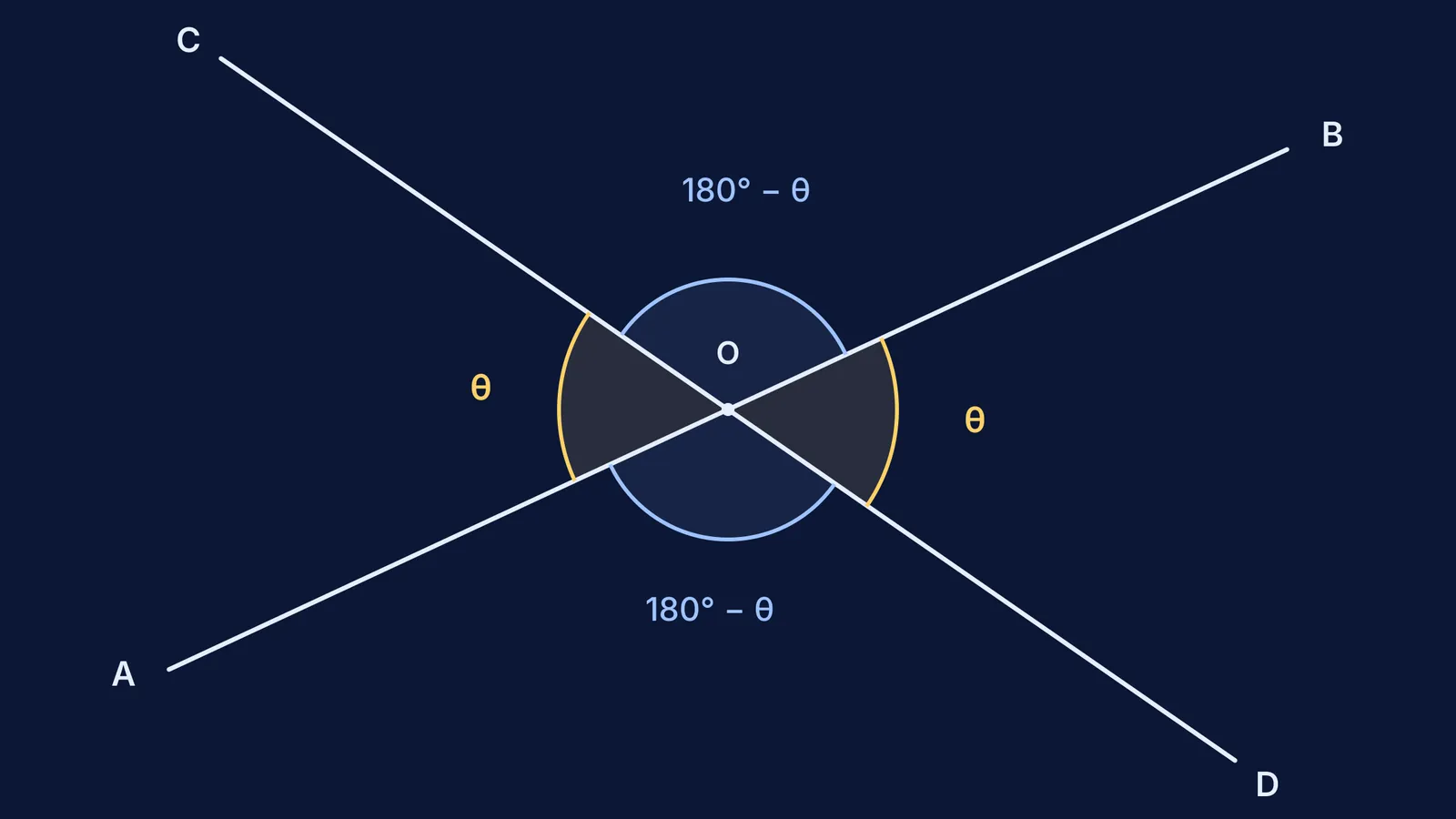
When two straight lines cross, the angles opposite each other across the common vertex are called vertically opposite angles. According to the NCERT Class 9 Mathematics curriculum, whenever two straight lines intersect, the vertically opposite angles are always equal. Historical records from the philosopher Proclus attribute the earliest known mathematical demonstration of this property to Thales of Miletus in the sixth century BCE, a result later codified as Proposition 15 in Book I of Euclid's Elements.
The geometric reason behind this equality rests on the linear pair property of straight lines. A straight line forms a continuous angle of 180°, as established in Euclid's Proposition 13. When two lines intersect at a point, any two adjacent angles that lie along either straight line must sum to 180°. Because two opposite angles sit on opposite sides of the exact same adjacent angle, both are supplementary to that single shared neighbor. Since both angles equal 180° minus the exact same quantity, their measures are identical.
What does the two-line proof of vertical angles look like?
The formal proof requires only two lines of algebraic deduction using the Linear Pair Axiom from NCERT Class 9 Mathematics.
Consider two straight lines, AB and CD, intersecting at vertex O. To prove that ∠AOC equals ∠BOD:
Ray OA stands on straight line CD, which means ∠AOC + ∠AOD = 180°.
Ray OD stands on straight line AB, which means ∠BOD + ∠AOD = 180°.
Because both angle sums equal 180°, we equate them directly:
∠AOC + ∠AOD = ∠BOD + ∠AOD
Subtracting the common angle ∠AOD from both sides yields the final equality:
∠AOC = ∠BOD
The exact same subtraction demonstrates that ∠AOD = ∠BOC on the other side of vertex O. Furthermore, as stated in the corollary to Proposition 15 in Euclid's Elements, the four angles formed around the intersection point always sum to 360°, or four right angles.
What common mistakes trap students during angle chasing?
Students frequently assume angles are vertically opposite simply because they appear across from each other in a textbook figure. In an empirical study of 192 students across Grades 2 through 8 published in *Educational Studies in Mathematics*, Mitchelmore and White (2000) found that children readily recognise angles in physical two-line intersections but struggle to connect these static contexts to the standard, abstract angle concept.
Three common pitfalls recur throughout school exams:
Assuming bent lines form vertical angles: If two line segments meet at a vertex but do not continue along a straight 180° trajectory, the opposite angles are not equal.
Confusing vertical angles with adjacent supplements: Vertically opposite angles share only a vertex and opposite rays, whereas adjacent linear pairs share a ray and sum to 180°.
Forgetting to verify collinearity: In multi-line geometry diagrams, two segments may meet at a point without forming an unbroken straight line.
When diagram complexity grows, relying on visual intuition leads to persistent slips. In the Fermi Concept Library, every concept in physics, chemistry, biology, mathematics and computing has its own lesson and its place in the map, allowing students to trace geometric properties back to first principles before attempting advanced calculations.
How do you solve multi-line angle-chasing problems step by step?
Angle chasing is the systematic process of finding unknown angle measures across complex geometric configurations. According to NCERT Class 9 Mathematics, systematic angle chasing relies on chaining linear pairs, vertically opposite angles, and rotational sums. You can solve multi-line intersection questions without confusion by applying this four-step procedure:
Identify continuous straight lines: Trace each unbroken line passing through the vertex. Ensure you never apply vertical angle equality across rays that change direction.
Calculate adjacent linear pairs: If one angle measures θ, immediately label its adjacent neighbor along either straight line as 180° − θ.
Propagate vertical equality across the vertex: Label the angle directly opposite the known angle as θ without unnecessary intermediate steps.
Verify the 360° circular sum: Confirm that all angles around the vertex add up to 360°, ensuring no arithmetic error occurred during the linear-pair subtractions.
Consider a practical example where three straight lines AB, CD, and EF intersect at a single vertex O. Suppose ∠AOE = 42° and ∠COB = 68°, with ray OE positioned between ray OA and ray OC. Because line AB is a straight line, the angles along one side must sum to 180°. We find the middle angle:
∠EOC = 180° − (42° + 68°) = 70°
By applying vertically opposite angles across vertex O, the remaining three angles follow immediately:
∠BOF = ∠AOE = 42°
∠AOD = ∠COB = 68°
∠DOF = ∠EOC = 70°
Checking the sum of all six angles yields 2 × (42° + 68° + 70°) = 360°, confirming the solution is sound.
For students tackling Olympiad and competitive exam problems, the Fermi Problem Library provides worked problems with a step-by-step solver that explains the reasoning rather than printing an answer. To strengthen your geometry foundations further, explore our guides on lines and angles in Class 9 and Euclid's geometry axioms, or learn how deductive proof first took shape in Thales and his geometric theorems.


