On this page
Ask who proved the first theorem in geometry and many books will say Thales. The truth is more interesting: we have no writing by him at all, and historians disagree about whether he "proved" anything in the modern sense. What we do have are a handful of results credited to him that you use every year in school maths. This post sorts what is reported from what is legend, then works through two of his results properly.
Who was Thales, and how do we know about him?
According to the MacTutor biography of Thales from the University of St Andrews, he lived from about 624 BC to about 547 BC in Miletus, a Greek city on the coast of what is now Turkey. He was counted among the Seven Sages of Greece. None of his writing survives, and it is unclear whether he wrote any books at all.
That means every claim about him comes second-hand, often centuries later. MacTutor warns that "it was the habit of the time to credit famous men with discoveries they did not make". Keep that in mind as you read anything about him, including this post.
What theorems is Thales credited with?
MacTutor lists the five usually attributed to him:
A circle is bisected by any diameter.
The base angles of an isosceles triangle are equal.
The angles between two intersecting straight lines are equal.
Two triangles are congruent if they have two angles and one side equal.
An angle in a semicircle is a right angle.
The first four come from Proclus, writing around 450 AD and drawing on a lost history of geometry by Eudemus, a pupil of Aristotle. The fifth comes from Diogenes Laertius, who also reports that others gave the credit to Pythagoras. MacTutor adds that Proclus' word in the second theorem is closer to "similar" than "equal", so Thales may have claimed something looser than what we now prove.
The Internet Encyclopedia of Philosophy article on Thales also records the famous eclipse. Herodotus wrote that Thales foretold a solar eclipse within the year it happened, which astronomers date to 28 May 585 BC. How he could have done this is disputed.
Worked example 1: the height of a pyramid from its shadow
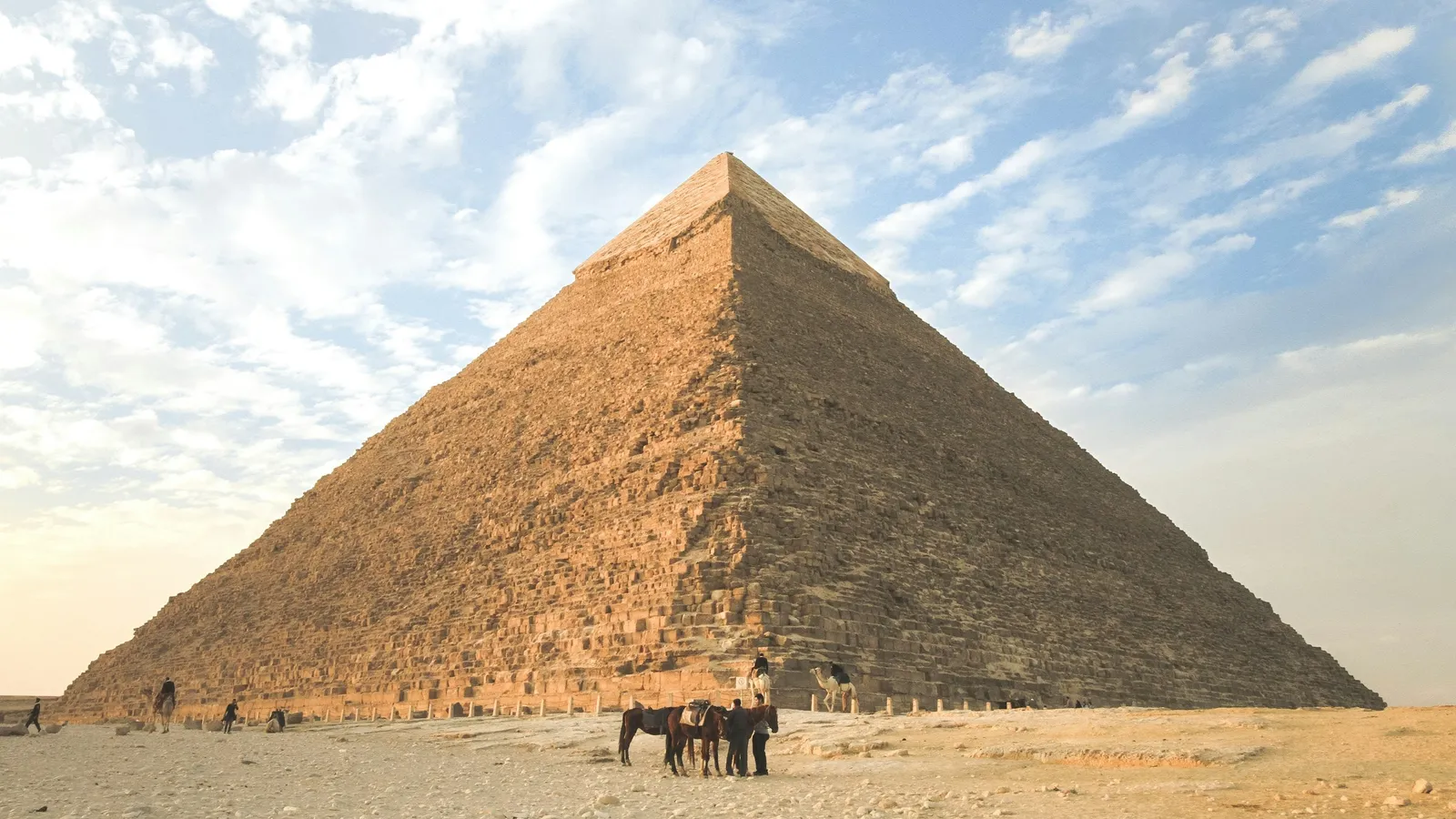
MacTutor gives two versions of the pyramid story. In one, from Diogenes Laertius, Thales waited for the moment when shadows equal the heights of the objects that cast them. In Plutarch's version, he set up a stick at the end of the pyramid's shadow and compared the two triangles formed by the Sun's rays. That second method is similar triangles.
Here it is with illustrative numbers.
A stick 1.5 m tall casts a shadow 2.0 m long.
At the same moment, the pyramid's shadow, measured from the point under its apex, is 196 m.
The Sun's rays are parallel, so the two triangles have the same angles and are similar. Height ÷ shadow is the same for both.
Height = 196 × (1.5 ÷ 2.0) = 196 × 0.75 = 147 m.
Common mistake: measuring the pyramid's shadow only from the edge of its base. The apex sits above the centre, so you must add half the base width to the visible shadow. This is the same error students make when a JEE question puts a lamp post at a distance and asks for the length of a shadow: measure from the foot of the vertical line, not from where the object begins.
Worked example 2: why the angle in a semicircle is 90 degrees
This proof uses Thales' own isosceles-triangle theorem. It is essentially how Euclid proves Book III, Proposition 31, citing Book I, Proposition 5, the base-angle theorem.
Let AB be a diameter of a circle with centre O, and let C be any other point on the circle.
OA, OB and OC are all radii, so they are equal.
Triangle OAC is isosceles, so angle OAC = angle OCA. Call this x.
Triangle OBC is isosceles, so angle OBC = angle OCB. Call this y.
The angle at C in triangle ABC is x + y.
Angles in triangle ABC add to 180°: x + y + (x + y) = 180°, so x + y = 90°.
So angle ACB is a right angle wherever C sits on the circle. Notice that one "Thales theorem" proves another. That chain of reasoning, not any single result, is what Greek geometry gave the world. Our post on Euclid's Elements shows how far it went.
How did Thales find the distance to a ship?
Proclus says Eudemus credited Thales with the congruence theorem because his method for finding a ship's distance needed it. MacTutor describes one reconstruction by the historian Heath: an observer on a tower points a sighting stick at the ship, then turns round, keeps the same angle and notes where the stick points on land. The distance to that point equals the distance to the ship, because the two triangles share a side and two angles. MacTutor also notes Thales could have used the method without any formal idea of congruence.
What can a student take from Thales?
Turn a measurement problem into a geometry problem. He could not climb a pyramid with a tape, so he used shadows.
Link results. The semicircle theorem drops out of the isosceles theorem. When you learn a new theorem, ask which older one proves it.
Be honest about evidence. Even ancient writers disagreed about who discovered what. Saying "attributed to" is accurate, not weak.
Practise this week: prove the semicircle theorem from memory, then do three height-and-shadow problems from your similar triangles chapter. Our Class 10 guide to similar triangles has more. If a proof step will not come, the Fermi Problem Library has a step-by-step solver that explains the reasoning rather than printing an answer.
Tonight, draw a circle, mark a diameter and three points on the circle, and measure the three angles to see the theorem for yourself.