

On this page
A geometric locus sounds like an abstract rule. A textbook might define a parabola as the locus of points equidistant from a focus and a directrix. If you try to memorise that, you are left with words on a page.
A 2014 study of 30 prospective mathematics teachers at a Spanish university found that dynamic geometry software helps make the cognitive leap from seeing static shapes to visualising a locus as a continuous path traced by a moving point (Gómez-Chacón & Escribano, 2014). When you drag a point across a screen and watch it leave a trail behind it, the rule becomes a shape you can see.
What is a locus?
A locus is simply the path formed by a moving point that obeys specific geometric constraints.
Instead of thinking of a circle as a ring, think of it as a single point moving around a fixed centre, staying exactly the same distance away. That distance is the radius. As the point moves, it sweeps out the locus we call a circle.
What happens when a point is equidistant from a point and a line?
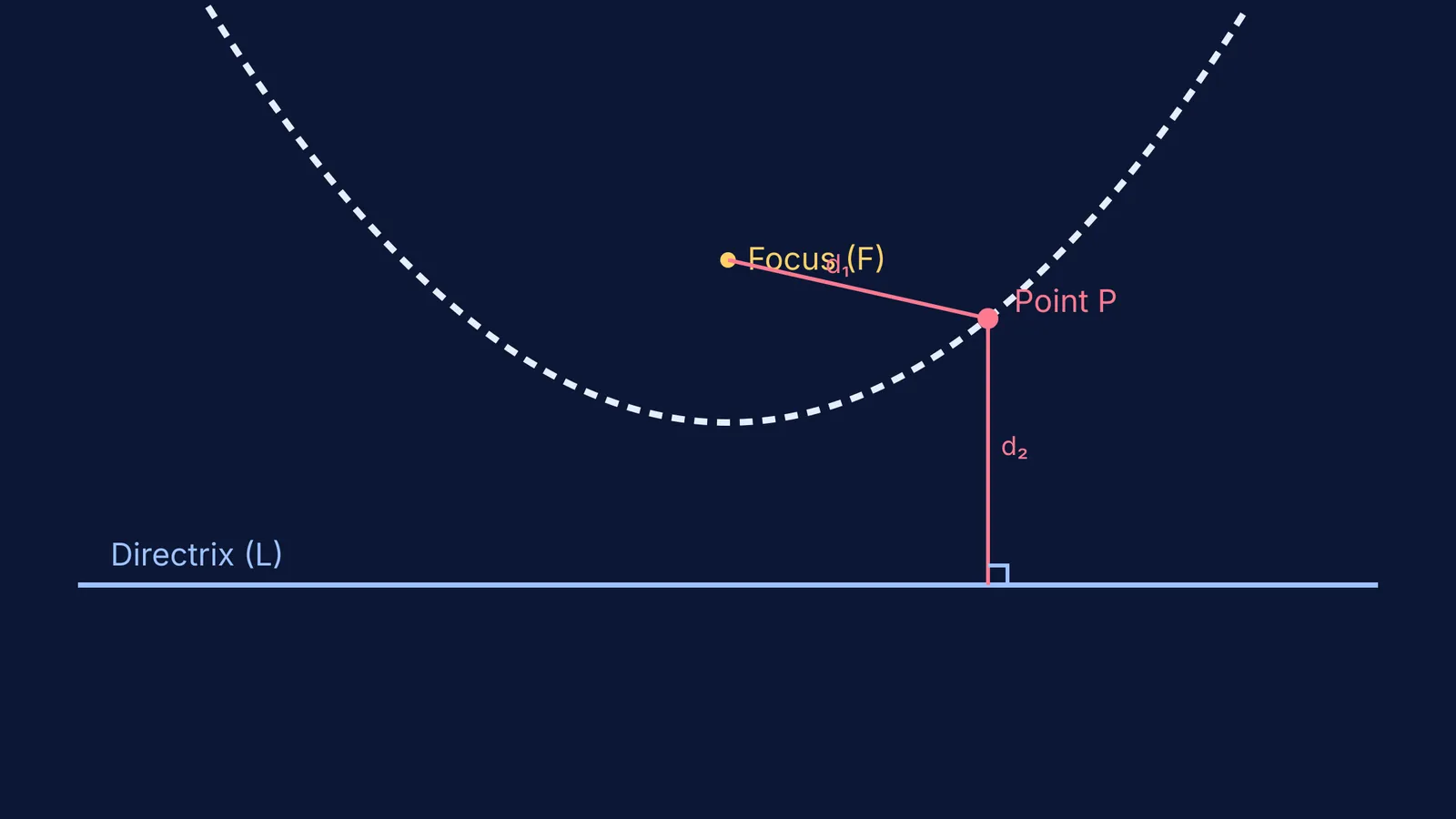
Let us take a harder rule. Imagine a fixed point (the focus) and a straight line (the directrix). What is the locus of a moving point that stays exactly the same distance from both?
If you pick a point halfway between the focus and the directrix, that is one valid spot (the vertex). But as your point moves left or right, it has to curve away from the line to stay equidistant from the focus. If you trace that movement, the point sweeps out a parabola.
This is not just a coordinate geometry trick. It is the defining property of a parabola. The distance to the focus (d₁) divided by the distance to the directrix (d₂) is always exactly 1.
What if the distance ratio changes?
The ratio of those two distances—from the moving point to the focus, and from the moving point to the directrix—is called the eccentricity (e).
When the point moves so that d₁ / d₂ = e, the curve it traces changes completely based on the value of e:
If e = 1, the point is equidistant, and the locus is a parabola.
If 0 < e < 1, the point stays closer to the focus than to the line. The path closes in on itself, tracing an ellipse.
If e > 1, the point moves further from the focus than from the line. The path breaks open into a hyperbola.
How do you find the locus equation?
You can turn any locus rule into an algebraic equation. Here is a worked example for finding the locus of a point P(x, y) that is equidistant from the origin (0, 0) and the line y = 4.
Set up the distances: The distance to the origin is √(x² + y²). The perpendicular distance to the line y = 4 is |y − 4|.
Apply the condition: √(x² + y²) = |y − 4|.
Square both sides: x² + y² = (y − 4)².
Expand and simplify: x² + y² = y² − 8y + 16.
Solve for y: x² = −8y + 16, which rearranges to y = −(1/8)x² + 2.
The locus is a downward-opening parabola with its vertex at (0, 2).
How can you visualise these rules?
Visualising these paths in your head is hard. Drawing them on paper point by point is slow.
In the Fermi Simulation Lab, you can interact with simulations for the ideas that are easier to see than to read. You can place a focus and a directrix, drop a moving point, and drag it. As you move it, the simulation keeps the distances matched and leaves a trail of where the point has been.
If you are stuck on setting up the equations for these paths, Fermi's AI tutor can help. Bring a locus problem from your textbook. The tutor works out what you already know, builds a plan for the session, and teaches through it — drawing the figure and checking your understanding as it goes.
If you want to try solving equations yourself, the Fermi Problem Library has worked problems with a step-by-step solver that explains the reasoning rather than printing an answer.
You can read more about converting motion into formulas in our guides on differentiating parametric functions and finding the equation of trajectory of a projectile.


