

On this page
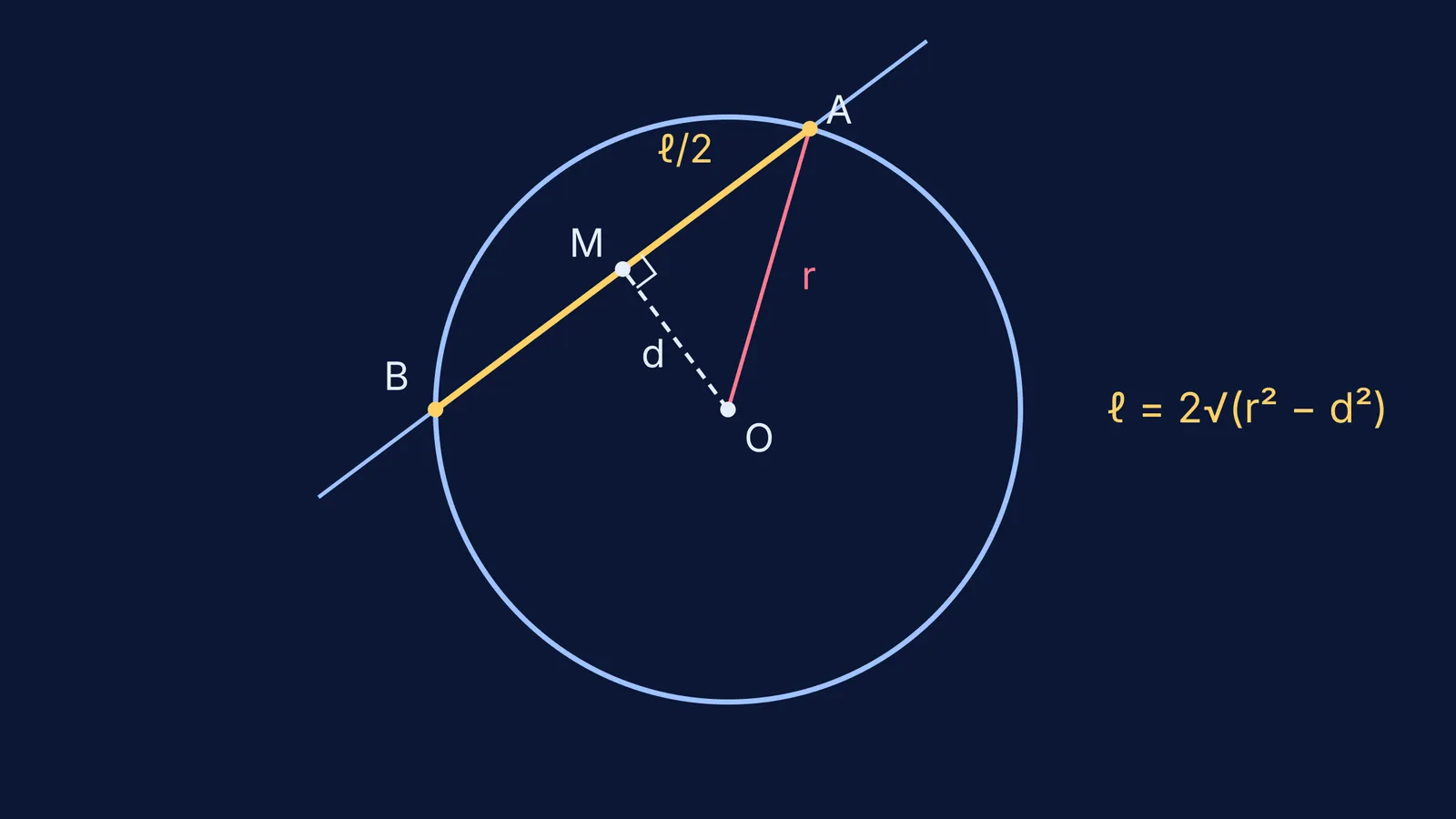
You do not need to find where a line meets a circle to know how long the chord is. Two numbers decide it: the radius r and the perpendicular distance d from the centre to the line.
What is the formula for the length of a chord cut off by a line?
For a circle of radius r and a line at perpendicular distance d from its centre, the chord length is 2√(r² − d²); Wolfram MathWorld lists it as a = 2√(R² − r²), using R for the radius and r for the centre-to-chord distance.
Why it works: let the line cut the circle at A and B, and drop the perpendicular OM from the centre O to the line. Since OA = OB = r, OM splits triangle OAB into two congruent right triangles, so M is the midpoint of AB. In right triangle OMA, Pythagoras gives AM² = r² − d², so AB = 2√(r² − d²).
To get d, use the distance from a point (x₁, y₁) to the line Ax + By + C = 0, which NCERT Class 11 Mathematics, Chapter 9, section 9.4 gives as d = |Ax₁ + By₁ + C| / √(A² + B²). The centre and radius come from writing the circle as (x − h)² + (y − k)² = r², the standard form in NCERT's Conic Sections chapter.
Comparing d with r also tells you whether there is a chord at all, the same three cases MathWorld's circle-line intersection page sorts by a discriminant:
d < r: the line cuts the circle twice, and the formula gives the chord.
d = r: the line is a tangent, and the formula gives 0.
d > r: the line misses, and there is no chord.
How do you find the chord length step by step?
Worked example: find the chord that the line 3x − 4y − 3 = 0 cuts on x² + y² − 4x + 6y − 12 = 0.
Complete the squares: (x − 2)² + (y + 3)² = 4 + 9 + 12 = 25. Centre (2, −3), r = 5.
Distance: d = |3(2) − 4(−3) − 3| / √(9 + 16) = 15/5 = 3.
Check d < r: 3 < 5, so a chord exists.
Chord = 2√(25 − 9) = 2√16 = 8.
Solving the line and circle together confirms it: the points are (−3, −3) and (3.4, 1.8), which are 8 apart.
How do you find the line when the chord length is given?
If the chord has length ℓ, then d = √(r² − (ℓ/2)²), and the job becomes one distance-formula equation with one unknown.
Case 1: the direction is fixed. Find lines parallel to 3x − 4y = 0 that cut a chord of length 8 on the same circle. Here d = √(25 − 16) = 3. Any parallel line is 3x − 4y + c = 0, so |6 + 12 + c| / 5 = 3, giving c = −3 or c = −33. Two answers, one on each side of the centre: 3x − 4y − 3 = 0 and 3x − 4y − 33 = 0.
Case 2: the line passes through a fixed point. Find lines through (3, 6) that cut a chord of length 8 on x² + y² = 25. Again d = 3, from (0, 0). Write the line as mx − y + 6 − 3m = 0. Then |6 − 3m| / √(m² + 1) = 3. Squaring: 36 − 36m + 9m² = 9m² + 9, so m = 3/4, and the line is 3x − 4y + 15 = 0.
A point outside a circle usually gives two such lines, but here the m² terms cancelled and left one. That signals a vertical line, which slope form cannot write. Test x = 3: its distance from (0, 0) is 3, and it meets the circle at (3, 4) and (3, −4), a chord of exactly 8.
If you keep losing a line in problems like Case 2, the Fermi Problem Library has worked problems with a step-by-step solver that explains the reasoning rather than printing an answer.
Which mistakes cost marks on chord-length questions?
Reading the centre and radius before dividing through, when the circle starts as 2x² + 2y² + … = 0.
Forgetting the absolute value in the distance formula, which hides the second line.
Not checking d < r first. If d > r, write "no chord" instead of forcing a square root of a negative number.
The chord of a larger circle that touches a smaller concentric circle is this formula with d equal to the smaller radius. When you know a chord's midpoint rather than its length, the T = S₁ chord equation is quicker. If the distance formula or circle equations feel shaky, the Fermi Concept Library gives each mathematics concept its own lesson and its place in the map.


