

On this page
When two circles share the same centre, any straight line tangent to the inner circle that terminates on the outer circle is a chord of the larger circle. Calculating its length is a classic question in school geometry because it bridges two separate circle theorems from two successive years of study. Instead of demanding trigonometry or coordinate geometry, the problem resolves into a single right-angled triangle governed by the Pythagorean theorem.
Why does the tangent chord get bisected?
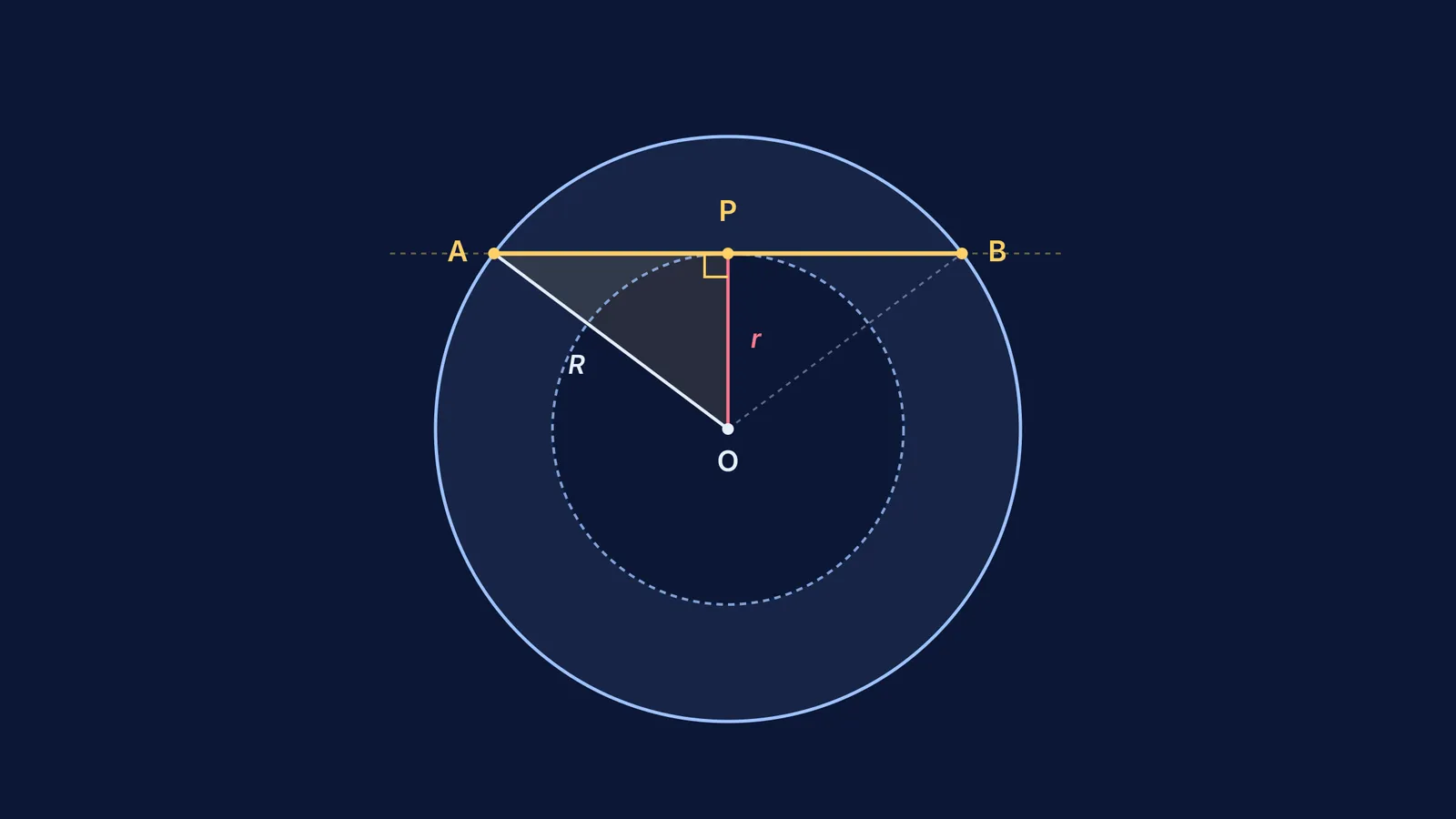
Consider two concentric circles, C₁ and C₂, with a common centre O. Circle C₁ has radius R, and circle C₂ has radius r, with R > r. Chord AB of circle C₁ touches the inner circle C₂ at point P.
In geometry, touching means tangency: line segment AB intersects C₂ at exactly one point, P. Under the secondary mathematics curriculum published by the Central Board of Secondary Education, the tangent at any point of a circle is perpendicular to the radius through the point of contact. Because AB is tangent to C₂ at P, radius OP is perpendicular to AB (OP ⊥ AB).
Now look at AB from the perspective of the outer circle C₁. In C₁, AB is a chord, and OP is drawn from centre O perpendicular to it. As established in the curriculum for chords and circle properties in Class 9, the perpendicular dropped from the centre of a circle to a chord bisects the chord.
Therefore, point P bisects chord AB, which means AP = PB = AB / 2.
This connects Class 9 chord bisection with Class 10 tangent theorems with worked examples: the point of tangency on the inner circle is always the exact midpoint of the outer chord.
How do you derive the chord length 2√(R² − r²)?
To find the chord length AB, join centre O to endpoint A, forming right-angled triangle OPA with the right angle at vertex P.
The three sides of triangle OPA are:
Hypotenuse OA = R (radius of the larger circle)
Perpendicular leg OP = r (radius of the smaller circle)
Base leg AP = AB / 2 (half of chord AB)
Applying the Pythagorean theorem to right-angled triangle OPA gives OA² = OP² + AP², which translates to R² = r² + AP².
Rearranging the terms gives AP² = R² − r², so the half-chord length is AP = √(R² − r²). Because point P bisects chord AB, the total chord length is: AB = 2 × AP = 2√(R² − r²)
The geometric requirement R > r guarantees that R² − r² is strictly positive. If R = r, the chord collapses to a single tangent point of length 0.
How do you solve the NCERT 5 cm and 3 cm problem step by step?
Under the CBSE Class 10 Mathematics syllabus, a standard NCERT question asks for the chord length of a larger circle of radius 5 cm touching an inner concentric circle of radius 3 cm. You can present the solution in five clean steps:
Identify given values: outer radius R = 5 cm, and inner radius r = 3 cm.
State the tangent property: chord AB touches the inner circle at P, so OP ⊥ AB because the radius meets the tangent at 90°.
Apply chord bisection: OP is perpendicular to chord AB in circle C₁, so P bisects AB (AP = PB).
Apply the Pythagorean theorem in right triangle OPA: AP = √(5² − 3²) = √(25 − 9) = √16 = 4 cm.
Compute the total chord length: AB = 2 × AP = 2 × 4 cm = 8 cm.
A common exam mistake is stopping at the half-chord AP = 4 cm. Another error is assuming that AB = 8 cm because 5 + 3 = 8. That addition is a coincidental feature of the 3-4-5 Pythagorean triple. If R = 13 cm and r = 5 cm, the half-chord is √(169 − 25) = 12 cm, making the full chord 24 cm, not 18 cm. The Fermi Problem Library provides worked problems with a step-by-step solver that explains the reasoning rather than printing an answer, preventing dropped steps on board exams.
What happens when you use the chord to find annular area?
This chord length has a direct application in mensuration. The ring-shaped area between two concentric circles is an annulus, with area A = π (R² − r²).
As documented by mathematician Eric W. Weisstein on Wolfram MathWorld, the area of an annulus equals the area of a circle whose diameter is the chord of the outer circle tangent to the inner circle.
With chord length L = 2√(R² − r²), the semi-chord is d = L / 2 = √(R² − r²). Squaring both sides gives d² = R² − r². Substituting into the area formula yields: A = π (R² − r²) = π d² = π (L / 2)² = π L² / 4
In *The American Mathematical Monthly*, mathematicians Tom M. Apostol and Mamikon A. Mnatsakanian (2004) showed how visual calculus explains this: sweeping tangent segments around the inner circle covers the annular area purely as a function of the chord length. You do not need to measure either radius; measuring the chord gives the ring's area, a shortcut tested in CBSE problems on areas related to circles.
When tackling geometry derivations, Fermi's AI tutor works out what you already know, draws the figure on a board, and checks understanding as you work through each theorem.


