

On this page
A question gives you a conic and a point, and asks for the chord that the point bisects. Skip the endpoints: the answer is one line, T = S₁.
What do T and S₁ mean?
Write the conic as S = 0, with every term on one side. For a fixed point (x₁, y₁):
S₁ is S with x₁ and y₁ substituted. For a circle, ellipse or parabola written this way, S₁ is negative inside, zero on the curve and positive outside.
T is S with half-replacements: x² becomes xx₁, y² becomes yy₁, x becomes (x + x₁)/2, y becomes (y + y₁)/2.
For the standard forms:
Circle x² + y² + 2gx + 2fy + c = 0: T = xx₁ + yy₁ + g(x + x₁) + f(y + y₁) + c.
Parabola y² = 4ax: T = yy₁ − 2a(x + x₁), and S₁ = y₁² − 4ax₁.
Ellipse x²/a² + y²/b² = 1: T = xx₁/a² + yy₁/b² − 1, and S₁ = x₁²/a² + y₁²/b² − 1.
Hyperbola x²/a² − y²/b² = 1: T = xx₁/a² − yy₁/b² − 1, and S₁ = x₁²/a² − y₁²/b² − 1.
So T = 0 is the tangent at a point on the curve and the chord of contact from a point outside, while T = S₁ is the chord whose midpoint is (x₁, y₁).
Why does T = S₁ give the chord with a given midpoint?
Take the ellipse. Let the chord's endpoints be (p₁, q₁) and (p₂, q₂), with midpoint (h, k). Both endpoints satisfy the equation, so subtracting gives (p₁ − p₂)(p₁ + p₂)/a² + (q₁ − q₂)(q₁ + q₂)/b² = 0.
Since p₁ + p₂ = 2h and q₁ + q₂ = 2k, the chord's slope is −b²h/(a²k). The line through (h, k) with that slope is h(x − h)/a² + k(y − k)/b² = 0, which rearranges to hx/a² + ky/b² − 1 = h²/a² + k²/b² − 1. That is exactly T = S₁, and the same subtract-and-factor step works for each standard conic.
Worked examples for each conic
Circle. x² + y² = 25, midpoint (2, 1). T = 2x + y − 25 and S₁ = −20, so 2x + y = 5.
Parabola. y² = 8x (so a = 2), midpoint (3, 2). T = 2y − 4(x + 3) and S₁ = 4 − 24 = −20, giving y = 2x − 4. Check: substituting gives x² − 6x + 4 = 0, whose roots add to 6.
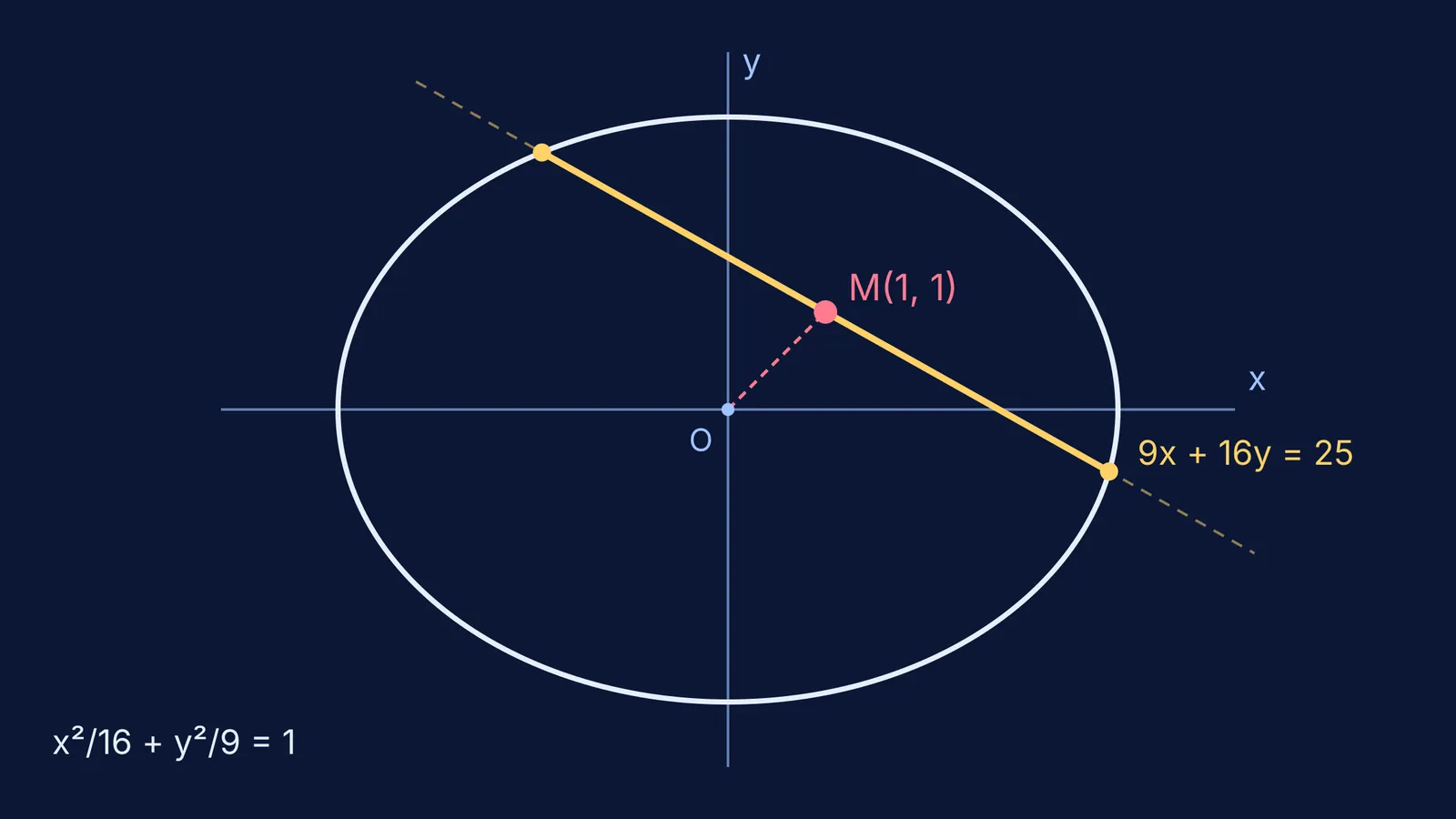
Ellipse. x²/16 + y²/9 = 1, midpoint (1, 1). T = S₁ becomes x/16 + y/9 = 1/16 + 1/9 = 25/144, so 9x + 16y = 25, the chord in the diagram above.
Hyperbola. x²/9 − y²/4 = 1, midpoint (5, 2). T = S₁ gives 5x/9 − y/2 = 25/9 − 1, so 10x − 9y = 32. Check: substituting gives 16x² − 160x + 337 = 0, with real roots adding to 10. Always run this check on a hyperbola, where some points bisect no real chord.
How is the chord of contact T = 0 different?
From a point outside a conic you can draw two tangents; the line joining their points of contact is the chord of contact, T = 0. It is also called the polar of the point: the Wikipedia article on pole and polar states that when two tangents can be drawn from a point, its polar passes through both tangent points, and Wolfram MathWorld describes it the same way.
Example: for x² + y² = 9 and the point (3, 4), the chord of contact is 3x + 4y = 9.
Two slips that cost marks:
Writing T = 0 when the question gives a midpoint. A midpoint always means T = S₁.
Dropping the halves. For a circle with 2gx, T contains g(x + x₁), not 2g(x + x₁).
If tangent, chord of contact and polar are blurring together, the Fermi Concept Library gives each concept its own lesson and its place in the map.
How do you find the locus of midpoints of chords?
T = S₁ turns most midpoint-locus questions into four steps:
Call the midpoint (h, k).
Write the chord as T = S₁ in terms of h and k.
Apply the given condition (passes through a point, fixed slope, touches a curve).
Replace h and k with x and y.
Focal chords of y² = 4ax. The chord with midpoint (h, k) is ky − 2ax = k² − 2ah. Making it pass through the focus (a, 0) gives −2a² = k² − 2ah, so the locus is y² = 2a(x − a), a parabola with its vertex at the focus.
For more practice, see our five-step method for locus problems. If your locus comes out wrong, the Fermi Problem Library has worked problems with a step-by-step solver that explains the reasoning rather than printing an answer.
Next, see Parabola for JEE: focal chords, tangents and normals and our five-step method for any conic sections problem.


