On this page
This guide is for the CBSE Class 11 school exam: what the 2026-27 syllabus keeps, the formulas to know, four solved examples with our own numbers, and practice questions with answers. Preparing for an entrance test instead? Our guide on sequences and series for JEE goes further into derivations and tricky sums.
What is in the 2026-27 syllabus for Sequences and Series?
The CBSE Mathematics curriculum for 2026-27 places Sequence and Series in Unit II, Algebra, which carries 25 marks of the 80-mark Class XI theory paper. That figure is for the whole unit, which also holds complex numbers and quadratic equations, linear inequalities, permutations and combinations, and the binomial theorem. The curriculum adds: "No chapter/unit-wise weightage. Care to be taken to cover all the chapters."
The listed content is the G.P. (general term, sum of n terms, infinite G.P. and its sum), the arithmetic mean (A.M.), the geometric mean (G.M.) and the relation between them.
A separate Class XI table in the same document says: "The following topics are included in the syllabus but will be assessed only formatively to reinforce understanding without adding to summative assessments." For this chapter it lists the special sums of k, k² and k³, so we leave them out below.
One gap to know about: the current NCERT Class 11 Mathematics chapter (Reprint 2026-27) covers sequences, series, the G.P., the G.M. and the A.M.-G.M. relation, but has no section on the sum of an infinite G.P., which the curriculum names. Ask your teacher how your school handles it.
Which formulas do you need for the G.P. and the means?
A sequence is terms in a definite order; a series is their sum, often in sigma notation (see our sequence vs series explainer).
G.P.: each term over the one before gives the same ratio r. With first term a, aₙ = arⁿ⁻¹.
Sum of the first n terms: Sₙ = a(rⁿ − 1)/(r − 1) when r ≠ 1, and Sₙ = na when r = 1.
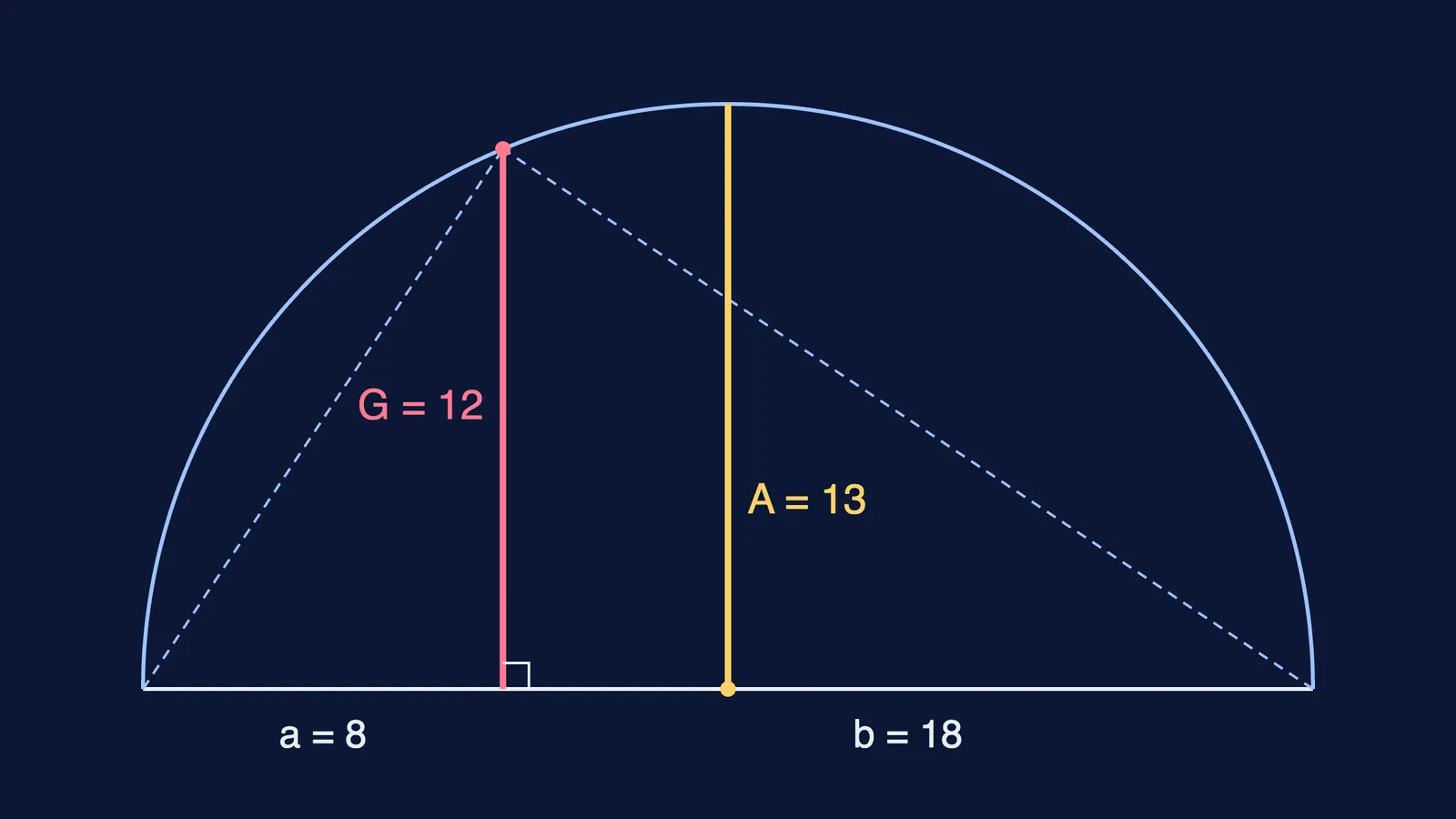
For positive a and b: A = (a + b)/2 and G = √(ab), so a, G, b is a G.P.
A ≥ G for positive a and b, because A − G = (√a − √b)²/2 ≥ 0, with equality only when a = b.
Solved examples with our own numbers
Example 1. For 3, 6, 12, …, find the 6th term and the sum of 6 terms. Here a = 3 and r = 2. The 6th term is 3 × 2⁵ = 96. The sum is S₆ = 3(2⁶ − 1)/(2 − 1) = 3 × 63 = 189. Adding 3 + 6 + 12 + 24 + 48 + 96 confirms 189.
Example 2. Which term of 5, 15, 45, … is 3645? Set 5 × 3ⁿ⁻¹ = 3645, so 3ⁿ⁻¹ = 729 = 3⁶. Then n − 1 = 6 and n = 7.
Example 3. Two positive numbers have A.M. 13 and G.M. 12. Then a + b = 26 and ab = 144. So (a − b)² = (a + b)² − 4ab = 676 − 576 = 100, so a − b = ±10. Solving gives the numbers 8 and 18. The diagram above draws this case: the radius is the A.M., the half-chord the G.M.
Example 4. Insert two numbers between 2 and 250 to make a G.P. Here 250 is the 4th term, so 2r³ = 250, r³ = 125 and r = 5. The numbers are 10 and 50.
What practice questions should you try?
The mark labels below are our suggestion for the kind of question, not a CBSE allocation.
(1 mark) Find the 7th term of the G.P. 4, −8, 16, …
(2 marks) Find the sum of the first 5 terms of 2, 6, 18, …
(3 marks) Two positive numbers have A.M. 17 and G.M. 15. Find them.
(3 marks) The 2nd term of a G.P. is 6 and the 5th term is 162. Find the sum of its first 6 terms.
(5 marks) Prove that A ≥ G for two positive numbers and say when they are equal. Then find what ₹8,000 becomes after 3 years at 5% compounded yearly.
Answers: 1. 256. 2. 242. 3. 25 and 9. 4. r = 3, a = 2, S₆ = 728. 5. Equality when the numbers are equal; ₹9,261.
Which slips should you watch for?
Writing arⁿ for the nth term. Test n = 1: it must give a.
Dropping the negative root: r² = 9 allows r = 3 or −3.
Taking a G.M. of a negative number.
Ending the A ≥ G proof without saying why (√a − √b)² is never negative.
How should you revise this chapter?
Do one short round per idea: the general term, the sum, inserting means, and the A.M.-G.M. pair. Write the formula from memory first, and check one answer by adding the terms by hand.
Stuck on a step? The Fermi Problem Library has worked problems with a step-by-step solver that explains the reasoning rather than printing an answer.