On this page
Every chapter on progressions uses aₙ, Sₙ and Σ. Mix them up and you give "the nth term" when the question asked for "the sum of n terms". Here are the two words, their notation, and checks for any answer.
What is a sequence in maths?
A sequence is an ordered list of numbers a₁, a₂, a₃, …, aₙ, …, as defined in OpenStax Calculus Volume 2. Each number is a term, and the subscript n is the index: it gives the term's position, not its value. Order matters: 2, 4, 6, 8 and 8, 6, 4, 2 are different sequences.
The same OpenStax section describes two ways to give a sequence:
An explicit formula, aₙ = f(n), lets you jump straight to any term. For aₙ = 4n − 1, the 10th term is 39.
A recurrence relation gives the first term and builds each new term from earlier ones, such as a₁ = 3 and aₙ = aₙ₋₁ + 4.
Both describe the same list: 3, 7, 11, 15, 19, …
What is a series, and what does Sₙ mean?
"The sum of the terms of a sequence is called a series," according to OpenStax College Algebra 2e. The list 3, 7, 11, 15, … becomes the series 3 + 7 + 11 + 15 + ….
The nth partial sum Sₙ is the sum of the first n terms, starting from the first term, as the same OpenStax section defines it. So here S₁ = 3, S₂ = 10, S₃ = 21 and S₄ = 36.
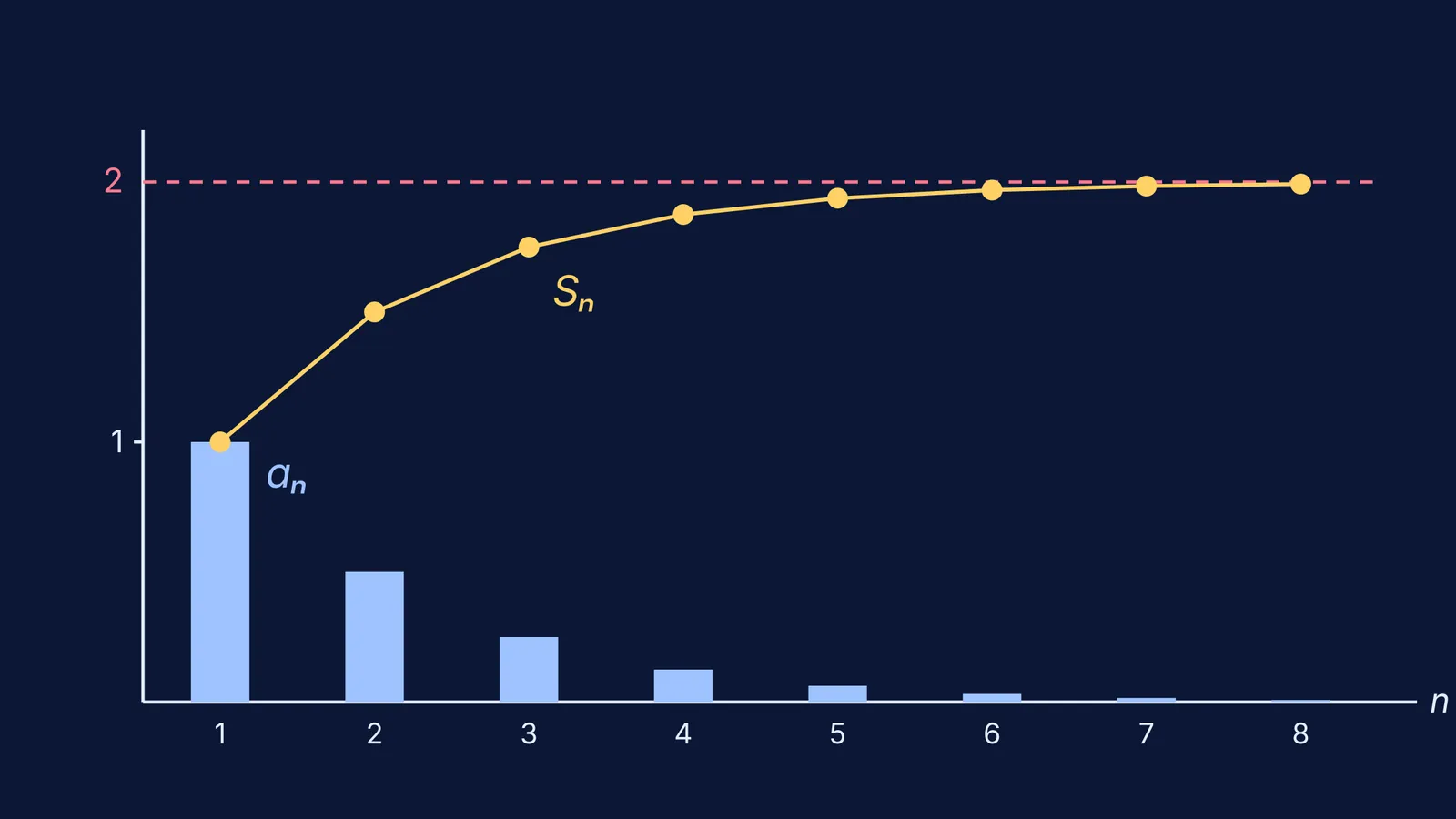
The partial sums form a sequence of their own: an infinite series converges only if its sequence of partial sums settles towards one number, which is how OpenStax Calculus defines convergence. The diagram at the top shows this for 1 + 1/2 + 1/4 + …: the blue bars (the terms) shrink, while the yellow dots (the partial sums) climb towards 2. Our post on what it means for a series to converge picks up from there.
How do you read sigma notation?
Sigma (Σ) is shorthand for "add these up". OpenStax College Algebra 2e names its parts. In Σ from k = 1 to 5 of (4k − 1):
k is the index of summation, written below the sigma.
1 is the lower limit, which gives the first term.
5 is the upper limit, which gives the last term.
4k − 1 is the rule that turns each k into a term.
So Σ from k = 1 to 5 of (4k − 1) = 3 + 7 + 11 + 15 + 19 = 55, which is S₅. In general, Sₙ is Σ from k = 1 to n of aₖ.
Watch the lower limit: Σ from k = 0 to 4 of (4k − 1) has five terms too, but totals 35.
How do you find aₙ from Sₙ? A worked example
Problem: the sum of the first n terms of a sequence is Sₙ = 2n² + n. Find aₙ.
Sₙ includes aₙ, and Sₙ₋₁ stops one term short, so aₙ = Sₙ − Sₙ₋₁ for n ≥ 2.
Sₙ₋₁ = 2(n − 1)² + (n − 1) = 2n² − 3n + 1.
aₙ = (2n² + n) − (2n² − 3n + 1) = 4n − 1.
Check n = 1 on its own: a₁ = S₁ = 3, and 4(1) − 1 = 3. It matches.
Check backwards with the arithmetic series formula Sₙ = n(a₁ + aₙ)/2 from OpenStax College Algebra 2e: n(3 + 4n − 1)/2 = 2n² + n.
Step 4 is easy to skip. If Sₙ = 2n² + n + 5, subtraction still gives 4n − 1 for n ≥ 2, but a₁ = S₁ = 8, so the sequence is not an AP from its first term.
Not sure whether a list is an AP or a GP? Our guide on how to identify an AP or GP from a sequence walks through the tests.
Which mistakes cost marks, and how do you avoid them?
Run this checklist before you write the final answer:
Underline whether the question asks for a term (aₙ, "the 20th term") or a sum (Sₙ, "the sum of n terms", Σ).
Write out the first three terms by hand. A wrong starting index shows up at once.
Check that S₁ = a₁.
For a sum, count the terms: from k = p to k = q there are q − p + 1 of them.
A slip that keeps coming back may be a gap in the idea. The Fermi Concept Library has a lesson for every concept in mathematics, each with its place in the map. For practice, the Fermi Problem Library has worked problems with a step-by-step solver that explains the reasoning rather than printing an answer.