

On this page
A question gives you four numbers and asks for the 20th term. Before any formula, you have to decide what kind of sequence it is. Pick the wrong one and every step after is wrong, however clean your algebra. The check needs only subtraction, division and the habit of testing every pair of terms, not just the first two.
How do you tell if a sequence is an AP or a GP?
Start with the definitions, because the test comes straight out of them.
An arithmetic progression is a list of numbers in which each term after the first is found by adding a fixed number, the common difference, to the term before it (NCERT Class 10 Mathematics, Chapter 5). The same chapter points out that the common difference can be positive, negative or zero.
A geometric progression is a sequence in which every term is non-zero and the ratio of each term to the one before it is a constant r, called the common ratio (NCERT Class 11 Mathematics, Chapter 8).
So the test is:
AP test: work out a₂ − a₁, a₃ − a₂, a₄ − a₃ and so on. All equal means AP.
GP test: work out a₂ ÷ a₁, a₃ ÷ a₂, a₄ ÷ a₃ and so on. All equal, with no zero terms, means GP.
What is the quickest way to check, step by step?
Use the same four steps every time.
Write the gaps. Under each neighbouring pair, write the difference. If all match, write AP and note d.
Write the ratios. If any term is zero, it cannot be a GP. Otherwise divide each term by the one before. If all match, write GP and note r.
Check every pair. 2, 4, 8, 14 has ratios 2, 2 and then 1.75; stopping early fools you.
If neither test passes, look at the differences of the differences, or at the reciprocals, before giving up.
Worked examples: which ones are AP, GP, both or neither?
The first two lists below come from the opening pages of the NCERT Class 10 chapter on APs (NCERT Class 10, Chapter 5).
8000, 8500, 9000, ... (a salary with a fixed yearly raise). Differences: 500, 500. AP with d = 500.
10000, 12500, 15625, 19531.25 (savings that grow to 5/4 of themselves every three years). Differences: 2500, 3125, 3906.25, so not an AP. Ratios: 1.25, 1.25, 1.25. GP with r = 5/4.
−2, 4, −8, 16. Differences: 6, −12, 24. Ratios: −2, −2, −2. GP with a negative ratio, which is why the signs alternate.
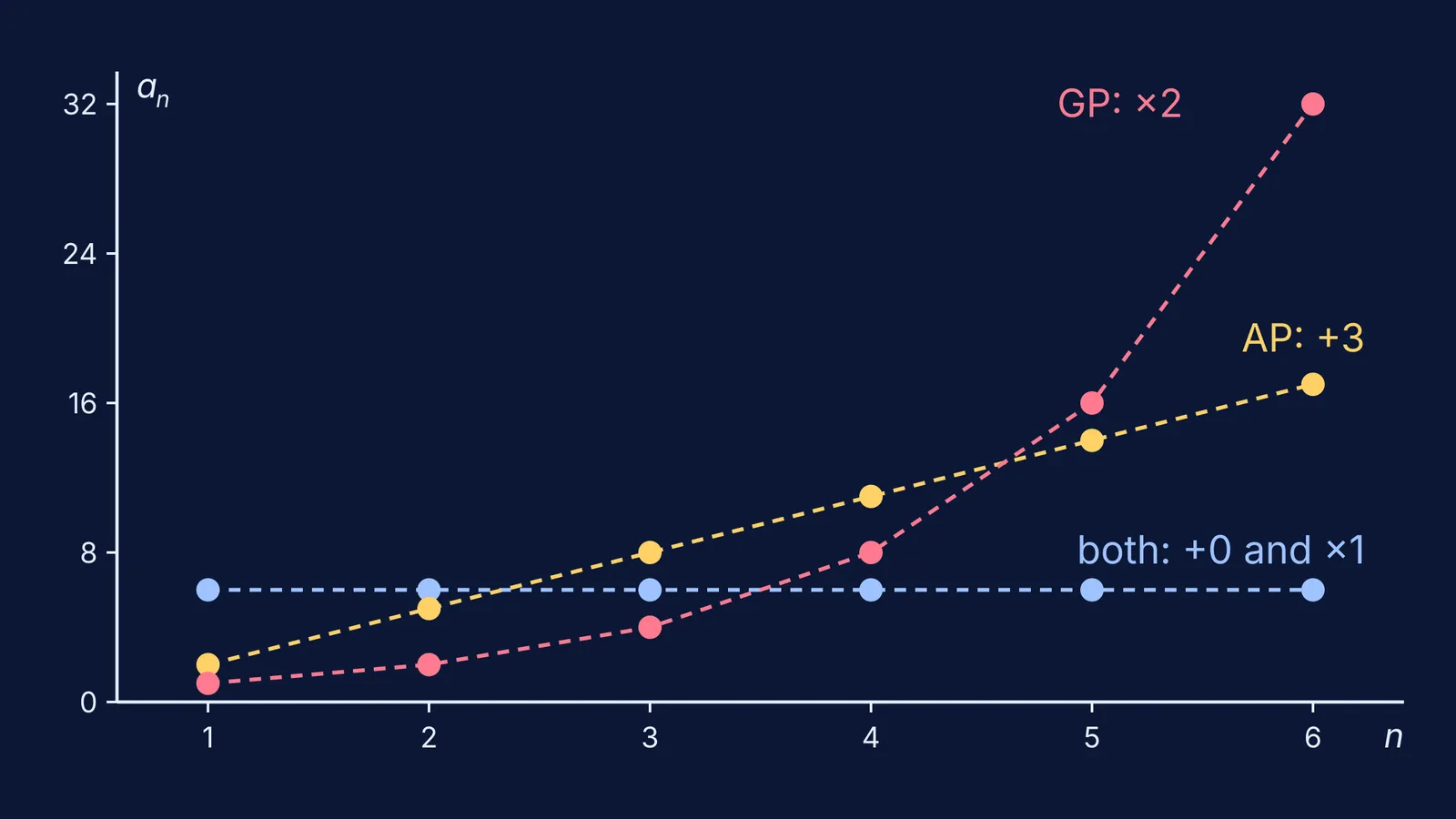
3, 3, 3, 3. Differences: 0, 0, 0. Ratios: 1, 1, 1. Both an AP (d = 0) and a GP (r = 1).
1, 1, 2, 3, 5, 8 (the rabbit-pairs sequence NCERT uses as an example). Differences: 0, 1, 1, 2, 3. Ratios: 1, 2, 1.5, 1.67, 1.6. Neither.
Can a sequence be both an AP and a GP?
Yes, but only one kind: a constant sequence with a non-zero term, like 3, 3, 3 or −7, −7, −7.
Here is why nothing else works. Take three terms of an AP: a, a + d, a + 2d. If they are also in GP, the middle term squared equals the product of its neighbours, so (a + d)² = a(a + 2d). Expanding gives a² + 2ad + d² = a² + 2ad, which leaves d² = 0. So d must be 0 and every term is equal.
The all-zero sequence 0, 0, 0 is an AP with d = 0, but it is not a GP, because the NCERT definition requires every term of a GP to be non-zero.
What if a sequence is neither an AP nor a GP?
That is normal. The useful question becomes what pattern it does follow. Three checks are worth trying first.
Differences of the differences. For 1, 4, 9, 16, 25 the differences are 3, 5, 7, 9, and those form an AP. A constant second difference means the nth term is a quadratic in n.
Reciprocals. If 1/a₁, 1/a₂, 1/a₃ form an AP, the sequence is a harmonic progression. Our guide on solving harmonic progression problems by flipping to an AP works through these.
A rule linking each term to the last. Sequences like 1, 5, 17, 53 follow aₙ = 3aₙ₋₁ + 2, which is neither add-a-constant nor multiply-by-a-constant. See how to find the nth term of aₙ = p·aₙ₋₁ + q.
For the AP side alone, our post on checking whether a sequence is an arithmetic progression goes deeper.
When a verdict goes wrong and you cannot see why, the Fermi Problem Library has worked problems with a step-by-step solver that explains the reasoning rather than printing an answer. If the gap is the idea itself, the Fermi Concept Library gives each mathematics concept its own lesson.
Next time you meet a sequence, write the differences and ratios under it before you reach for a formula.


