

On this page
A harmonic progression such as 2/3, 2/5, 2/7, 2/9 looks awkward: fractions with shrinking gaps. The trick for almost every HP question is to stop working with the HP. Flip each term, solve the AP you get, and flip back.
What is a harmonic progression?
A harmonic progression is a sequence formed by taking the reciprocals of an arithmetic progression (Wikipedia: Harmonic progression). So 2/3, 2/5, 2/7, 2/9 is an HP because 3/2, 5/2, 7/2, 9/2 is an AP with common difference 1. The same page requires that no term of the underlying AP is zero, since zero has no reciprocal, and notes that each term of an HP is the harmonic mean of its neighbours.
How do you solve harmonic progression problems step by step?
Write down the reciprocals of the terms you are given.
Treat them as an AP with first term A and common difference D.
Use AP formulas to find what is asked: a term, D, or a missing value.
Flip that answer back to get the HP term.
Worked example. The 3rd term of an HP is 1/7 and the 7th term is 1/15. Find the 10th term.
The reciprocals form an AP, so A + 2D = 7 and A + 6D = 15. Subtracting gives 4D = 8, so D = 2 and A = 3. The 10th reciprocal is A + 9D = 3 + 18 = 21, so the 10th term of the HP is 1/21.
What is the harmonic mean of two numbers?
The harmonic mean is the reciprocal of the arithmetic mean of the reciprocals, and for two numbers a and b it equals 2ab/(a + b) (Wikipedia: Harmonic mean). To see why, note that if a, H, b are in HP, then 1/a, 1/H, 1/b are in AP, so 2/H = 1/a + 1/b.
If you travel a distance at speed v₁ and return the same distance at speed v₂, your average speed is the harmonic mean of v₁ and v₂, not their arithmetic mean (same source). Going at 40 km/h and returning at 60 km/h gives 2 × 40 × 60 / 100 = 48 km/h, not 50 km/h.
How do you insert n harmonic means between two numbers?
Inserting n harmonic means between a and b means filling in n terms so that all n + 2 terms form an HP. Flip the two ends, insert n arithmetic means between 1/a and 1/b, then flip each one back. The common difference of that AP is D = (1/b − 1/a)/(n + 1).
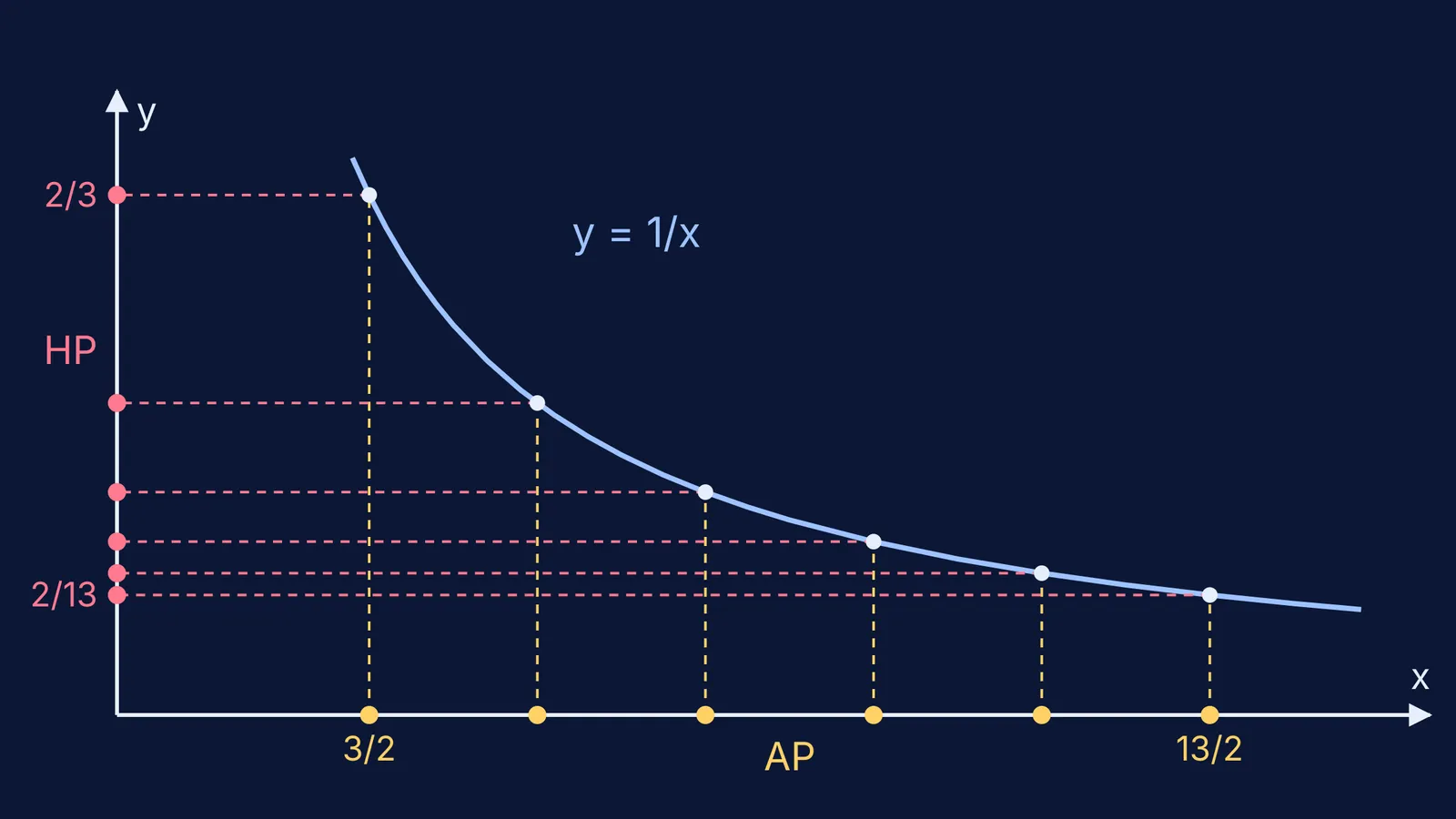
Worked example. Insert four harmonic means between 2/3 and 2/13.
Reciprocals of the ends: 3/2 and 13/2.
There are six terms in all, so D = (13/2 − 3/2)/5 = 1.
The AP is 3/2, 5/2, 7/2, 9/2, 11/2, 13/2.
Flip the middle four: the harmonic means are 2/5, 2/7, 2/9 and 2/11.
The diagram above shows this example: equally spaced x-values, sent through y = 1/x, land at unequally spaced heights. Our guide to inserting arithmetic and geometric means between two numbers uses the same pattern.
How are AM, GM and HM related?
For positive numbers, AM ≥ GM ≥ HM, and the three are equal only when all the numbers are equal (Wikipedia: Harmonic mean). For two numbers there is a closer link: G² = A × H (same source).
Check it with 4 and 9. A = 6.5, G = 6 and H = 2 × 4 × 9 / 13 = 72/13, about 5.54. Then A × H = 6.5 × 72/13 = 36, which is G². The order 6.5 > 6 > 5.54 matches AM ≥ GM ≥ HM.
G² = AH is a quick route when a question gives two of the means and asks for the third: if A = 10 and G = 8, then H = 64/10 = 6.4. For using the inequality to find maximum and minimum values, see the AM-GM inequality in JEE maths.
What mistakes cost marks in HP questions?
Using the AP sum formula on the HP terms themselves.
Solving the AP correctly and forgetting to flip back.
Getting an HM larger than the GM of the same positive numbers, which is a sure sign of an algebra slip.
Missing an HP hidden in the wording: if 1/a, 1/b, 1/c are in AP, then a, b, c are in HP.
Picking awkward unknowns. Writing the reciprocals as A − D, A, A + D keeps the algebra short, as in choosing three numbers in AP or GP.
If you keep choosing the wrong method rather than slipping on arithmetic, the Fermi Problem Library has worked problems with a step-by-step solver that explains the reasoning rather than printing an answer. If the gap is in the definitions underneath, the Fermi Concept Library gives each concept its own lesson and shows where it sits in the map.
Next time an HP turns up in a mock test, write the reciprocals down first. Most of the question is then an AP you already know how to solve.


