

On this page
An arithmetic progression (AP) is one of the first formal sequences you meet in mathematics. Recognizing one is straightforward when the numbers are simple and laid out clearly, but exams often disguise them with square roots, fractions, or algebraic formulas.
If you are stuck on a textbook problem and cannot tell whether a list of numbers forms an AP, the Fermi Problem Library can guide you through testing the sequence step by step.
Here is how to test any sequence to see if it is a true arithmetic progression, and how to spot the traps examiners use to trick you.
What is the simplest way to check if a sequence is an AP?
By definition, an arithmetic progression is a sequence where the difference between any succeeding term and its preceding term remains constant throughout (Wikipedia). This constant value is known as the common difference, usually written as d.
To test a simple list of numbers, you must calculate the difference for at least three consecutive terms:
Find the first difference: d₁ = a₂ − a₁
Find the second difference: d₂ = a₃ − a₂
Compare the two results.
If d₁ = d₂, the sequence is an AP. If they do not match, it is not. A very common mistake among students is checking only the first pair of numbers and assuming the rest of the sequence follows the exact same rule. Always check at least the first three terms to confirm the pattern holds.
How do you check sequences with square roots like √2, √8, √18?
Examiners love to hide arithmetic progressions inside irrational numbers. A classic trap question asks whether the sequence √2, √8, √18, √32 is an AP.
At a glance, the differences appear unequal. For example, √8 − √2 is not the same as √18 − √8 if you just look at the numbers under the root sign. However, you cannot subtract square roots unless the number inside the root is identical.
To properly test this sequence, you must simplify each term first:
a₁ = √2
a₂ = √8 = √(4 × 2) = 2√2
a₃ = √18 = √(9 × 2) = 3√2
a₄ = √32 = √(16 × 2) = 4√2
Now, apply the standard test by subtracting consecutive terms:
d₁ = a₂ − a₁ = 2√2 − 1√2 = √2
d₂ = a₃ − a₂ = 3√2 − 2√2 = √2
Because the difference is a constant √2 across the terms, the sequence is indeed a valid AP.
How do you handle sequences with fractions?
Fractions are another way examiners try to hide a simple arithmetic progression. Consider the sequence 1/2, 5/6, 7/6, 3/2. At first glance, the changing denominators make it difficult to see the pattern.
To test this sequence properly, you must rewrite every term with a common denominator. In this case, 6 is the lowest common multiple for the denominators 2 and 6.
Let's convert the terms:
a₁ = 1/2 = 3/6
a₂ = 5/6
a₃ = 7/6
a₄ = 3/2 = 9/6
Now, calculate the differences:
d₁ = a₂ − a₁ = 5/6 − 3/6 = 2/6
d₂ = a₃ − a₂ = 7/6 − 5/6 = 2/6
d₃ = a₄ − a₃ = 9/6 − 7/6 = 2/6
Because every difference simplifies to 2/6 (which is 1/3), the sequence is an arithmetic progression. Finding a common denominator first is the most reliable way to avoid careless subtraction errors when working with fractions.
How to test if a formula for aₙ forms an AP?
Sometimes, you are not given a list of numbers, but an algebraic formula for the nth term, aₙ. (You might also need to use the subtraction trick to recover aₙ from a formula for Sₙ before you can start).
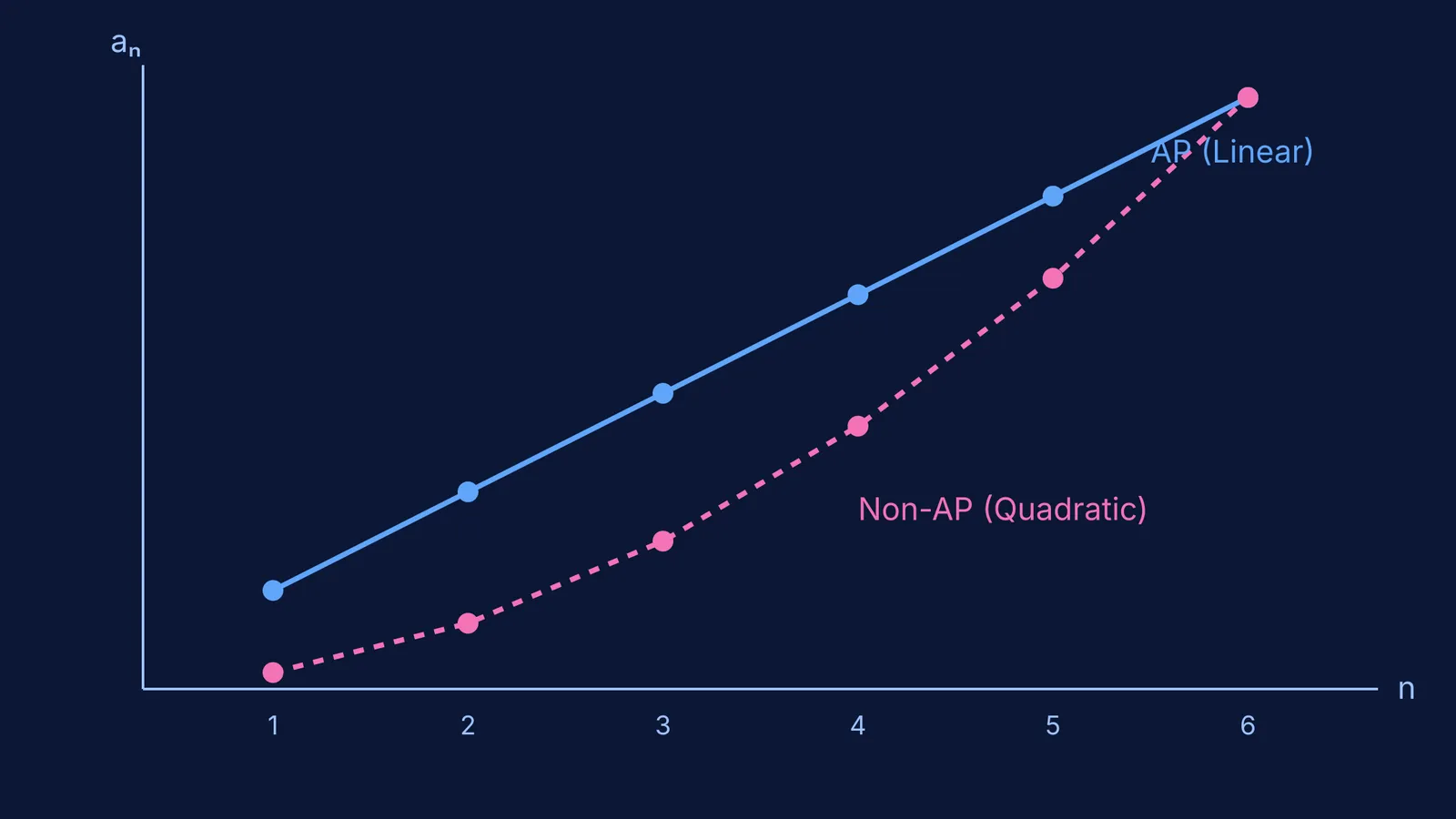
To test if a general formula generates an AP, you must prove mathematically that the difference between the nth term and the previous term, aₙ − aₙ₋₁, evaluates to a constant number that does not depend on the variable n.
Let's test the formula aₙ = 3n + 5:
The preceding term is found by replacing n with (n − 1), which gives aₙ₋₁ = 3(n − 1) + 5 = 3n − 3 + 5 = 3n + 2.
The difference is aₙ − aₙ₋₁ = (3n + 5) − (3n + 2) = 3.
Because the result is exactly 3—a pure number with no n attached—the sequence is an AP with a common difference of 3. In fact, any sequence where aₙ is a linear expression in n (of the form An + B) is always an arithmetic progression.
What sequences look like APs but are not?
Not every sequence that follows a neat, predictable pattern is an arithmetic progression. It is dangerously easy to look at a list of numbers and guess the pattern incorrectly.
Here are common lists that mimic the feel of an AP but fail the constant difference test completely:
The squares: 1², 2², 3², 4²… (which evaluates to 1, 4, 9, 16). The differences between these terms are 3, 5, 7. Because the gaps are continually growing, this is a quadratic sequence, not an AP.
The powers: 2, 4, 8, 16, 32. The differences here are 2, 4, 8, 16. This is actually a geometric progression. (If you are working with sequences like this, you might eventually find yourself rewriting sums like 9 + 99 + 999 with a GP).
Primes: 2, 3, 5, 7, 11. The gaps are 1, 2, 2, 4. There is absolutely no constant difference here.
When setting up your own equations to solve an algebra word problem, you must be extremely careful. For instance, choosing three numbers as a − d, a, and a + d is a powerful shortcut, but only if the question explicitly confirms the numbers are in an arithmetic progression. If you blindly apply it to a generic sequence, your entire solution will collapse. Always take the time to test for that constant difference first.


