On this page
Conic Sections is Chapter 10 of the current NCERT Class 11 Mathematics textbook, marked Reprint 2026-27. Here is what CBSE 2026-27 keeps, how marks work, and worked examples.
Preparing for JEE Main too? Our circles guide for JEE Main goes further; this post sticks to the school paper.
What is in Conic Sections for CBSE Class 11 in 2026-27?
The CBSE 2026-27 Mathematics curriculum lists sections of a cone, standard equations of all four conics and simple properties of the parabola, ellipse and hyperbola. The NCERT chapter matches:
Sections of a cone. A plane meets a double cone at angle β to its axis; α is the cone's semi-vertical angle. β = 90° gives a circle, α < β < 90° an ellipse, β = α a parabola, 0 ≤ β < α a hyperbola.
Degenerate cases. A plane through the vertex gives a point, a straight line or a pair of intersecting lines.
Scope. Ellipses and hyperbolas are centred at the origin, axes along the coordinate axes.
How many marks does Conic Sections carry in Class 11?
The course-structure table gives marks per unit, not per chapter. Conic Sections sits in Unit III, Coordinate Geometry, which carries 12 of the 80 theory marks, with 20 more for internal assessment (CBSE curriculum, Class XI course structure). Straight Lines and Introduction to Three-dimensional Geometry share those 12 marks. The curriculum adds: "No chapter/unit-wise weightage. Care to be taken to cover all the chapters."
How do the four conics compare?
From the NCERT chapter, with a > 0:
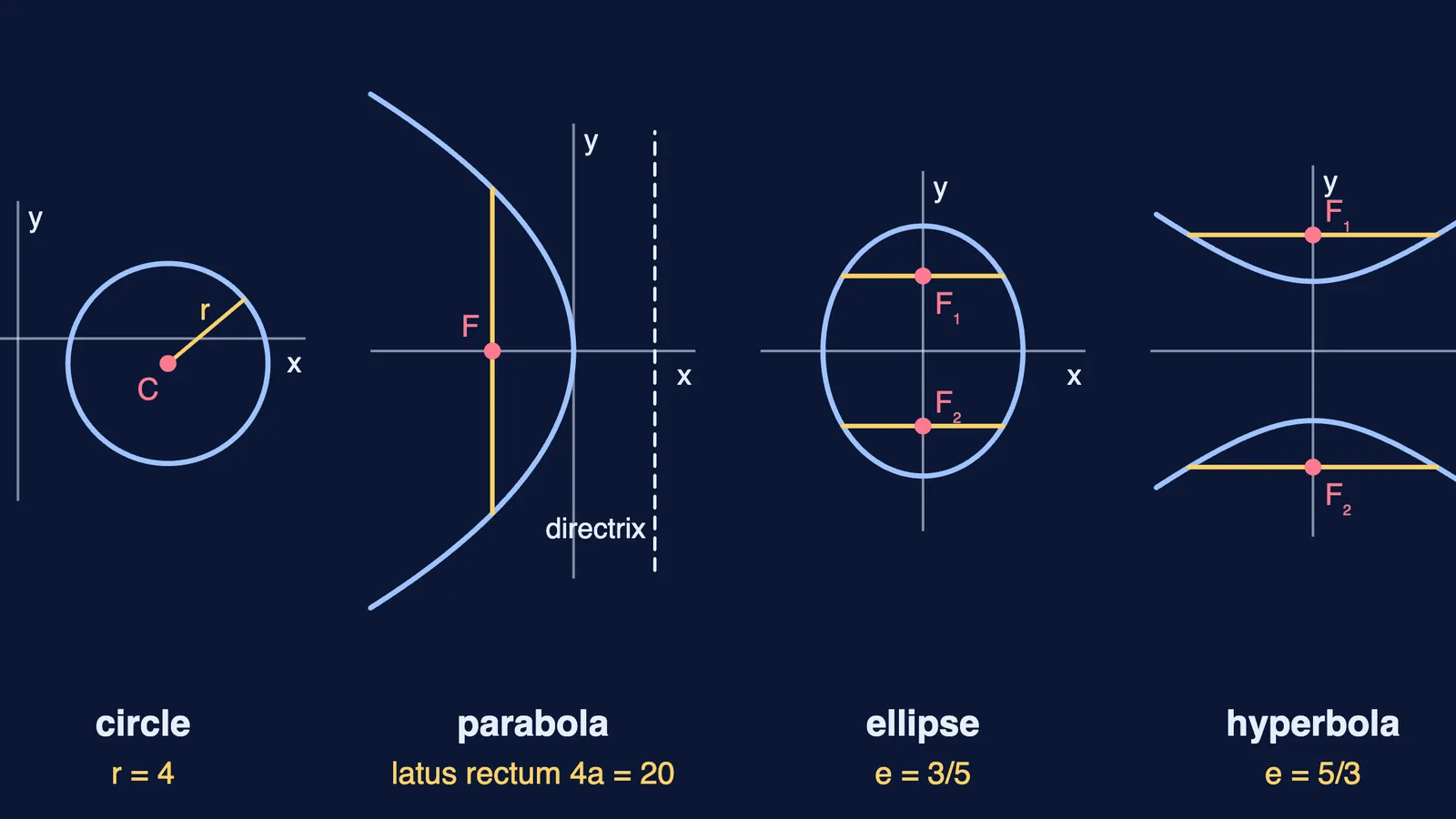
Circle (x − h)² + (y − k)² = r². Centre (h, k), radius r.
Parabola y² = 4ax. Focus (a, 0), directrix x = −a, latus rectum 4a. Other forms: y² = −4ax, x² = 4ay, x² = −4ay.
Ellipse x²/a² + y²/b² = 1, a > b. Foci (±c, 0), c² = a² − b², vertices (±a, 0), latus rectum 2b²/a, e = c/a.
Hyperbola x²/a² − y²/b² = 1. Foci (±c, 0), c² = a² + b², vertices (±a, 0), latus rectum 2b²/a, e = c/a.
In an ellipse c < a, so e < 1; a hyperbola's e is never less than 1. An ellipse's foci lie on the axis of the larger denominator; a hyperbola's, on the axis of the positive term. For what e does to the shape, see what eccentricity tells you about a conic.
How do you find the focus, foci and eccentricity step by step?
Our own numbers, checked by hand and by program. The mark splits are our suggestion, not CBSE's.
Example 1. Centre and radius of x² + y² − 12x + 2y + 21 = 0.
Complete squares: (x − 6)² + (y + 1)² = −21 + 36 + 1 = 16. [1 mark]
Centre (6, −1), radius 4. [1 mark]
Example 2. Focus, directrix and latus rectum of y² = −20x.
Compare with y² = −4ax: a = 5, opening left. [1 mark]
Focus (−5, 0), directrix x = 5, latus rectum 20. [1 mark]
Example 3. Foci, vertices, e and latus rectum of 25x² + 16y² = 400.
Divide by 400: x²/16 + y²/25 = 1. The larger denominator is under y², so a = 5, b = 4. [1 mark]
c = √(25 − 16) = 3: foci (0, ±3), vertices (0, ±5). [1 mark]
e = 3/5; latus rectum 2(16)/5 = 32/5. [1 mark]
Example 4. Hyperbola with vertices (0, ±6) and e = 5/3.
Vertices on the y-axis, so y²/a² − x²/b² = 1 with a = 6. [1 mark]
c = ae = 10, so b² = 100 − 36 = 64. [1 mark]
y²/36 − x²/64 = 1, latus rectum 64/3. [1 mark]
What questions can you practise for the school exam?
We wrote these. The mark labels are our suggestion; your school's paper may differ.
A plane through the cone's vertex has β = α. What is the section? [1 mark]
Find the eccentricity of x²/49 + y²/24 = 1. [1 mark]
Find the circle with centre (−2, 5) through (1, 1). [2 marks]
Find the hyperbola with foci (±10, 0) and conjugate axis 12. [3 marks]
Find the ellipse with foci (±2, 0) through (2, 3), and its latus rectum. [5 marks]
Answers: 1) A straight line. 2) 5/7. 3) (x + 2)² + (y − 5)² = 25. 4) x²/64 − y²/36 = 1. 5) x²/16 + y²/12 = 1, latus rectum 6.
Which slips cost marks?
Not sure where to start? Fermi's AI tutor can work out what you already know and build a plan for the session.