On this page
How many marks is Classification of Elements in CBSE Class 11?
The Class XI course structure in the CBSE Chemistry curriculum for 2026-27 lists Unit 3, Classification of Elements and Periodicity in Properties, at 6 of the 70 theory marks. Its topics run from the modern periodic law and naming elements above Z = 100 to the four blocks and periodic trends.
The curriculum's question paper design gives 40% of marks to remembering and understanding, 30% to applying, and 30% to analysing, evaluating and creating, with 33% internal choice in all sections. Its notes add that no chapter-wise weightage is provided, so treat 6 as the unit's course-structure mark, not a fixed share of your paper.
Study from the rationalised NCERT Chemistry Part I, Unit 3 (Reprint 2026-27).
What does the modern periodic law say?
Mendeleev arranged elements by atomic mass; in 1913 Henry Moseley's X-ray spectra showed atomic number is more fundamental, as the NCERT chapter explains. In the modern periodic law, atomic number replaces atomic mass: the physical and chemical properties of elements repeat periodically as atomic number increases.
The long form has seven periods and 18 groups. The period number is the valence shell's n; the block is the subshell that receives the last electron. See our guide on finding period, group and block from atomic number. Hydrogen sits on its own; see why hydrogen's position is anomalous.
How do the periodic trends change across a period and down a group?
Across a period, electrons enter the same shell while nuclear charge rises. Down a group, a new shell is added and inner electrons shield the outer ones. The values below are from the NCERT tables in Unit 3.
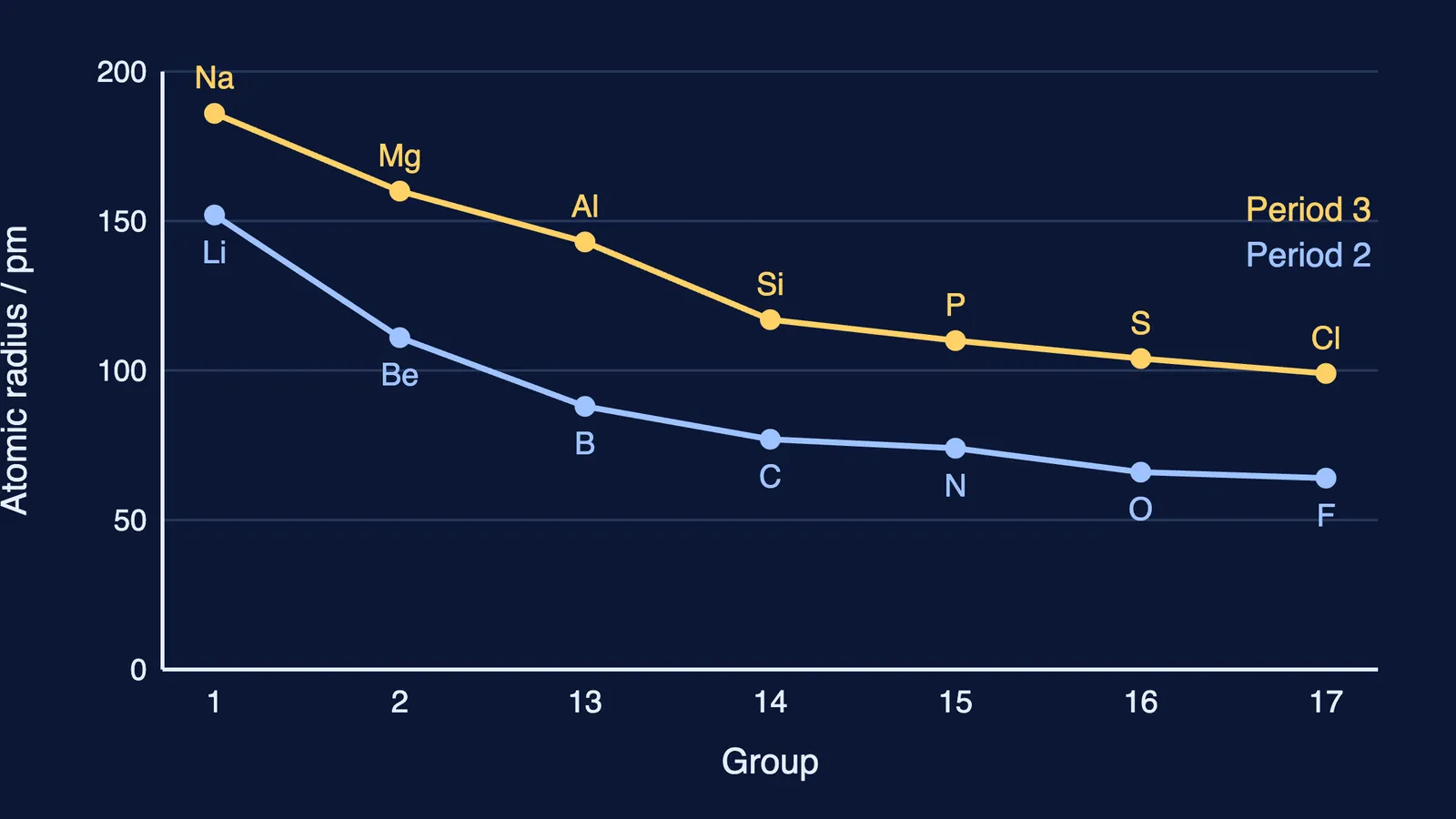
Atomic radius falls across a period and rises down a group. Lithium is 152 pm and fluorine 64 pm; sodium is 186 pm and chlorine 99 pm.
Ionisation enthalpy generally increases from left to right and decreases as you go down a group.
Electron gain enthalpy usually turns more negative from left to right, and less negative as you go down a group.
Electronegativity increases left to right and decreases down a group. On the Pauling scale, fluorine is 4.0 and lithium 1.0.
Metallic character falls across a period and rises down a group.
The chart above plots these radii.
Which exceptions do board questions test?
The NCERT text explains three exceptions you should be able to reason out.
Boron below beryllium in ionisation enthalpy. Boron gives up a 2p electron, beryllium a 2s one. The 2p electron penetrates less toward the nucleus and is screened by the 2s pair, so it leaves more easily.
Oxygen below nitrogen in ionisation enthalpy. Nitrogen has one electron in each 2p orbital (Hund's rule). Oxygen's fourth 2p electron must pair up, and repulsion within that orbital lets it go more easily.
Chlorine more negative than fluorine in electron gain enthalpy. In NCERT's Table 3.7, chlorine is −349 kJ mol⁻¹ and fluorine −328 kJ mol⁻¹; sulphur (−200) is likewise more negative than oxygen (−141). In F and O the incoming electron is squeezed into a compact second shell, where repulsion is stronger than in the larger third shell of Cl or S.
For the JEE Main angle, read periodic trends for JEE Main. For boards, write each reason in one or two lines.
Practice questions for the board exam
We wrote these questions. The mark labels are our suggestion, not CBSE's.
(1 mark) Write the IUPAC temporary name and symbol for Z = 119.
Answer: the roots for 1, 1 and 9 are un, un and enn, so the name is ununennium and the symbol Uue.
(2 marks) Locate the element with Z = 34 in the periodic table.
Answer: 1s² 2s² 2p⁶ 3s² 3p⁶ 3d¹⁰ 4s² 4p⁴. Valence shell n = 4, so period 4; the last electron enters a p orbital, so p-block; 2 + 4 = 6 valence electrons gives group 10 + 6 = 16.
(2 marks) NCERT lists covalent radii of 99 pm for chlorine and 114 pm for bromine. Estimate the Br–Cl bond length in BrCl.
Answer: each atom contributes its covalent radius, so the bond is about 99 + 114 = 213 pm.
(3 marks) Arrange Ca²⁺, Cl⁻, K⁺ and S²⁻ in decreasing order of radius, with a reason.
Answer: each has 18 electrons; nuclear charge rises from 16 (S) to 17 (Cl), 19 (K) and 20 (Ca), so the ions shrink in that order: S²⁻ > Cl⁻ > K⁺ > Ca²⁺.
(3 marks) Why is sulphur's first ionisation enthalpy lower than phosphorus's? Use electronic configurations.
Answer: phosphorus, [Ne]3s² 3p³, has one electron in each 3p orbital. Sulphur, [Ne]3s² 3p⁴, must pair one, and the repulsion makes it easier to remove, as for O and N.
How should you revise this chapter?
Make one page with the five trends, their directions and one-line reasons, then the three exceptions. Practise ranking questions until each reason comes from memory.
Unsure where your gaps are? Fermi's AI tutor can work out what you already know and build a plan for the session, so you start with a clear next step.