On this page
Most periodic tables print hydrogen at the top of group 1, above lithium and sodium. The Royal Society of Chemistry's periodic table lists it in group 1, period 1, and gives its melting point as 13.99 K (RSC periodic table: hydrogen). So the element heading a column of soft, shiny metals is a colourless gas that only freezes about 14 degrees above absolute zero.
That mismatch is why textbooks call hydrogen's position anomalous. Below is the evidence for each side, where each comparison breaks down, and how to write the answer in an exam.
Why does hydrogen resemble the alkali metals?
The case for group 1 rests on electron configuration. PubChem's element data gives hydrogen as 1s1, lithium as [He]2s1 and sodium as [Ne]3s1 (PubChem periodic table data). Each has a single electron in its outermost s orbital.
From that one electron come the familiar resemblances:
Hydrogen shows a +1 oxidation state, as sodium does.
It forms compounds with non-metals whose formulas match the alkali metals: HCl and NaCl, H2O and Na2O.
Why does hydrogen also resemble the halogens?
Now count from the other end. Hydrogen's one electron leaves it one short of helium's filled 1s2 shell, just as fluorine is one electron short of neon. Like the halogens, hydrogen can complete its shell by gaining an electron or by sharing one.
It is a non-metal and exists as a diatomic gas, H2, as fluorine and chlorine exist as F2 and Cl2.
It forms a negative ion. Saline hydrides are formed by the group 1 and 2 metals, and in them hydrogen acts as the hydride ion, H- (LibreTexts: saline hydrides/10%3A_Hydrogen/10.07%3A_Binary_Hydrides_-_Classification_and_General_Properties/10.7C%3A_Saline_Hydrides)). NaH has the same pattern as NaCl.
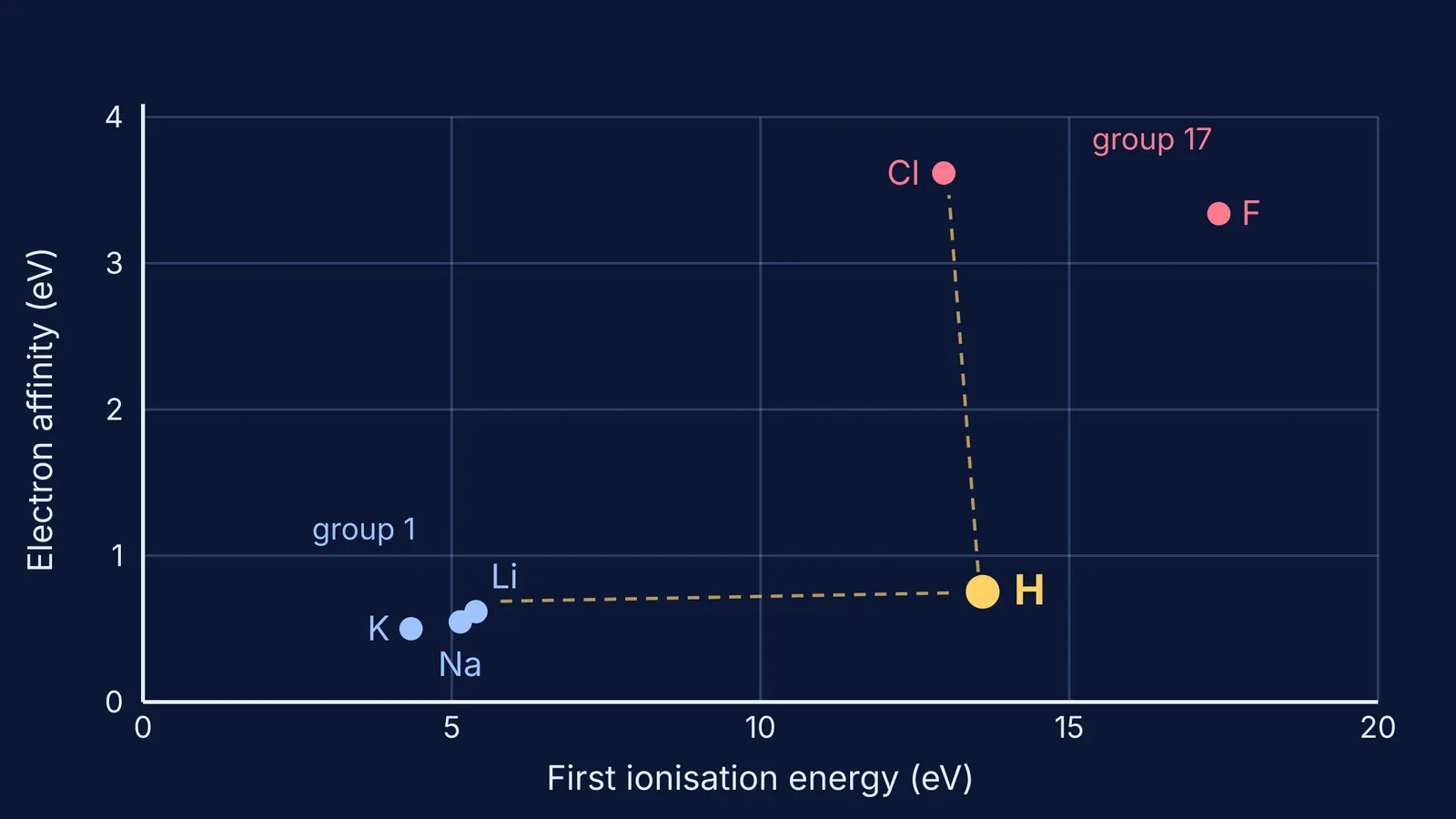
Its energy to remove an electron looks halogen-like. Hydrogen's first ionisation energy is 13.598 eV, against 12.968 eV for chlorine and 5.392 eV for lithium (PubChem periodic table data).
Why does hydrogen fit neither group fully?
Here is the part that earns marks. Hydrogen resembles both groups, but it breaks the pattern of each.
Against group 1: hydrogen's ionisation energy is about two and a half times lithium's (13.598 eV against 5.392 eV, from PubChem's periodic table data). In his 2003 paper in the Journal of Chemical Education, Marshall Cronyn of Reed College lists covalent bond energies of 435.99 kJ/mol for H-H against 110.21 kJ/mol for Li-Li, and notes that hydrogen is never a free H+ cation in any condensed medium (Cronyn, 2003). His verdict: "Hydrogen is clearly no more metallic than mashed potatoes."
Against group 17: hydrogen's electron affinity is 0.754 eV, far below fluorine's 3.339 eV and chlorine's 3.617 eV, and close to lithium's 0.618 eV (PubChem periodic table data). The hydride ion is also much less stable than the halide ions: the LibreTexts page on saline hydrides/10%3A_Hydrogen/10.07%3A_Binary_Hydrides_-_Classification_and_General_Properties/10.7C%3A_Saline_Hydrides) gives a standard enthalpy of formation of -90.5 kJ/mol for LiH against -409 kJ/mol for LiCl.
Some chemists go further. Cronyn argued that hydrogen belongs above carbon, because both have a half-filled outer shell and similar electronegativity (Cronyn, 2003). The anomaly is not a textbook quirk. Cronyn opens by calling hydrogen's place "still the subject of doubt, confusion, and inadequate explanation" after more than 130 years of the periodic table.
Hydrogen is not the only rule-breaker: see the anomalous behaviour of second-period elements and exceptions to periodic trends.
How do you answer "justify the position of hydrogen" in an exam?
Use a four-step structure. It fits a 3-mark or 5-mark question by adjusting how many points you give.
State the configuration: 1s1, one electron in its only shell, one short of a stable duplet.
Give two alkali-metal resemblances: +1 oxidation state, and formulas like HCl matching NaCl.
Give two halogen resemblances: forms H- in hydrides such as NaH, and exists as a diatomic non-metal gas, H2.
Conclude: it is placed in group 1 by configuration, but its high ionisation energy and low electron affinity set it apart from both groups, so its position is anomalous.
A quick worked check for the ionisation energy point in step 4. Using the PubChem values, the gap between hydrogen and lithium is 13.598 - 5.392 = 8.206 eV. The gap between hydrogen and chlorine is 13.598 - 12.968 = 0.630 eV. On ionisation energy, hydrogen is about 13 times closer to chlorine than to lithium.
If that sign convention trips you up, read our explainer on electron gain enthalpy and its sign. To see how ionisation energy, electron affinity and electronegativity connect, the Fermi Concept Library gives each concept its own lesson and its place in the map. For practice on give-reasons questions, the Fermi Problem Library has worked problems with a step-by-step solver that explains the reasoning rather than printing an answer.