On this page
In chemistry, students expect groups to behave uniformly. Sodium reacts like potassium, and chlorine resembles bromine. Yet the topmost element of every group—lithium, beryllium, boron, carbon, nitrogen, oxygen, and fluorine—breaks these trends.
As documented in Greenwood and Earnshaw's Chemistry of the Elements, this divergence, termed the uniqueness principle, stems from three physical factors:
Exceptionally small atomic and ionic radii with only two inner core electrons (1s²).
High electronegativity and ionization enthalpy.
The complete absence of d orbitals in quantum shell n = 2.
Because lithium and beryllium have tiny ionic radii, their high charge density polarizes adjacent anions, giving their compounds significant covalent character. Lithium chloride dissolves in ethanol, while sodium chloride forms an ionic crystal. Similarly, beryllium forms covalent halides, whereas magnesium halides form ionic lattices.
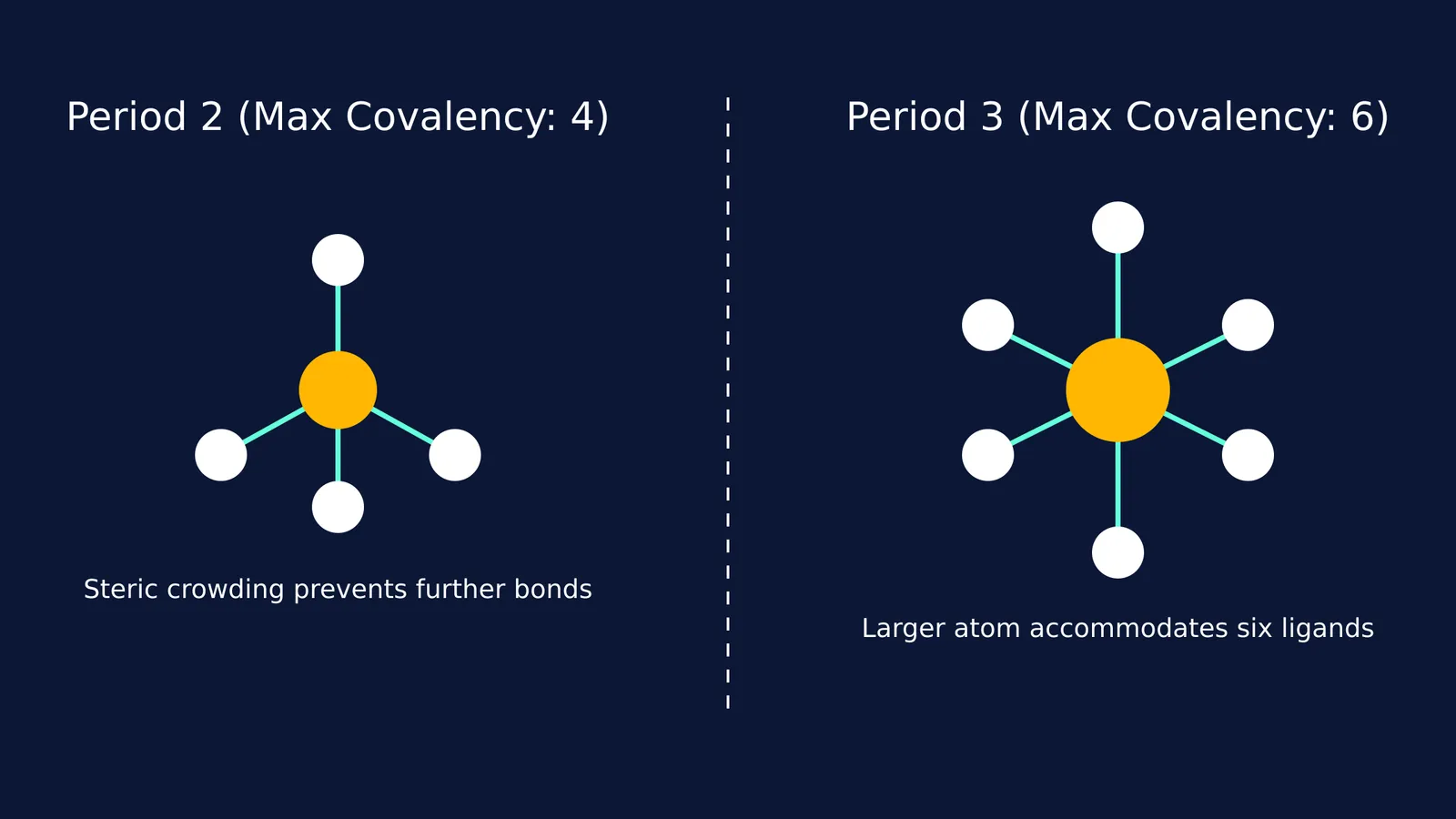
Why is covalency restricted to four?
The structural divergence across the second period arises from valence orbital capacity and atom size. As theoretical chemist Werner Kutzelnigg demonstrated in Angewandte Chemie, the extended valence observed in heavier elements has little to do with vacant d orbitals. Instead, second-period elements have only an s-core (1s²), which confines their valence s and p orbitals to roughly the same small spatial region. This small size increases steric hindrance between ligands, strictly limiting their maximum covalency to 4.
Heavier elements, possessing an inner p-core, have a larger size and reduced steric hindrance, enabling them to expand their coordination numbers to 5 or 6:
Boron forms [BF4]⁻ (covalency 4), whereas aluminium forms [AlF6]³⁻ (covalency 6).
Nitrogen forms NCl3 and NH4⁺, but NCl5 cannot exist. Phosphorus readily forms PCl5 and [PCl6]⁻.
Carbon tetrachloride (CCl4) resists ambient hydrolysis because carbon cannot coordinate water, while silicon tetrachloride (SiCl4) hydrolyses rapidly.
When reviewing orbital structures, the Fermi Concept Library maps every concept in physics, chemistry, biology, mathematics and computing, each with its own lesson and its place in the map.
Why do second-period elements form stable multiple bonds?
Another anomaly is the ability to form strong pπ–pπ multiple bonds. Because of their small size, compact 2p orbitals permit close atomic approach and lateral overlap:
Carbon forms double bonds in carbon dioxide (O=C=O) gas. Silicon forms silicon dioxide (SiO2), a covalent solid of single Si–O bonds, because 3p orbitals are too extended in space for sideways overlap.
Nitrogen exists as a diatomic gas (N≡N) with a bond dissociation enthalpy of 945 kJ/mol recorded in the NIST Chemistry WebBook. Phosphorus forms white phosphorus (P4) with single P–P bonds (enthalpy 201 kJ/mol).
Halogen chemistry shows a related anomaly. Fluorine has an electronegativity of 3.98 on the Pauling scale, the highest of any element. Yet NIST data shows the F–F bond dissociation enthalpy is only 158.8 kJ/mol, significantly weaker than the Cl–Cl bond at 242.6 kJ/mol. In tiny fluorine atoms, lone pairs in compact 2p orbitals crowd together, generating intense interelectronic repulsion that weakens the bond.
Related analyses explore why boric acid acts as a Lewis acid, why basicity decreases from NH₃ to BiH₃, and how to use Bent's rule for bond angles.
What causes the diagonal relationship across periods two and three?
Because second-period elements have smaller radii and higher electronegativities, their chemistry resembles the element diagonally to their right in period 3. Moving across a period decreases size and increases electronegativity, whereas moving down a group does the reverse. These opposing vectors balance along a diagonal:
Lithium and Magnesium: Both react with nitrogen to form nitrides (Li3N, Mg3N2), their carbonates decompose on heating, and their chlorides form deliquescent hydrates.
Beryllium and Aluminium: Both form amphoteric oxides (BeO, Al2O3) and covalent chlorides (BeCl2, AlCl3) that dimerise through chloro bridges.
Boron and Silicon: Both act as semiconductors, form acidic oxides (B2O3, SiO2), and yield flammable hydrides.
How can students systematically predict anomalous behaviour?
Instead of memorising isolated exceptions, evaluate periodic questions with a four-step diagnostic filter:
Coordination ceiling: If the central atom is in period 2, cap its covalency at 4. Eliminate expanded octets (such as NF5 or [BF6]³⁻).
Bonding mode: Expect second-period p-block elements (C, N, O) to form discrete molecules with pπ–pπ bonds (CO2, N2), whereas heavier congeners (Si, P, S) form networks or single-bonded rings (SiO2, P4, S8).
Polarizing power: For small cations (Li⁺, Be²⁺), high charge density polarizes anions, creating covalent character and organic solubility.
Diagonal partner: For anomalous decomposition or solubility questions, compare lithium to magnesium, and beryllium to aluminium.
If you get stuck on coordination limits or octet exceptions, the Fermi Problem Library provides worked problems with a step-by-step solver that explains the reasoning rather than printing an answer. Fermi's AI tutor can work out what you already know, build a plan for the session, and notice where you get stuck.